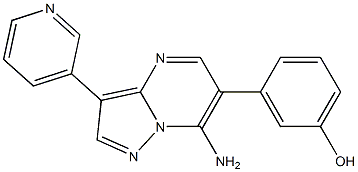
Ehp inhibitor is a novel and potent inhibitor of EHP. Ehp is a new secreted Staphylococcus aureus protein that potently inhibits the alternative complement activation pathway. Ehp was identified through a genomic scan as an uncharacterized secreted protein from S. aureus, and immunoblotting of conditioned S. aureus culture medium revealed that the Ehp protein was secreted at the highest levels during log-phase bacterial growth.
Physicochemical Properties
| Molecular Formula | C19H19N5O | |
| Molecular Weight | 333.16 | |
| Exact Mass | 303.112 | |
| CAS # | 861249-77-6 | |
| Related CAS # |
|
|
| PubChem CID | 11638044 | |
| Appearance | White to off-white solid powder | |
| Density | 1.4±0.1 g/cm3 | |
| Index of Refraction | 1.756 | |
| LogP | 0.42 | |
| Hydrogen Bond Donor Count | 2 | |
| Hydrogen Bond Acceptor Count | 5 | |
| Rotatable Bond Count | 2 | |
| Heavy Atom Count | 23 | |
| Complexity | 408 | |
| Defined Atom Stereocenter Count | 0 | |
| InChi Key | RDCISORSAAOABP-UHFFFAOYSA-N | |
| InChi Code | InChI=1S/C17H13N5O/c18-16-14(11-3-1-5-13(23)7-11)9-20-17-15(10-21-22(16)17)12-4-2-6-19-8-12/h1-10,23H,18H2 | |
| Chemical Name |
|
|
| Synonyms |
|
|
| HS Tariff Code | 2934.99.9001 | |
| Storage |
Powder-20°C 3 years 4°C 2 years In solvent -80°C 6 months -20°C 1 month Note: This product requires protection from light (avoid light exposure) during transportation and storage. |
|
| Shipping Condition | Room temperature (This product is stable at ambient temperature for a few days during ordinary shipping and time spent in Customs) |
Biological Activity
| ln Vitro | Ehp is a new secreted Staphylococcus aureus protein that potently inhibits the alternative complement activation pathway. Ehp was identified through a genomic scan as an uncharacterized secreted protein from S. aureus, and immunoblotting of conditioned S. aureus culture medium revealed that the Ehp protein was secreted at the highest levels during log-phase bacterial growth. The mature Ehp polypeptide is composed of 80 residues and is 44% identical to the complement inhibitory domain of S. aureus Efb (extracellular fibrinogen-binding protein). We observed preferential binding by Ehp to native and hydrolyzed C3 relative to fully active C3b and found that Ehp formed a subnanomolar affinity complex with these various forms of C3 by binding to its thioester-containing C3d domain. Site-directed mutagenesis demonstrated that Arg and Asn are important in forming the Ehp.C3d complex, but loss of these side chains did not completely disrupt Ehp/C3d binding. This suggested the presence of a second C3d-binding site in Ehp, which was mapped to the proximity of Ehp Asn. Further molecular level details of the Ehp/C3d interaction were revealed by solving the 2.7-A crystal structure of an Ehp.C3d complex in which the low affinity site had been mutationally inactivated. Ehp potently inhibited C3b deposition onto sensitized surfaces by the alternative complement activation pathway. This inhibition was directly related to Ehp/C3d binding and was more potent than that seen for Efb-C. An altered conformation in Ehp-bound C3 was detected by monoclonal antibody C3-9, which is specific for a neoantigen exposed in activated forms of C3. Our results suggest that increased inhibitory potency of Ehp relative to Efb-C is derived from the second C3-binding site in this new protein. |
| References | :J Biol Chem.2007 Oct 12;282(41):30051-61. |
Solubility Data
| Solubility (In Vitro) |
|
|||
| Solubility (In Vivo) |
Note: Listed below are some common formulations that may be used to formulate products with low water solubility (e.g. < 1 mg/mL), you may test these formulations using a minute amount of products to avoid loss of samples. Injection Formulations (e.g. IP/IV/IM/SC) Injection Formulation 1: DMSO : Tween 80: Saline = 10 : 5 : 85 (i.e. 100 μL DMSO stock solution → 50 μL Tween 80 → 850 μL Saline) *Preparation of saline: Dissolve 0.9 g of sodium chloride in 100 mL ddH ₂ O to obtain a clear solution. Injection Formulation 2: DMSO : PEG300 :Tween 80 : Saline = 10 : 40 : 5 : 45 (i.e. 100 μL DMSO → 400 μLPEG300 → 50 μL Tween 80 → 450 μL Saline) Injection Formulation 3: DMSO : Corn oil = 10 : 90 (i.e. 100 μL DMSO → 900 μL Corn oil) Example: Take the Injection Formulation 3 (DMSO : Corn oil = 10 : 90) as an example, if 1 mL of 2.5 mg/mL working solution is to be prepared, you can take 100 μL 25 mg/mL DMSO stock solution and add to 900 μL corn oil, mix well to obtain a clear or suspension solution (2.5 mg/mL, ready for use in animals). Injection Formulation 4: DMSO : 20% SBE-β-CD in saline = 10 : 90 [i.e. 100 μL DMSO → 900 μL (20% SBE-β-CD in saline)] *Preparation of 20% SBE-β-CD in Saline (4°C,1 week): Dissolve 2 g SBE-β-CD in 10 mL saline to obtain a clear solution. Injection Formulation 5: 2-Hydroxypropyl-β-cyclodextrin : Saline = 50 : 50 (i.e. 500 μL 2-Hydroxypropyl-β-cyclodextrin → 500 μL Saline) Injection Formulation 6: DMSO : PEG300 : castor oil : Saline = 5 : 10 : 20 : 65 (i.e. 50 μL DMSO → 100 μLPEG300 → 200 μL castor oil → 650 μL Saline) Injection Formulation 7: Ethanol : Cremophor : Saline = 10: 10 : 80 (i.e. 100 μL Ethanol → 100 μL Cremophor → 800 μL Saline) Injection Formulation 8: Dissolve in Cremophor/Ethanol (50 : 50), then diluted by Saline Injection Formulation 9: EtOH : Corn oil = 10 : 90 (i.e. 100 μL EtOH → 900 μL Corn oil) Injection Formulation 10: EtOH : PEG300:Tween 80 : Saline = 10 : 40 : 5 : 45 (i.e. 100 μL EtOH → 400 μLPEG300 → 50 μL Tween 80 → 450 μL Saline) Oral Formulations Oral Formulation 1: Suspend in 0.5% CMC Na (carboxymethylcellulose sodium) Oral Formulation 2: Suspend in 0.5% Carboxymethyl cellulose Example: Take the Oral Formulation 1 (Suspend in 0.5% CMC Na) as an example, if 100 mL of 2.5 mg/mL working solution is to be prepared, you can first prepare 0.5% CMC Na solution by measuring 0.5 g CMC Na and dissolve it in 100 mL ddH2O to obtain a clear solution; then add 250 mg of the product to 100 mL 0.5% CMC Na solution, to make the suspension solution (2.5 mg/mL, ready for use in animals). Oral Formulation 3: Dissolved in PEG400 Oral Formulation 4: Suspend in 0.2% Carboxymethyl cellulose Oral Formulation 5: Dissolve in 0.25% Tween 80 and 0.5% Carboxymethyl cellulose Oral Formulation 6: Mixing with food powders Note: Please be aware that the above formulations are for reference only. InvivoChem strongly recommends customers to read literature methods/protocols carefully before determining which formulation you should use for in vivo studies, as different compounds have different solubility properties and have to be formulated differently. (Please use freshly prepared in vivo formulations for optimal results.) |
| Preparing Stock Solutions | 1 mg | 5 mg | 10 mg | |
| 1 mM | 3.0016 mL | 15.0078 mL | 30.0156 mL | |
| 5 mM | 0.6003 mL | 3.0016 mL | 6.0031 mL | |
| 10 mM | 0.3002 mL | 1.5008 mL | 3.0016 mL |