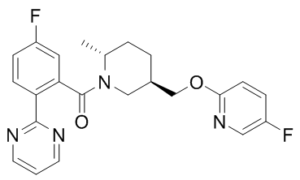
DORA-22 is a novel, potent and selective dual orexin receptor antagonist that may be useful for insomnia and AD-relevant symptoms. It can lower histamine levels in the lateral hypothalamus and prefrontal cortex without lowering hippocampal acetylcholine. DORA-22 suppresses the release of the wake neurotransmitter histamine in the lateral hypothalamus, prefrontal cortex, and hippocampus with no significant alterations in acetylcholine levels. Compared with the GABAA modulator eszopiclone, DORA-22 elicits a neurotransmitter profile consistent with wake reduction that does not impinge on neurotransmitter levels associated with cognition and rapid eye movement sleep. DORAs may improve sleep in AD patients. Further investigations should optimize the dose and duration of DORA-22 treatment and explore additional AD-relevant animal models and cognitive tests.
Physicochemical Properties
| Molecular Formula | C23H22F2N4O2 | |
| Molecular Weight | 424.45 | |
| Exact Mass | 424.171 | |
| CAS # | 1088991-95-0 | |
| Related CAS # |
|
|
| PubChem CID | 25126515 | |
| Appearance | Typically exists as solid at room temperature | |
| LogP | 4.074 | |
| Hydrogen Bond Donor Count | 0 | |
| Hydrogen Bond Acceptor Count | 7 | |
| Rotatable Bond Count | 5 | |
| Heavy Atom Count | 31 | |
| Complexity | 592 | |
| Defined Atom Stereocenter Count | 2 | |
| SMILES | FC1=CC=C(C2N=CC=CN=2)C(=C1)C(N1C[C@H](COC2C=CC(=CN=2)F)CC[C@H]1C)=O |
|
| InChi Key | ADNQCBKNFSDDHY-HZPDHXFCSA-N | |
| InChi Code | InChI=1S/C23H22F2N4O2/c1-15-3-4-16(14-31-21-8-6-18(25)12-28-21)13-29(15)23(30)20-11-17(24)5-7-19(20)22-26-9-2-10-27-22/h2,5-12,15-16H,3-4,13-14H2,1H3/t15-,16-/m1/s1 | |
| Chemical Name |
|
|
| Synonyms |
|
|
| HS Tariff Code | 2934.99.9001 | |
| Storage |
Powder-20°C 3 years 4°C 2 years In solvent -80°C 6 months -20°C 1 month |
|
| Shipping Condition | Room temperature (This product is stable at ambient temperature for a few days during ordinary shipping and time spent in Customs) |
Biological Activity
| ln Vivo | Wild-type (C57Bl6/SJL) and 5XFAD mice received chronic treatment with vehicle or DORA-22. Piezoelectric recordings monitored sleep and spatial memory was assessed via spontaneous Y-maze alternations. Aβ plaques, Aβ levels, and neuroinflammatory markers were measured by immunohistochemistry, enzyme-linked immunosorbent assay, and real-time polymerase chain reaction, respectively. In 5XFAD mice, DORA-22 significantly increased light-phase sleep without reducing Aβ levels, plaque density, or neuroinflammation. Effects of DORA-22 on cognitive deficits could not be determined because the 5XFAD mice did not exhibit deficits. These findings suggest that DORAs may improve sleep in AD patients. Further investigations should optimize the dose and duration of DORA-22 treatment and explore additional AD-relevant animal models and cognitive tests.[1] |
| Animal Protocol | DORA-22 (100 mg/kg, Merck & Co, Inc) or VEH was administered daily by oral gavage for 5 weeks. Dosing occurred at the time of lights on, that is, at the beginning of the daily inactive phase for mice to mimic a translationally relevant treatment regimen. In a previous study of male C57BL6NTc mice, this dose of DORA-22, although given at dark onset, significantly suppressed wake time for 2 hours after administration while increasing light sleep and REM sleep for ∼5 hours and delta sleep for 1.5 hours. On the basis of the instructions from Merck, the DORA-22 solution was prepared the afternoon before dosing began and was stirred at room temperature thereafter; a fresh solution was prepared every 12 to 14 days.[1] |
| References | Alzheimers Dement (N Y).2019 Feb 28;5:70-80;J Neurochem.2017 Jul;142(2):204-214. |
Solubility Data
| Solubility (In Vitro) |
|
|||
| Solubility (In Vivo) |
Note: Listed below are some common formulations that may be used to formulate products with low water solubility (e.g. < 1 mg/mL), you may test these formulations using a minute amount of products to avoid loss of samples. Injection Formulations (e.g. IP/IV/IM/SC) Injection Formulation 1: DMSO : Tween 80: Saline = 10 : 5 : 85 (i.e. 100 μL DMSO stock solution → 50 μL Tween 80 → 850 μL Saline) *Preparation of saline: Dissolve 0.9 g of sodium chloride in 100 mL ddH ₂ O to obtain a clear solution. Injection Formulation 2: DMSO : PEG300 :Tween 80 : Saline = 10 : 40 : 5 : 45 (i.e. 100 μL DMSO → 400 μLPEG300 → 50 μL Tween 80 → 450 μL Saline) Injection Formulation 3: DMSO : Corn oil = 10 : 90 (i.e. 100 μL DMSO → 900 μL Corn oil) Example: Take the Injection Formulation 3 (DMSO : Corn oil = 10 : 90) as an example, if 1 mL of 2.5 mg/mL working solution is to be prepared, you can take 100 μL 25 mg/mL DMSO stock solution and add to 900 μL corn oil, mix well to obtain a clear or suspension solution (2.5 mg/mL, ready for use in animals). Injection Formulation 4: DMSO : 20% SBE-β-CD in saline = 10 : 90 [i.e. 100 μL DMSO → 900 μL (20% SBE-β-CD in saline)] *Preparation of 20% SBE-β-CD in Saline (4°C,1 week): Dissolve 2 g SBE-β-CD in 10 mL saline to obtain a clear solution. Injection Formulation 5: 2-Hydroxypropyl-β-cyclodextrin : Saline = 50 : 50 (i.e. 500 μL 2-Hydroxypropyl-β-cyclodextrin → 500 μL Saline) Injection Formulation 6: DMSO : PEG300 : castor oil : Saline = 5 : 10 : 20 : 65 (i.e. 50 μL DMSO → 100 μLPEG300 → 200 μL castor oil → 650 μL Saline) Injection Formulation 7: Ethanol : Cremophor : Saline = 10: 10 : 80 (i.e. 100 μL Ethanol → 100 μL Cremophor → 800 μL Saline) Injection Formulation 8: Dissolve in Cremophor/Ethanol (50 : 50), then diluted by Saline Injection Formulation 9: EtOH : Corn oil = 10 : 90 (i.e. 100 μL EtOH → 900 μL Corn oil) Injection Formulation 10: EtOH : PEG300:Tween 80 : Saline = 10 : 40 : 5 : 45 (i.e. 100 μL EtOH → 400 μLPEG300 → 50 μL Tween 80 → 450 μL Saline) Oral Formulations Oral Formulation 1: Suspend in 0.5% CMC Na (carboxymethylcellulose sodium) Oral Formulation 2: Suspend in 0.5% Carboxymethyl cellulose Example: Take the Oral Formulation 1 (Suspend in 0.5% CMC Na) as an example, if 100 mL of 2.5 mg/mL working solution is to be prepared, you can first prepare 0.5% CMC Na solution by measuring 0.5 g CMC Na and dissolve it in 100 mL ddH2O to obtain a clear solution; then add 250 mg of the product to 100 mL 0.5% CMC Na solution, to make the suspension solution (2.5 mg/mL, ready for use in animals). Oral Formulation 3: Dissolved in PEG400 Oral Formulation 4: Suspend in 0.2% Carboxymethyl cellulose Oral Formulation 5: Dissolve in 0.25% Tween 80 and 0.5% Carboxymethyl cellulose Oral Formulation 6: Mixing with food powders Note: Please be aware that the above formulations are for reference only. InvivoChem strongly recommends customers to read literature methods/protocols carefully before determining which formulation you should use for in vivo studies, as different compounds have different solubility properties and have to be formulated differently. (Please use freshly prepared in vivo formulations for optimal results.) |
| Preparing Stock Solutions | 1 mg | 5 mg | 10 mg | |
| 1 mM | 2.3560 mL | 11.7800 mL | 23.5599 mL | |
| 5 mM | 0.4712 mL | 2.3560 mL | 4.7120 mL | |
| 10 mM | 0.2356 mL | 1.1780 mL | 2.3560 mL |