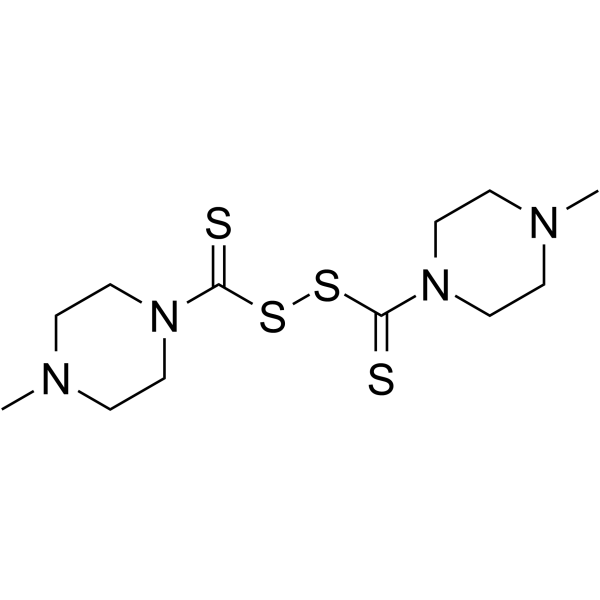
Physicochemical Properties
| Molecular Formula | C12H22N4S4 |
| Molecular Weight | 350.58988 |
| Exact Mass | 350.073 |
| CAS # | 20231-01-0 |
| PubChem CID | 30054 |
| Appearance | White to off-white solid powder |
| Density | 1.339g/cm3 |
| Boiling Point | 450.5ºC at 760 mmHg |
| Melting Point | 142ºC |
| Flash Point | 226.3ºC |
| Vapour Pressure | 2.62E-08mmHg at 25°C |
| Index of Refraction | 1.673 |
| LogP | 1.184 |
| Hydrogen Bond Donor Count | 0 |
| Hydrogen Bond Acceptor Count | 6 |
| Rotatable Bond Count | 3 |
| Heavy Atom Count | 20 |
| Complexity | 315 |
| Defined Atom Stereocenter Count | 0 |
| InChi Key | OOBDBFPYJXJEHC-UHFFFAOYSA-N |
| InChi Code | InChI=1S/C12H22N4S4/c1-13-3-7-15(8-4-13)11(17)19-20-12(18)16-9-5-14(2)6-10-16/h3-10H2,1-2H3 |
| Chemical Name | (4-methylpiperazine-1-carbothioyl)sulfanyl 4-methylpiperazine-1-carbodithioate |
| HS Tariff Code | 2934.99.9001 |
| Storage |
Powder-20°C 3 years 4°C 2 years In solvent -80°C 6 months -20°C 1 month Note: This product requires protection from light (avoid light exposure) during transportation and storage. |
| Shipping Condition | Room temperature (This product is stable at ambient temperature for a few days during ordinary shipping and time spent in Customs) |
Biological Activity
| ln Vitro | In prelabeled GH3 cells, EWP 815 decreases the basal breakdown rate without influencing the thyrotropin-releasing hormone (TRH; 0.03 mM)-stimulated inositol phospholipid breakdown [1]. The soluble enzyme IC50 is 83 mM, whereas the granzyme is 71 mM. With an average [3H]Ins(1,4)P2 recovery of 2.6[1], EWP 815 (30 μM; 1 hour) suppresses Ins(1,4)P2 phosphatase more than Ins(1,4,5)P3 5-phosphatase. With an IC50 of 6 μM and 8 μM, respectively, EWP 815 (6, 8 μM; 10 min) inhibits the dephosphorylation of [3H]Ins(1,4,5)P3 5-phosphatase in both the soluble and particulate fractions[1]. Without changing Ins (1,4,5)P3 binding, EWP 815 (3-300 μM; 30 min) reduces the amount of inositol phospholipid produced in response to thyrotropin-releasing hormone (TRH) stimulation (100 nM) by 30% at 100 μM and 1.8% at 300 μM, respectively[1]. |
| ln Vivo | Mice treated intraperitoneally with EWP 815 (50 mg/kg; 30 minutes prior to sacrifice) have their dopamine β-hydroxylase activity inhibited [2]. |
| Animal Protocol |
Animal/Disease Models: Female mice (20 g) [2] Doses: 50 mg/kg Route of Administration: intraperitoneal (ip) injection; 30 minutes before sacrifice Hydroxylase. The amount of 3H-α-Me-NA was diminished by 12%. |
| References |
[1]. Inhibition of inositol 1,4,5-trisphosphate 5-phosphatase by micromolar concentrations of disulfiram and its analogues. Biochem J. 1993 Feb 1;289 ( Pt 3)(Pt 3):853-9. [2]. On the beta-hydroxylation of (+-)-alpha-methyldopamine in vivo. Eur J Pharmacol. 1968 Dec;5(1):85-92. |
Solubility Data
| Solubility (In Vitro) | DMSO : ~50 mg/mL (~142.62 mM) |
| Solubility (In Vivo) |
Solubility in Formulation 1: ≥ 1.25 mg/mL (3.57 mM) (saturation unknown) in 10% DMSO + 90% (20% SBE-β-CD in Saline) (add these co-solvents sequentially from left to right, and one by one), clear solution. For example, if 1 mL of working solution is to be prepared, you can add 100 μL of 12.5 mg/mL clear DMSO stock solution to 900 μL of 20% SBE-β-CD physiological saline solution and mix evenly. Preparation of 20% SBE-β-CD in Saline (4°C,1 week): Dissolve 2 g SBE-β-CD in 10 mL saline to obtain a clear solution. Solubility in Formulation 2: ≥ 1.25 mg/mL (3.57 mM) (saturation unknown) in 10% DMSO + 90% Corn Oil (add these co-solvents sequentially from left to right, and one by one), clear solution. For example, if 1 mL of working solution is to be prepared, you can add 100 μL of 12.5 mg/mL clear DMSO stock solution to 900 μL of corn oil and mix evenly. (Please use freshly prepared in vivo formulations for optimal results.) |
| Preparing Stock Solutions | 1 mg | 5 mg | 10 mg | |
| 1 mM | 2.8523 mL | 14.2617 mL | 28.5233 mL | |
| 5 mM | 0.5705 mL | 2.8523 mL | 5.7047 mL | |
| 10 mM | 0.2852 mL | 1.4262 mL | 2.8523 mL |