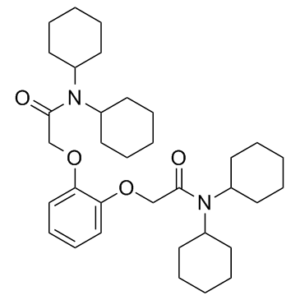
ETH2120 (also known as Sodium ionophore III) is a Na+ ionophore that is suitable for the assay of sodium activity in blood, plasma, serum. etc. The sodium ionophore ETH2120, but not protonophores, stimulated hydrogen-dependent caffeate reduction by 280%, indicating that caffeate reduction is coupled to the buildup of a membrane potential generated by primary Na(+) extrusion. Caffeate reduction was coupled to the synthesis of ATP, and again, ATP synthesis coupled to hydrogen-dependent caffeate reduction was strictly Na(+) dependent and abolished by ETH2120, but not by protonophores, indicating the involvement of a transmembrane Na(+) gradient in ATP synthesis. The ATPase inhibitor N,N'-dicyclohexylcarbodiimide (DCCD) abolished ATP synthesis, and at the same time, hydrogen-dependent caffeate reduction was inhibited. This inhibition could be relieved by ETH2120.
Physicochemical Properties
| Molecular Formula | C34H52N2O4 | |
| Molecular Weight | 552.80 | |
| Exact Mass | 552.393 | |
| CAS # | 81686-22-8 | |
| Related CAS # |
|
|
| PubChem CID | 613672 | |
| Appearance | White to off-white solid powder | |
| Density | 1.12g/cm3 | |
| Boiling Point | 709.4ºC at 760 mmHg | |
| Flash Point | 382.8ºC | |
| Index of Refraction | 1.564 | |
| LogP | 7.432 | |
| Hydrogen Bond Donor Count | 0 | |
| Hydrogen Bond Acceptor Count | 4 | |
| Rotatable Bond Count | 10 | |
| Heavy Atom Count | 40 | |
| Complexity | 666 | |
| Defined Atom Stereocenter Count | 0 | |
| InChi Key | GKRBLFCTFPAHMH-UHFFFAOYSA-N | |
| InChi Code | InChI=1S/C34H52N2O4/c37-33(35(27-15-5-1-6-16-27)28-17-7-2-8-18-28)25-39-31-23-13-14-24-32(31)40-26-34(38)36(29-19-9-3-10-20-29)30-21-11-4-12-22-30/h13-14,23-24,27-30H,1-12,15-22,25-26H2 | |
| Chemical Name |
|
|
| Synonyms |
|
|
| HS Tariff Code | 2934.99.9001 | |
| Storage |
Powder-20°C 3 years 4°C 2 years In solvent -80°C 6 months -20°C 1 month |
|
| Shipping Condition | Room temperature (This product is stable at ambient temperature for a few days during ordinary shipping and time spent in Customs) |
Biological Activity
| Targets |
The target of ETH2120 is related to sodium ion transport, functioning as a sodium ionophore that disrupts transmembrane sodium ion gradients. [1] - ETH2120 acts as a sodium ionophore, targeting sodium ion gradients across biological membranes to interfere with sodium-dependent processes. [2] |
||
| ln Vitro |
In addition to stimulating caffeate reduction, preincubation of the cells with sodium ionophore III (Na+) entirely eliminated ATP production. When cells in a constant state of caffeate reduction were exposed to sodium ionophore III, the intracellular ATP level was rapidly depleted[1]. Cells cultured in lactate sulfate are resistant to the Na+ ionophore ETH2120[2]. One possible extraction agent for nuclear seizure treatment is sodium ionophore III ligand, which is a particularly efficient receptor for the Eu3+ and Am3+ cations[3]. In cell suspensions of Acetobacterium woodii grown on fructose plus caffeate, ETH2120 (final concentration 27 μM) stimulated hydrogen-dependent caffeate reduction by 280%, while protonophores (e.g., SF6847 at 27 μM) had no such stimulatory effect. This indicated that ETH2120 disrupts the transmembrane sodium ion gradient generated by primary sodium extrusion, thereby relieving the feedback inhibition of caffeate reduction caused by the sodium gradient. Additionally, ETH2120 (20 μM) abolished ATP synthesis coupled to hydrogen-dependent caffeate reduction in the presence of 10 mM Na⁺, whereas protonophores (20 μM SF6847) and TCS (20 μM) had no inhibitory effect on ATP synthesis. When the ATPase inhibitor DCCD (100 μM) inhibited hydrogen-dependent caffeate reduction, the addition of ETH2120 (final concentration 36 μM) relieved this inhibition, further confirming that ETH2120 acts by disrupting the sodium ion gradient [1] - In in vitro experiments with Desulfovibrio alaskensis G20 and its Rnf mutants (rnfA and rnfD), ETH2120 had no effect on lactate-sulfate dependent growth of the parental strain, while the protonophore TCS strongly inhibited this growth. This suggested that ETH2120 does not interfere with proton gradient-dependent processes in this bacterium, consistent with its role as a specific sodium ionophore [2] |
||
| ln Vivo |
|
||
| Cell Assay |
For the hydrogen-dependent caffeate reduction assay in Acetobacterium woodii cell suspensions: Cell suspensions (1.25 mg of protein/ml) were prepared from cultures grown on fructose plus caffeate and incubated under a hydrogen atmosphere at 30°C in a shaking water bath with buffer containing the appropriate concentration of NaCl. After preincubation, caffeate was added from a stock solution. At the indicated time, ETH2120 (final concentration 27 μM) or protonophore SF6847 (final concentration 27 μM) was added to the cell suspensions, with a control group receiving only solvent. Samples were withdrawn at different time points to analyze caffeate concentration and determine the rate of caffeate reduction. For the ATP synthesis assay coupled to hydrogen-dependent caffeate reduction: Cell suspensions (1.54 mg of protein/ml) were preincubated under a hydrogen atmosphere in the presence of 10 mM Na⁺ and 20 μM ETH2120, 20 μM SF6847, or 20 μM TCS, with a control group receiving only solvent. Caffeate was added to a final concentration of 10 mM at the indicated time, and samples were withdrawn at different time points to measure cellular ATP content. For the assay of relieving DCCD inhibition: Cell suspensions (1.54 mg of protein/ml) were preincubated under a hydrogen atmosphere in the presence of 3 mM Na⁺ and 100 μM DCCD for 30 min (a control group had no DCCD). Caffeate was added to a final concentration of 10 mM at time zero. At the indicated time, ETH2120 was added to one of the DCCD-treated groups to a final concentration of 36 μM. Samples were withdrawn at different time points to analyze caffeate concentration and evaluate the effect of ETH2120 on relieving DCCD inhibition [1] - For the growth inhibition assay of Desulfovibrio alaskensis: The parental strain of Desulfovibrio alaskensis G20 and its rnfA, rnfD mutants were cultured in media with different electron donor-acceptor combinations (e.g., lactate-sulfate, lactate-sulfite). ETH2120 was added to the culture media at appropriate concentrations, and the growth curves of the strains were monitored by measuring optical density or other growth indicators over time. The effect of ETH2120 on bacterial growth was compared with that of the protonophore TCS, which was added at concentrations of 5 μM and 20 μM [2] |
||
| Animal Protocol |
|
||
| References |
[1]. Chemiosmotic energy conservation with Na(+) as the coupling ion during hydrogen-dependent caffeate reduction by Acetobacterium woodii. J Bacteriol. 2002 Apr;184(7):1947-51. [2]. The role of Rnf in ion gradient formation in Desulfovibrio alaskensis. PeerJ. 2016 Apr 14;4:e1919. [3]. Sodium Ionophore III as Very Effective Receptor for Trivalent Europium and Americium.J Solution Chem (2016) 45: 463. |
||
| Additional Infomation |
ETH2120 is a specific sodium ionophore that selectively disrupts transmembrane sodium ion gradients without affecting proton gradients. In the chemiosmotic energy conservation system of Acetobacterium woodii during hydrogen-dependent caffeate reduction, the transmembrane sodium ion gradient is essential for ATP synthesis and caffeate reduction regulation. ETH2120 interferes with these processes by dissipating the sodium gradient, which helps confirm that sodium ions are the coupling ions in this energy conservation mechanism [1] - As a sodium ionophore, ETH2120 specifically targets sodium ion gradients. In Desulfovibrio alaskensis, the Rnf complex functions as a primary proton pump, and the bacterium relies on proton gradients for energy conservation during lactate-sulfate dependent growth. The lack of effect of ETH2120 on this growth further verifies its specificity for sodium ions and its non-interference with proton-dependent energy metabolism, which is crucial for distinguishing the roles of sodium and proton gradients in bacterial energy conservation [2] |
Solubility Data
| Solubility (In Vitro) |
|
|||
| Solubility (In Vivo) |
Solubility in Formulation 1: 2 mg/mL (3.62 mM) in Corn Oil (add these co-solvents sequentially from left to right, and one by one), suspension solution; with sonication. (Please use freshly prepared in vivo formulations for optimal results.) |
| Preparing Stock Solutions | 1 mg | 5 mg | 10 mg | |
| 1 mM | 1.8090 mL | 9.0449 mL | 18.0897 mL | |
| 5 mM | 0.3618 mL | 1.8090 mL | 3.6179 mL | |
| 10 mM | 0.1809 mL | 0.9045 mL | 1.8090 mL |