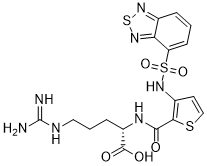
EG00229 (EG-00229) is a novel and potent Neuropilin 1 (NRP1) receptor antagonist with anticancer activity. It acts by selectively inhibiting VEGF-A binding to NRP1 b1 domain with an IC50 of 3 μM, but has no effect on VEGFA binding to VEGFR-1 and VEGFR-2. EG00229 inhibits VEGFA binding to NRP1.
Physicochemical Properties
| Molecular Weight | 497.571658372879 |
| Exact Mass | 497.06 |
| CAS # | 1018927-63-3 |
| Related CAS # | 1018927-63-3;1210945-69-9 (TFA); |
| PubChem CID | 44631827 |
| Appearance | Typically exists as solid at room temperature |
| Density | 1.8±0.1 g/cm3 |
| Index of Refraction | 1.810 |
| LogP | 0.63 |
| Hydrogen Bond Donor Count | 5 |
| Hydrogen Bond Acceptor Count | 11 |
| Rotatable Bond Count | 10 |
| Heavy Atom Count | 32 |
| Complexity | 818 |
| Defined Atom Stereocenter Count | 1 |
| SMILES | S(C1=CC=CC2C1=NSN=2)(NC1C=CSC=1C(N[C@H](C(=O)O)CCC/N=C(\N)/N)=O)(=O)=O |
| InChi Key | ZWWMEDURALZMEV-NSHDSACASA-N |
| InChi Code | InChI=1S/C17H19N7O5S3/c18-17(19)20-7-2-4-11(16(26)27)21-15(25)14-10(6-8-30-14)24-32(28,29)12-5-1-3-9-13(12)23-31-22-9/h1,3,5-6,8,11,24H,2,4,7H2,(H,21,25)(H,26,27)(H4,18,19,20)/t11-/m0/s1 |
| Chemical Name | (3-(benzo[c][1,2,5]thiadiazole-4-sulfonamido)thiophene-2-carbonyl)-L-arginine |
| Synonyms | EG00229 EG-00229 EG 00229 |
| HS Tariff Code | 2934.99.9001 |
| Storage |
Powder-20°C 3 years 4°C 2 years In solvent -80°C 6 months -20°C 1 month Note: Please store this product in a sealed and protected environment, avoid exposure to moisture. |
| Shipping Condition | Room temperature (This product is stable at ambient temperature for a few days during ordinary shipping and time spent in Customs) |
Biological Activity
| ln Vitro | Over the course of a 48-hour incubation, treatment with EG00229 (Compound 2; 0-100 μM; A549 cells) significantly reduces cell viability[1]. In endothelial cells, EG00229 (Compound 2) exhibits a reduction in VEGFR2 phosphorylation and a suppression of VEGF-A binding to NRP1. HUVECs have also been shown to inhibit endothelial cell migration[1]. Compound 2, EG00229, exhibits a selectivity of 8 μM in inhibiting radiolabeled 125I-VEGF-A binding to porcine aortic endothelial (PAE)/NRP1 cells, but not effecting VEGFR2-expressing cells. Moreover, EG00229 similarly and potently blocks VEGF-A binding to NRP1-expressing lung carcinoma A549 and prostate cancer DU145 cells, but not to VEGFR1 or VEGFR2. EG00229, with an IC50 of 23 μM, also inhibits the binding of VEGF-A to human umbilical vein endothelial cells (HUVECs), which express VEGFR2, VEGFR1, and NRP1[1]. |
| ln Vivo | The intraperitoneal injection of EG00229 (0-10 mg/kg) administered three times a week for four weeks to NSG mice significantly inhibits tumor growth and evident vascularization[2]. |
| Cell Assay |
Cell Viability Assay[1] Cell Types: A549 cells Tested Concentrations: 0 µM, 10 μM, 30 μM, 100 μM Incubation Duration: 48 hrs (hours) Experimental Results: Caused a significant reduction in cell viability. |
| Animal Protocol |
Animal/Disease Models: 6-week old female NOD scid IL2 receptor gamma chain knockout mice (NSG mice) with ECS cells[2] Doses: 0 mg/kg, 10 mg/kg Route of Administration: intraperitoneal (ip)injection; three times per week; for 4 weeks Experimental Results: Reduces tumor growth and visible vascularization. |
| References |
[1]. Jarvis\nA, et al. Small molecule inhibitors of the neuropilin-1 vascular\nendothelial growth factor A (VEGF-A) interaction. J Med Chem. 2010 Mar\n11;53(5):2215-26. [2]. Grun\nD, et al. VEGF-A acts via neuropilin-1 to enhance epidermal cancer stem\ncell survival and formation of aggressive and highly vascularized\ntumors. Oncogene. 2016 Aug 18;35(33):4379-87. |
| Additional Infomation | EG00229 is a member of the class of thiophenes that is thiophene substituted by a carbonyl-L-arginine and (2,1,3-benzothiadiazole-4-sulfonyl)amino groups at positions 2 and 3. It is an inhibitor of the neuropilin-1 and VEGF-A interaction and a potential anti-cancer agent. It has a role as an antineoplastic agent, a neuropilin receptor antagonist and an angiogenesis inhibitor. It is a benzothiadiazole, a sulfonamide, a member of thiophenes, a secondary carboxamide, a L-arginine derivative and a dicarboxylic acid monoamide. |
Solubility Data
| Solubility (In Vitro) | May dissolve in DMSO (in most cases), if not, try other solvents such as H2O, Ethanol, or DMF with a minute amount of products to avoid loss of samples |
| Solubility (In Vivo) |
Note: Listed below are some common formulations that may be used to formulate products with low water solubility (e.g. < 1 mg/mL), you may test these formulations using a minute amount of products to avoid loss of samples. Injection Formulations (e.g. IP/IV/IM/SC) Injection Formulation 1: DMSO : Tween 80: Saline = 10 : 5 : 85 (i.e. 100 μL DMSO stock solution → 50 μL Tween 80 → 850 μL Saline) *Preparation of saline: Dissolve 0.9 g of sodium chloride in 100 mL ddH ₂ O to obtain a clear solution. Injection Formulation 2: DMSO : PEG300 :Tween 80 : Saline = 10 : 40 : 5 : 45 (i.e. 100 μL DMSO → 400 μLPEG300 → 50 μL Tween 80 → 450 μL Saline) Injection Formulation 3: DMSO : Corn oil = 10 : 90 (i.e. 100 μL DMSO → 900 μL Corn oil) Example: Take the Injection Formulation 3 (DMSO : Corn oil = 10 : 90) as an example, if 1 mL of 2.5 mg/mL working solution is to be prepared, you can take 100 μL 25 mg/mL DMSO stock solution and add to 900 μL corn oil, mix well to obtain a clear or suspension solution (2.5 mg/mL, ready for use in animals). Injection Formulation 4: DMSO : 20% SBE-β-CD in saline = 10 : 90 [i.e. 100 μL DMSO → 900 μL (20% SBE-β-CD in saline)] *Preparation of 20% SBE-β-CD in Saline (4°C,1 week): Dissolve 2 g SBE-β-CD in 10 mL saline to obtain a clear solution. Injection Formulation 5: 2-Hydroxypropyl-β-cyclodextrin : Saline = 50 : 50 (i.e. 500 μL 2-Hydroxypropyl-β-cyclodextrin → 500 μL Saline) Injection Formulation 6: DMSO : PEG300 : castor oil : Saline = 5 : 10 : 20 : 65 (i.e. 50 μL DMSO → 100 μLPEG300 → 200 μL castor oil → 650 μL Saline) Injection Formulation 7: Ethanol : Cremophor : Saline = 10: 10 : 80 (i.e. 100 μL Ethanol → 100 μL Cremophor → 800 μL Saline) Injection Formulation 8: Dissolve in Cremophor/Ethanol (50 : 50), then diluted by Saline Injection Formulation 9: EtOH : Corn oil = 10 : 90 (i.e. 100 μL EtOH → 900 μL Corn oil) Injection Formulation 10: EtOH : PEG300:Tween 80 : Saline = 10 : 40 : 5 : 45 (i.e. 100 μL EtOH → 400 μLPEG300 → 50 μL Tween 80 → 450 μL Saline) Oral Formulations Oral Formulation 1: Suspend in 0.5% CMC Na (carboxymethylcellulose sodium) Oral Formulation 2: Suspend in 0.5% Carboxymethyl cellulose Example: Take the Oral Formulation 1 (Suspend in 0.5% CMC Na) as an example, if 100 mL of 2.5 mg/mL working solution is to be prepared, you can first prepare 0.5% CMC Na solution by measuring 0.5 g CMC Na and dissolve it in 100 mL ddH2O to obtain a clear solution; then add 250 mg of the product to 100 mL 0.5% CMC Na solution, to make the suspension solution (2.5 mg/mL, ready for use in animals). Oral Formulation 3: Dissolved in PEG400 Oral Formulation 4: Suspend in 0.2% Carboxymethyl cellulose Oral Formulation 5: Dissolve in 0.25% Tween 80 and 0.5% Carboxymethyl cellulose Oral Formulation 6: Mixing with food powders Note: Please be aware that the above formulations are for reference only. InvivoChem strongly recommends customers to read literature methods/protocols carefully before determining which formulation you should use for in vivo studies, as different compounds have different solubility properties and have to be formulated differently. (Please use freshly prepared in vivo formulations for optimal results.) |
| Preparing Stock Solutions | 1 mg | 5 mg | 10 mg | |
| 1 mM | 2.0098 mL | 10.0488 mL | 20.0977 mL | |
| 5 mM | 0.4020 mL | 2.0098 mL | 4.0195 mL | |
| 10 mM | 0.2010 mL | 1.0049 mL | 2.0098 mL |