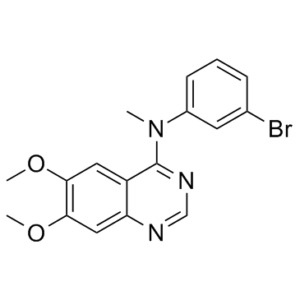
EBE-A22 is a N-methyl derivative of PD-153035 which exhibits a very high affinity and selectivity for the epidermal growth factor receptor tyrosine kinase (EGF-R TK) and shows a remarkable cytotoxicity against several types of tumor cell lines. Nevertheless, EBE-A22 retains a high cytotoxic profile while having no effect on EGF-R TK. EBE-A22 and PD-153035 both bind to DNA and act like typical intercalating agents, according to the results of a variety of optical and gel electrophoresis analyses. More specifically, as one might anticipate from an intercalating agent, EBE-A22 unwinds supercoiled plasmid, stabilizes duplex DNA against heat denaturation, and generates negative CD and ELD signals. DNase I footprinting experiments on a wide variety of DNA substrates demonstrate that EBE-A22 interacts preferentially with GC-rich sequences and discriminates against homooligomeric runs of A and T, which are frequently cut more easily by the enzyme in the presence of the drug than the control. However, PD153035 does not exhibit these properties. All things considered, the findings indicate that this N-methylated ring system is a promising candidate for the synthesis of DNA-targeted cytotoxic compounds and offer the first experimental proof that anilinoquinazoline derivatives target DNA. The potential significance of specific DNA binding for an activity is examined. The surprising GC-selective binding characteristics of EBE-A22 call for more research into the potential applications of N-methylanilinoquinazoline derivatives as instruments for the synthesis of DNA binding ligands that are sequence-specific.
Physicochemical Properties
| Molecular Formula | C17H16BRN3O2 | |
| Molecular Weight | 374.24 | |
| Exact Mass | 373.043 | |
| Elemental Analysis | C, 54.56; H, 4.31; Br, 21.35; N, 11.23; O, 8.55 | |
| CAS # | 229476-53-3 | |
| Related CAS # |
|
|
| PubChem CID | 5328227 | |
| Appearance | Solid powder | |
| LogP | 4.177 | |
| Hydrogen Bond Donor Count | 0 | |
| Hydrogen Bond Acceptor Count | 5 | |
| Rotatable Bond Count | 4 | |
| Heavy Atom Count | 23 | |
| Complexity | 387 | |
| Defined Atom Stereocenter Count | 0 | |
| SMILES | BrC1=CC(N(C)C2=NC=NC3=CC(OC)=C(OC)C=C23)=CC=C1 |
|
| InChi Key | IPWGDOZPSOZFOD-UHFFFAOYSA-N | |
| InChi Code | InChI=1S/C17H16BrN3O2/c1-21(12-6-4-5-11(18)7-12)17-13-8-15(22-2)16(23-3)9-14(13)19-10-20-17/h4-10H,1-3H3 | |
| Chemical Name | N-(3-bromophenyl)-6,7-dimethoxy-N-methylquinazolin-4-amine | |
| Synonyms |
|
|
| HS Tariff Code | 2934.99.9001 | |
| Storage |
Powder-20°C 3 years 4°C 2 years In solvent -80°C 6 months -20°C 1 month |
|
| Shipping Condition | Room temperature (This product is stable at ambient temperature for a few days during ordinary shipping and time spent in Customs) |
Biological Activity
| ln Vitro |
EBE-A22 exhibits significant cytotoxicity and antiproliferative activity against several tumor cell lines, despite its total absence of inhibitory effect on EGF-R TK. [1] EBE-A22 binds to double-stranded DNA and behaves as a typical intercalating agent, as demonstrated by spectroscopic and gel electrophoresis techniques. [1] EBE-A22 unwinds supercoiled plasmid DNA, stabilizes duplex DNA against heat denaturation, and produces negative CD and ELD signals consistent with intercalation. [1] EBE-A22 interacts preferentially with GC-rich DNA sequences and discriminates against homooligomeric runs of A and T, as shown by DNase I footprinting experiments. [1] |
| Enzyme Assay |
DNA relaxation assay: Supercoiled pKMp27 DNA (0.5 µg) was incubated with 4 units of human topoisomerase I or II at 37°C for 1 h in relaxation buffer (50 mM Tris, pH 7.8, 50 mM KCl, 10 mM MgCl₂, 1 mM DTT, 1 mM EDTA) in the presence of varying concentrations of EBE-A22. Reactions were terminated by adding SDS to 0.25% and proteinase K to 250 µg/mL. DNA samples were electrophoresed in a 1% agarose gel, stained with ethidium bromide, and visualized under UV light. [1] DNase I footprinting assay: Labeled DNA fragments were incubated with EBE-A22 in buffered solution for 30 min at 37°C. Digestion was initiated by adding DNase I to a final concentration of about 0.01 unit/mL. After 3 min, reactions were stopped by freeze-drying. Samples were resuspended in formamide, heated, and analyzed by denaturing polyacrylamide gel electrophoresis. Cleavage patterns were quantified using phosphor imaging. [1] |
| References |
[1]. DNA interaction of the tyrosine protein kinase inhibitor PD153035 and its N-methyl analogue. Biochemistry. 2001 Apr 17;40(15):4663-71. |
| Additional Infomation |
EBE-A22 is the N-methyl analogue of PD153035. Methylation of the anilino nitrogen abolishes EGF-R TK inhibitory activity but enhances DNA-binding affinity and confers sequence selectivity towards GC-rich regions. [1] EBE-A22 does not stabilize DNA–topoisomerase covalent complexes and is not a topoisomerase poison. [1] The compound may interfere with DNA-interacting proteins such as polymerases or transcription factors due to its DNA-binding properties. [1] EBE-A22 represents a promising scaffold for the development of DNA-targeted anticancer agents with sequence specificity. [1] |
Solubility Data
| Solubility (In Vitro) |
|
|||
| Solubility (In Vivo) |
Solubility in Formulation 1: ≥ 2.5 mg/mL (6.68 mM) (saturation unknown) in 10% DMSO + 40% PEG300 + 5% Tween80 + 45% Saline (add these co-solvents sequentially from left to right, and one by one), clear solution. For example, if 1 mL of working solution is to be prepared, you can add 100 μL of 25.0 mg/mL clear DMSO stock solution to 400 μL PEG300 and mix evenly; then add 50 μL Tween-80 to the above solution and mix evenly; then add 450 μL normal saline to adjust the volume to 1 mL. Preparation of saline: Dissolve 0.9 g of sodium chloride in 100 mL ddH₂ O to obtain a clear solution. Solubility in Formulation 2: ≥ 2.5 mg/mL (6.68 mM) (saturation unknown) in 10% DMSO + 90% Corn Oil (add these co-solvents sequentially from left to right, and one by one), clear solution. For example, if 1 mL of working solution is to be prepared, you can add 100 μL of 25.0 mg/mL clear DMSO stock solution to 900 μL of corn oil and mix evenly. (Please use freshly prepared in vivo formulations for optimal results.) |
| Preparing Stock Solutions | 1 mg | 5 mg | 10 mg | |
| 1 mM | 2.6721 mL | 13.3604 mL | 26.7208 mL | |
| 5 mM | 0.5344 mL | 2.6721 mL | 5.3442 mL | |
| 10 mM | 0.2672 mL | 1.3360 mL | 2.6721 mL |