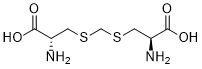
Djenkolic acid is a naturally occurring amino acid isolated from djenkol bean of Archidendron jiringa. It is a derivative of cysteine and is nephrotoxic to humans.
Physicochemical Properties
| Molecular Formula | C7H14N2O4S2 |
| Molecular Weight | 254.31 |
| Exact Mass | 254.039 |
| CAS # | 498-59-9 |
| PubChem CID | 68134 |
| Appearance | White to off-white solid powder |
| Density | 1.501g/cm3 |
| Boiling Point | 515.4ºC at 760 mmHg |
| Flash Point | 265.5ºC |
| Vapour Pressure | 5.2E-12mmHg at 25°C |
| Index of Refraction | -65 ° (C=1, 1mol/L HCl) |
| LogP | 0.634 |
| Hydrogen Bond Donor Count | 4 |
| Hydrogen Bond Acceptor Count | 8 |
| Rotatable Bond Count | 8 |
| Heavy Atom Count | 15 |
| Complexity | 205 |
| Defined Atom Stereocenter Count | 2 |
| SMILES | C([C@@H](C(=O)O)N)SCSC[C@@H](C(=O)O)N |
| InChi Key | JMQMNWIBUCGUDO-WHFBIAKZSA-N |
| InChi Code | InChI=1S/C7H14N2O4S2/c8-4(6(10)11)1-14-3-15-2-5(9)7(12)13/h4-5H,1-3,8-9H2,(H,10,11)(H,12,13)/t4-,5-/m0/s1 |
| Chemical Name | 3,3'-(Methylenedithio)dialanine |
| Synonyms | NSC76076L-Cysteine thioacetal of formaldehyde NSC 76076 Djenkolate NSC-76076Djenkolic acid |
| HS Tariff Code | 2934.99.9001 |
| Storage |
Powder-20°C 3 years 4°C 2 years In solvent -80°C 6 months -20°C 1 month |
| Shipping Condition | Room temperature (This product is stable at ambient temperature for a few days during ordinary shipping and time spent in Customs) |
Biological Activity
| Toxicity/Toxicokinetics |
Toxicity Summary The toxicity of djenkolic acid in humans arises from its poor solubility under acidic conditions after consumption of the jenkol bean. The amino acid precipitates into crystals which cause mechanical irritation of the renal tubules and urinary tract. (L1236) |
| References |
[1]. Djenkolism: case report and literature review. Int Med Case Rep J. 2014 Apr 16;7:79-84. |
| Additional Infomation |
L-djenkolic acid is a dithioacetal consisting of two molecules of L-cysteine joined via their sulfanyl groups to methylene. It has a role as a plant metabolite and a toxin. It is a dithioacetal, a L-cysteine derivative and a non-proteinogenic L-alpha-amino acid. L-Djenkolate has been reported in Euglena gracilis, Archidendron bubalinum, and Acacia with data available. Djenkolic acid is a plant toxin found in the beans of the South-East Asian legumes jengkol (Archidendron jiringa). It is nephrotoxic to humans. (L1236) |
Solubility Data
| Solubility (In Vitro) | H2O : ~25 mg/mL (~98.30 mM) |
| Solubility (In Vivo) |
Note: Listed below are some common formulations that may be used to formulate products with low water solubility (e.g. < 1 mg/mL), you may test these formulations using a minute amount of products to avoid loss of samples. Injection Formulations (e.g. IP/IV/IM/SC) Injection Formulation 1: DMSO : Tween 80: Saline = 10 : 5 : 85 (i.e. 100 μL DMSO stock solution → 50 μL Tween 80 → 850 μL Saline) *Preparation of saline: Dissolve 0.9 g of sodium chloride in 100 mL ddH ₂ O to obtain a clear solution. Injection Formulation 2: DMSO : PEG300 :Tween 80 : Saline = 10 : 40 : 5 : 45 (i.e. 100 μL DMSO → 400 μLPEG300 → 50 μL Tween 80 → 450 μL Saline) Injection Formulation 3: DMSO : Corn oil = 10 : 90 (i.e. 100 μL DMSO → 900 μL Corn oil) Example: Take the Injection Formulation 3 (DMSO : Corn oil = 10 : 90) as an example, if 1 mL of 2.5 mg/mL working solution is to be prepared, you can take 100 μL 25 mg/mL DMSO stock solution and add to 900 μL corn oil, mix well to obtain a clear or suspension solution (2.5 mg/mL, ready for use in animals). Injection Formulation 4: DMSO : 20% SBE-β-CD in saline = 10 : 90 [i.e. 100 μL DMSO → 900 μL (20% SBE-β-CD in saline)] *Preparation of 20% SBE-β-CD in Saline (4°C,1 week): Dissolve 2 g SBE-β-CD in 10 mL saline to obtain a clear solution. Injection Formulation 5: 2-Hydroxypropyl-β-cyclodextrin : Saline = 50 : 50 (i.e. 500 μL 2-Hydroxypropyl-β-cyclodextrin → 500 μL Saline) Injection Formulation 6: DMSO : PEG300 : castor oil : Saline = 5 : 10 : 20 : 65 (i.e. 50 μL DMSO → 100 μLPEG300 → 200 μL castor oil → 650 μL Saline) Injection Formulation 7: Ethanol : Cremophor : Saline = 10: 10 : 80 (i.e. 100 μL Ethanol → 100 μL Cremophor → 800 μL Saline) Injection Formulation 8: Dissolve in Cremophor/Ethanol (50 : 50), then diluted by Saline Injection Formulation 9: EtOH : Corn oil = 10 : 90 (i.e. 100 μL EtOH → 900 μL Corn oil) Injection Formulation 10: EtOH : PEG300:Tween 80 : Saline = 10 : 40 : 5 : 45 (i.e. 100 μL EtOH → 400 μLPEG300 → 50 μL Tween 80 → 450 μL Saline) Oral Formulations Oral Formulation 1: Suspend in 0.5% CMC Na (carboxymethylcellulose sodium) Oral Formulation 2: Suspend in 0.5% Carboxymethyl cellulose Example: Take the Oral Formulation 1 (Suspend in 0.5% CMC Na) as an example, if 100 mL of 2.5 mg/mL working solution is to be prepared, you can first prepare 0.5% CMC Na solution by measuring 0.5 g CMC Na and dissolve it in 100 mL ddH2O to obtain a clear solution; then add 250 mg of the product to 100 mL 0.5% CMC Na solution, to make the suspension solution (2.5 mg/mL, ready for use in animals). Oral Formulation 3: Dissolved in PEG400 Oral Formulation 4: Suspend in 0.2% Carboxymethyl cellulose Oral Formulation 5: Dissolve in 0.25% Tween 80 and 0.5% Carboxymethyl cellulose Oral Formulation 6: Mixing with food powders Note: Please be aware that the above formulations are for reference only. InvivoChem strongly recommends customers to read literature methods/protocols carefully before determining which formulation you should use for in vivo studies, as different compounds have different solubility properties and have to be formulated differently. (Please use freshly prepared in vivo formulations for optimal results.) |
| Preparing Stock Solutions | 1 mg | 5 mg | 10 mg | |
| 1 mM | 3.9322 mL | 19.6610 mL | 39.3221 mL | |
| 5 mM | 0.7864 mL | 3.9322 mL | 7.8644 mL | |
| 10 mM | 0.3932 mL | 1.9661 mL | 3.9322 mL |