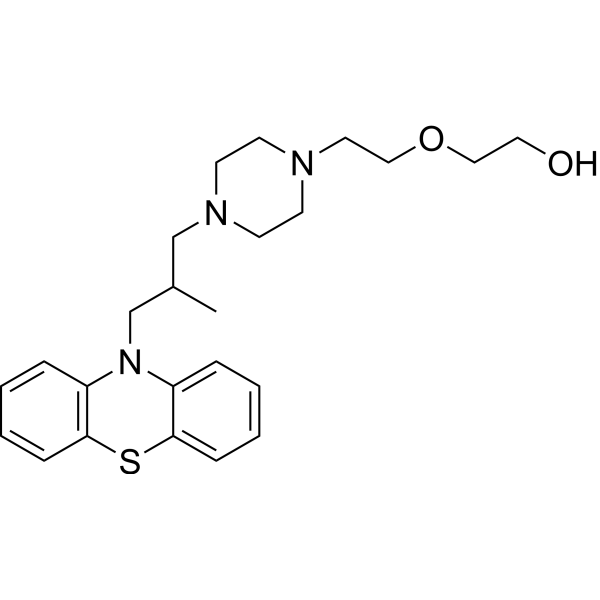
Physicochemical Properties
| Molecular Formula | C24H33N3O2S |
| Molecular Weight | 427.60272 |
| Exact Mass | 427.229 |
| CAS # | 2470-73-7 |
| PubChem CID | 17182 |
| Appearance | Typically exists as solid at room temperature |
| Density | 1.166g/cm3 |
| Boiling Point | 590ºC at 760mmHg |
| Flash Point | 310.6ºC |
| Vapour Pressure | 9.14E-15mmHg at 25°C |
| Index of Refraction | 1.597 |
| LogP | 3.492 |
| Hydrogen Bond Donor Count | 1 |
| Hydrogen Bond Acceptor Count | 6 |
| Rotatable Bond Count | 9 |
| Heavy Atom Count | 30 |
| Complexity | 481 |
| Defined Atom Stereocenter Count | 0 |
| SMILES | CC(CN1C2=C(C=CC=C2)SC3=CC=CC=C13)CN4CCN(CCOCCO)CC4 |
| InChi Key | MSYUMPGNGDNTIQ-UHFFFAOYSA-N |
| InChi Code | InChI=1S/C24H33N3O2S/c1-20(18-26-12-10-25(11-13-26)14-16-29-17-15-28)19-27-21-6-2-4-8-23(21)30-24-9-5-3-7-22(24)27/h2-9,20,28H,10-19H2,1H3 |
| Chemical Name | 2-[2-[4-(2-methyl-3-phenothiazin-10-ylpropyl)piperazin-1-yl]ethoxy]ethanol |
| HS Tariff Code | 2934.99.9001 |
| Storage |
Powder-20°C 3 years 4°C 2 years In solvent -80°C 6 months -20°C 1 month |
| Shipping Condition | Room temperature (This product is stable at ambient temperature for a few days during ordinary shipping and time spent in Customs) |
Biological Activity
| ln Vivo |
Pretreatment with dimethazine 10 mg/kg totally avoided cerebral edema and considerably reduced the increase in albumin in cerebrospinal fluid (CSF) [1]. The phenothiazine Dixyrazine (5 mg/kg iv) exhibits moderate, transient hypotensive effects but considerably lowers 126I-labeled blood albumin in conscious rats with acute hypertension caused by intravenous epinephrine or bicuculline. leakage. The diameters of leptomeningeal arteries and veins in sedated rats were measured continuously through a closed cranial window using a multichannel video vasculometer before and after intravenous injection of dimethazine (5 mg/kg). Dixyrazine, 5 mg/kg, causes a small temporary reduction in blood pressure (10-20 mm Hg). Maximal MAP was marginally but not significantly lowered in dithiazine-treated rats [2]. In cats (2.5-4.0 kg), intracarotid injection of protamine sulphate (10 mg/kg) induced severe brain oedema, characterized by increased brain water content (by 8.3% compared to baseline) and intracranial pressure (ICP increased from 12 mmHg to 38 mmHg). Pretreatment with Dixyrazine (5 mg/kg, intravenous injection) 30 minutes before protamine sulphate administration significantly prevented brain oedema: brain water content increased by only 2.1%, and ICP peaked at 19 mmHg. Histological examination showed reduced vasogenic oedema and preserved integrity of the blood-brain barrier (BBB) [1] In dogs (15-25 kg) with acute hypertension induced by intravenous infusion of angiotensin II (to raise mean arterial pressure to 180-200 mmHg), Dixyrazine (2 mg/kg, intravenous injection) administered 15 minutes before angiotensin II infusion protected the BBB. BBB permeability to Evans blue dye was reduced by 63% compared to the untreated hypertensive group. The compound did not significantly alter the angiotensin II-induced blood pressure elevation, indicating its protective effect was independent of blood pressure regulation [2] |
| Animal Protocol |
Cat brain oedema model: Adult cats (2.5-4.0 kg, n=6 per group) were anesthetized and ventilated mechanically. The right common carotid artery was exposed for drug and protamine sulphate injection. Dixyrazine was dissolved in physiological saline (5 mg/mL) and administered via intravenous injection at 5 mg/kg 30 minutes before protamine sulphate (10 mg/kg, intracarotid injection). Control cats received saline instead of Dixyrazine. Two hours after protamine sulphate injection, cats were euthanized, and brain tissue was collected to measure water content (wet-dry weight method) and ICP (via intraventricular catheter) [1] Dog acute hypertension model: Adult dogs (15-25 kg, n=5 per group) were anesthetized and instrumented for mean arterial pressure monitoring. Dixyrazine was dissolved in physiological saline (2 mg/mL) and administered via intravenous injection at 2 mg/kg 15 minutes before angiotensin II infusion (to maintain mean arterial pressure at 180-200 mmHg for 1 hour). Evans blue dye (20 mg/kg) was injected intravenously 30 minutes after angiotensin II infusion. Dogs were euthanized 1 hour later, and brain tissue was homogenized to quantify Evans blue concentration (fluorescence spectrophotometry) as an indicator of BBB permeability [2] |
| References |
[1]. Dixyrazine, a phenothiazine derivative, can prevent brain oedema induced by intracarotid injection of protamine sulphate. Acta Neurochir (Wien). 1991;113(3-4):171-5. [2]. Phenothiazine-mediated protection of the blood-brain barrier during acute hypertension. Stroke. 1982 Mar-Apr;13(2):220-5. |
| Additional Infomation |
Dixyrazine is a member of phenothiazines. Dixyrazine is a synthetic phenothiazine derivative with a tricyclic phenothiazine core structure [1][2] Its core pharmacological activity is protection of the blood-brain barrier, preventing vasogenic brain oedema induced by protamine sulphate or acute hypertension [1][2] The mechanism of action is proposed to involve stabilization of endothelial cell tight junctions in the BBB, reducing vascular permeability without affecting systemic blood pressure regulation [2] It is potentially applicable for treating conditions associated with BBB disruption and brain oedema, such as acute hypertensive encephalopathy or certain cerebrovascular injuries [1][2] |
Solubility Data
| Solubility (In Vitro) | DMSO : ~100 mg/mL (~233.86 mM) |
| Solubility (In Vivo) |
Note: Listed below are some common formulations that may be used to formulate products with low water solubility (e.g. < 1 mg/mL), you may test these formulations using a minute amount of products to avoid loss of samples. Injection Formulations (e.g. IP/IV/IM/SC) Injection Formulation 1: DMSO : Tween 80: Saline = 10 : 5 : 85 (i.e. 100 μL DMSO stock solution → 50 μL Tween 80 → 850 μL Saline) *Preparation of saline: Dissolve 0.9 g of sodium chloride in 100 mL ddH ₂ O to obtain a clear solution. Injection Formulation 2: DMSO : PEG300 :Tween 80 : Saline = 10 : 40 : 5 : 45 (i.e. 100 μL DMSO → 400 μLPEG300 → 50 μL Tween 80 → 450 μL Saline) Injection Formulation 3: DMSO : Corn oil = 10 : 90 (i.e. 100 μL DMSO → 900 μL Corn oil) Example: Take the Injection Formulation 3 (DMSO : Corn oil = 10 : 90) as an example, if 1 mL of 2.5 mg/mL working solution is to be prepared, you can take 100 μL 25 mg/mL DMSO stock solution and add to 900 μL corn oil, mix well to obtain a clear or suspension solution (2.5 mg/mL, ready for use in animals). Injection Formulation 4: DMSO : 20% SBE-β-CD in saline = 10 : 90 [i.e. 100 μL DMSO → 900 μL (20% SBE-β-CD in saline)] *Preparation of 20% SBE-β-CD in Saline (4°C,1 week): Dissolve 2 g SBE-β-CD in 10 mL saline to obtain a clear solution. Injection Formulation 5: 2-Hydroxypropyl-β-cyclodextrin : Saline = 50 : 50 (i.e. 500 μL 2-Hydroxypropyl-β-cyclodextrin → 500 μL Saline) Injection Formulation 6: DMSO : PEG300 : castor oil : Saline = 5 : 10 : 20 : 65 (i.e. 50 μL DMSO → 100 μLPEG300 → 200 μL castor oil → 650 μL Saline) Injection Formulation 7: Ethanol : Cremophor : Saline = 10: 10 : 80 (i.e. 100 μL Ethanol → 100 μL Cremophor → 800 μL Saline) Injection Formulation 8: Dissolve in Cremophor/Ethanol (50 : 50), then diluted by Saline Injection Formulation 9: EtOH : Corn oil = 10 : 90 (i.e. 100 μL EtOH → 900 μL Corn oil) Injection Formulation 10: EtOH : PEG300:Tween 80 : Saline = 10 : 40 : 5 : 45 (i.e. 100 μL EtOH → 400 μLPEG300 → 50 μL Tween 80 → 450 μL Saline) Oral Formulations Oral Formulation 1: Suspend in 0.5% CMC Na (carboxymethylcellulose sodium) Oral Formulation 2: Suspend in 0.5% Carboxymethyl cellulose Example: Take the Oral Formulation 1 (Suspend in 0.5% CMC Na) as an example, if 100 mL of 2.5 mg/mL working solution is to be prepared, you can first prepare 0.5% CMC Na solution by measuring 0.5 g CMC Na and dissolve it in 100 mL ddH2O to obtain a clear solution; then add 250 mg of the product to 100 mL 0.5% CMC Na solution, to make the suspension solution (2.5 mg/mL, ready for use in animals). Oral Formulation 3: Dissolved in PEG400 Oral Formulation 4: Suspend in 0.2% Carboxymethyl cellulose Oral Formulation 5: Dissolve in 0.25% Tween 80 and 0.5% Carboxymethyl cellulose Oral Formulation 6: Mixing with food powders Note: Please be aware that the above formulations are for reference only. InvivoChem strongly recommends customers to read literature methods/protocols carefully before determining which formulation you should use for in vivo studies, as different compounds have different solubility properties and have to be formulated differently. (Please use freshly prepared in vivo formulations for optimal results.) |
| Preparing Stock Solutions | 1 mg | 5 mg | 10 mg | |
| 1 mM | 2.3386 mL | 11.6932 mL | 23.3863 mL | |
| 5 mM | 0.4677 mL | 2.3386 mL | 4.6773 mL | |
| 10 mM | 0.2339 mL | 1.1693 mL | 2.3386 mL |