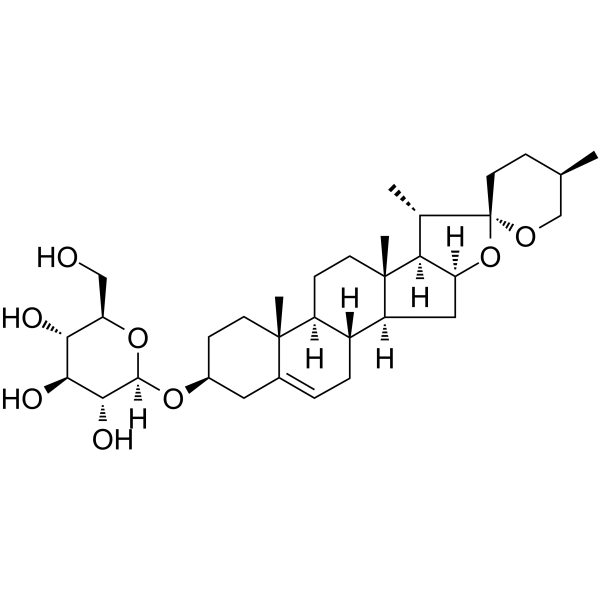
Physicochemical Properties
| Molecular Formula | C33H52O8 |
| Molecular Weight | 576.7612 |
| Exact Mass | 576.366 |
| CAS # | 14144-06-0 |
| Related CAS # | Diosgenin;512-04-9 |
| PubChem CID | 11827970 |
| Appearance | White to off-white solid powder |
| Density | 1.3±0.1 g/cm3 |
| Boiling Point | 705.1±60.0 °C at 760 mmHg |
| Flash Point | 380.2±32.9 °C |
| Vapour Pressure | 0.0±5.1 mmHg at 25°C |
| Index of Refraction | 1.594 |
| LogP | 3.89 |
| Hydrogen Bond Donor Count | 4 |
| Hydrogen Bond Acceptor Count | 8 |
| Rotatable Bond Count | 3 |
| Heavy Atom Count | 41 |
| Complexity | 1030 |
| Defined Atom Stereocenter Count | 16 |
| SMILES | C[C@@H]1CC[C@@]2([C@H]([C@H]3[C@@H](O2)C[C@@H]4[C@@]3(CC[C@H]5[C@H]4CC=C6[C@@]5(CC[C@@H](C6)O[C@H]7[C@@H]([C@H]([C@@H]([C@H](O7)CO)O)O)O)C)C)C)OC1 |
| InChi Key | WXMARHKAXWRNDM-GAMIEDRGSA-N |
| InChi Code | InChI=1S/C33H52O8/c1-17-7-12-33(38-16-17)18(2)26-24(41-33)14-23-21-6-5-19-13-20(8-10-31(19,3)22(21)9-11-32(23,26)4)39-30-29(37)28(36)27(35)25(15-34)40-30/h5,17-18,20-30,34-37H,6-16H2,1-4H3/t17-,18+,20+,21-,22+,23+,24+,25-,26+,27-,28+,29-,30-,31+,32+,33-/m1/s1 |
| Chemical Name | (2R,3S,4S,5R,6R)-2-(hydroxymethyl)-6-[(1S,2S,4S,5'R,6R,7S,8R,9S,12S,13R,16S)-5',7,9,13-tetramethylspiro[5-oxapentacyclo[10.8.0.02,9.04,8.013,18]icos-18-ene-6,2'-oxane]-16-yl]oxyoxane-3,4,5-triol |
| HS Tariff Code | 2934.99.9001 |
| Storage |
Powder-20°C 3 years 4°C 2 years In solvent -80°C 6 months -20°C 1 month Note: This product requires protection from light (avoid light exposure) during transportation and storage. |
| Shipping Condition | Room temperature (This product is stable at ambient temperature for a few days during ordinary shipping and time spent in Customs) |
Biological Activity
| Targets |
Inhibition of LPS-induced phosphorylation of IκB-α, p38 MAPK, and ERK MAPK in microglial cells, without affecting JNK phosphorylation [1] |
| ln Vitro |
Diosgenin glucoside (1, 5, 10 µM) alone had no cytotoxic effect on the viability of rat primary microglia and BV-2 microglial cells after 24-hour incubation in serum-free DMEM [1] Diosgenin glucoside (1, 5, 10 µM) inhibited the activity-induced cell death (AICD) of rat primary microglia and BV-2 cells incubated with LPS [1] Diosgenin glucoside (1, 5, 10 µM) suppressed the production of nitric oxide (NO), tumor necrosis factor-α (TNF-α), and interleukin-6 (IL-6) (M1 markers) in LPS-activated rat primary microglia and BV-2 cells in a dose-dependent manner [1] Diosgenin glucoside (10 µM) suppressed the LPS-induced mRNA expression of inducible nitric oxide synthase (iNOS), TNF-α, IL-6, interleukin-1β (IL-1β), interleukin-17 (IL-17), and interleukin-23 (IL-23) in BV-2 cells [1] Diosgenin glucoside did not affect the production of interleukin-10 (IL-10) and interleukin-1 receptor antagonist (IL-1Ra) (M2 markers) in LPS-activated primary microglia and BV-2 cells, nor did it reverse the LPS-induced suppression of CD206 protein expression [1] Diosgenin glucoside had no effect on the LPS-induced mRNA expression of IL-1Ra, IL-10, granulocyte-colony stimulating factor (G-CSF), suppressor of cytokine signaling 3 (SOCS3), CD206, resistin-like α (Fizz1), and chitinase 3-like 3 (Ym1) in BV-2 cells. It inhibited LPS-induced cyclooxygenase-2 (COX-2) mRNA expression but did not affect cyclooxygenase-1 (COX-1) and arginase-1 (Arg-1) mRNA levels [1] Diosgenin glucoside had no effect on the IL-4-induced mRNA expression of IL-10, CD206, Arg-1, and Ym1 in BV-2 cells [1] Diosgenin glucoside (10 µM) markedly inhibited LPS-induced phosphorylation of IκB-α, p38 MAPK, and ERK MAPK, but not JNK phosphorylation, in BV-2 cells [1] Conditioned medium from BV-2 cells treated with LPS and Diosgenin glucoside (10 µM) was significantly less toxic to Neuro-2a neuronal cells compared to conditioned medium from cells treated with LPS alone, indicating indirect neuroprotection via modulation of microglial secretions [1] |
| Cell Assay |
For cell viability testing (CCK-8 assay), primary microglia and BV-2 cells were incubated with Diosgenin glucoside (1, 5, or 10 µM) for 24 hours in serum-free Dulbecco's Modified Eagle Medium (DMEM). A 10% CCK-8 solution was then added, and after 0.5 hours of incubation, optical absorbance at 450 nm was measured with a plate reader [1] To assess activity-induced cell death (AICD), cells were pre-treated with Diosgenin glucoside (1, 5, or 10 µM) for 30 minutes, then stimulated with lipopolysaccharide (LPS) (0.1 µg/mL for BV-2 cells, 1 µg/mL for primary microglia) for 24 hours in serum-free DMEM, followed by the CCK-8 assay [1] For nitric oxide (NO) and cytokine level determination, cells pre-treated with Diosgenin glucoside (1, 5, or 10 µM) for 30 minutes were stimulated with LPS for 24 hours. Supernatant nitrite levels were measured using Griess reagents, and absorbance was read at 550 nm. Levels of IL-6 and TNF-α were measured using enzyme-linked immunosorbent assay (ELISA) kits [1] For quantitative real-time polymerase chain reaction (qRT-PCR), BV-2 cells were treated with LPS (0.1 µg/mL) and/or Diosgenin glucoside for 8 hours, or with interleukin-4 (IL-4, 40 ng/mL) and/or Diosgenin glucoside for 8 hours. Total RNA was extracted, reverse transcribed into cDNA, and mRNA levels were quantified using specific primers and SYBR Green PCR Master Mix [1] For ELISA measurement of cytokines, cells were pre-treated with Diosgenin glucoside for 30 minutes, then stimulated with LPS for 24 hours. Supernatant concentrations of TNF-α, IL-6, IL-10, and IL-1Ra were determined using ELISA kits [1] For Western blot analysis, BV-2 cells were treated with LPS and/or Diosgenin glucoside (10 µM) for 1 hour. Total proteins were extracted, quantified, separated by electrophoresis, transferred to membranes, and probed with primary antibodies against IκB-α, phospho-JNK, JNK, phospho-p38, p38, phospho-ERK, ERK, and β-actin, followed by appropriate secondary antibodies and detection [1] For immunofluorescence, BV-2 cells treated with LPS and/or Diosgenin glucoside (10 µM) for 24 hours were fixed, blocked, and stained with an anti-CD206 antibody and a fluorescent secondary antibody. Nuclei were stained with DAPI, and samples were observed under a confocal microscope [1] For microglia-conditioned medium toxicity assay, BV-2 cells were stimulated with LPS (0.1 µg/mL) and/or Diosgenin glucoside (1, 5, or 10 µM) for 24 hours. The conditioned media were then applied to Neuro-2a cells for 24 hours, after which Neuro-2a cell viability was assessed using the CCK-8 assay [1] |
| Toxicity/Toxicokinetics |
Diosgenin glucoside at concentrations of 1, 5, and 10 µM showed no cytotoxic effects on rat primary microglia and BV-2 microglial cells after 24-hour incubation [1] |
| References |
[1]. Int Immunopharmacol. 2017 Sep;50:22-29. doi: 10.1016/j.intimp.2017.06.008. Epub 2017 Jun 14. [2]. Diosgenin Glucoside Protects against Spinal Cord Injury by Regulating Autophagy and Alleviating Apoptosis. Int J Mol Sci. 2018 Aug 2;19(8). pii: E2274. |
| Additional Infomation |
Diosgenin 3-O-beta-D-glucoside is a sterol 3-beta-D-glucoside having diosgenin as the sterol component. It has a role as a metabolite. It is a sterol 3-beta-D-glucoside, a monosaccharide derivative, a hexacyclic triterpenoid and a spiroketal. It is functionally related to a diosgenin. It derives from a hydride of a spirostan. Disogluside has been reported in Dioscorea panthaica, Polygonatum zanlanscianense, and other organisms with data available. Diosgenin glucoside is a saponin compound extracted from the plant Tribulus terrestris L. [1] The study demonstrates that Diosgenin glucoside selectively suppresses the production/expression of pro-inflammatory M1 markers (e.g., IL-1β, NO, IL-6, TNF-α, IL-17, IL-23) in activated microglia while preserving several anti-inflammatory M2 markers (e.g., IL-10, IL-1Ra, CD206, Arg-1), thereby regulating microglial polarization [1] The neuroprotective effect of Diosgenin glucoside appears to be indirect, achieved by reducing the release of neurotoxic pro-inflammatory factors from activated microglia, rather than by directly protecting neurons [1] The results suggest that Diosgenin glucoside has potential for the treatment of neuroinflammatory diseases mediated by microglia [1] |
Solubility Data
| Solubility (In Vitro) | DMSO : ~125 mg/mL (~216.73 mM) |
| Solubility (In Vivo) |
Solubility in Formulation 1: ≥ 2.08 mg/mL (3.61 mM) (saturation unknown) in 10% DMSO + 90% Corn Oil (add these co-solvents sequentially from left to right, and one by one), clear solution. For example, if 1 mL of working solution is to be prepared, you can add 100 μL of 20.8 mg/mL clear DMSO stock solution to 900 μL of corn oil and mix evenly. (Please use freshly prepared in vivo formulations for optimal results.) |
| Preparing Stock Solutions | 1 mg | 5 mg | 10 mg | |
| 1 mM | 1.7338 mL | 8.6691 mL | 17.3382 mL | |
| 5 mM | 0.3468 mL | 1.7338 mL | 3.4676 mL | |
| 10 mM | 0.1734 mL | 0.8669 mL | 1.7338 mL |