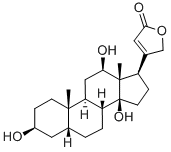
Physicochemical Properties
| Molecular Formula | C23H34O5 |
| Molecular Weight | 390.5131 |
| Exact Mass | 390.241 |
| CAS # | 1672-46-4 |
| PubChem CID | 15478 |
| Appearance | White to off-white solid powder |
| Density | 1.297 g/cm3 |
| Boiling Point | 589.4ºC at 760 mmHg |
| Melting Point | 222 °C(lit.) |
| Flash Point | 203ºC |
| Vapour Pressure | 2.4E-16mmHg at 25°C |
| Index of Refraction | 1.609 |
| LogP | 2.575 |
| Hydrogen Bond Donor Count | 3 |
| Hydrogen Bond Acceptor Count | 5 |
| Rotatable Bond Count | 1 |
| Heavy Atom Count | 28 |
| Complexity | 718 |
| Defined Atom Stereocenter Count | 9 |
| SMILES | O([H])[C@]12C([H])([H])C([H])([H])[C@]([H])(C3=C([H])C(=O)OC3([H])[H])[C@@]1(C([H])([H])[H])[C@@]([H])(C([H])([H])[C@]1([H])[C@@]3(C([H])([H])[H])C([H])([H])C([H])([H])[C@@]([H])(C([H])([H])[C@@]3([H])C([H])([H])C([H])([H])[C@@]21[H])O[H])O[H] |
| InChi Key | SHIBSTMRCDJXLN-KCZCNTNESA-N |
| InChi Code | InChI=1S/C23H34O5/c1-21-7-5-15(24)10-14(21)3-4-17-18(21)11-19(25)22(2)16(6-8-23(17,22)27)13-9-20(26)28-12-13/h9,14-19,24-25,27H,3-8,10-12H2,1-2H3/t14-,15+,16-,17-,18+,19-,21+,22+,23+/m1/s1 |
| Chemical Name | 3-[(3S,5R,8R,9S,10S,12R,13S,14S,17R)-3,12,14-trihydroxy-10,13-dimethyl-1,2,3,4,5,6,7,8,9,11,12,15,16,17-tetradecahydrocyclopenta[a]phenanthren-17-yl]-2H-furan-5-one |
| Synonyms | Lanadigenin Digoxigenine Digoxigenin |
| HS Tariff Code | 2934.99.9001 |
| Storage |
Powder-20°C 3 years 4°C 2 years In solvent -80°C 6 months -20°C 1 month Note: This product requires protection from light (avoid light exposure) during transportation and storage. |
| Shipping Condition | Room temperature (This product is stable at ambient temperature for a few days during ordinary shipping and time spent in Customs) |
Biological Activity
| ln Vitro | Digoxigenin has an EC50 value of 0.358 μM and a concentration of 1 μM, making it a powerful activator of RORγ regulation [2]. |
| Cell Assay |
Cell Viability Assay[2] Cell Types: HepG2 (Human Hepatocellular Carcinoma) Cell Line Tested Concentrations: 0-10 μM Incubation Duration: 24 hrs (hours) Experimental Results: The optimal concentration of digoxigenin was determined: 1 μM. Cytotoxicity assay [2] Cell Types: RORγ-HepG2 Cell Tested Concentrations: 0-2 μM Incubation Duration: 24 h Experimental Results: Intracellular luciferase activity increased in a concentration-dependent manner. |
| Toxicity/Toxicokinetics |
Toxicity Summary IDENTIFICATION AND USE: Digoxigenin is a metabolite of digoxin and it can be produced by hydrolysis of digoxin. HUMAN STUDIES: All cardiac glycosides and their genins exhibited greater than 100-fold higher toxicity towards cultured human and monkey cells in comparison to the cell lines of mouse, Syrian hamster, and Chinese hamster origins. ANIMAL STUDIES: A possibility that intracellular Na+ ions available to Na+, K+-adenosine triphosphatase influence the action of digoxigenin to cause sodium-pump inhibition and a positive inotropic effect was examined with isolated left atria of guinea-pig hearts. The positive inotropic action of digoxigenin developed more rapidly when atria were stimulated at 3 Hz than at 1.5 Hz. The rate of development of the positive inotropic action was dependent on the frequency of membrane depolarizations rather than on contractions. Sodium pump activity, as estimated from ouabain-sensitive 86Rb uptake, was inhibited by digoxigenin in a concentration-dependent manner in quiescent atria. The inhibition was enhanced by electrical stimulation which shifted the concentration-inhibition curves to the left. The sensitivity of the sodium pump for digoxigenin was also affected by membrane depolarizations, suggesting a role for intracellular Na+. These data indicate that similar to the cardiac glycosides, the interaction of the aglycone with Na+,K+-adenosine triphosphatase is essential for the development of the positive inotropic action of this agent. Interactions Both the competition of ethanol with cardiac sterols and the narrow margin of safety in the therapeutic use of digitalis derivatives would seem to place at increased risk those individuals who receive digitalis and simultaneously consume large amounts of ethanol or whose alcohol dehydrogenase function is impaired. |
| References |
[1]. Long noncoding RNA (lncRNA) EIF3J-DT induces chemoresistance of gastric cancer via autophagy activation. Autophagy vol. 17,12 (2021): 4083-4101. [2]. The cardenolides strophanthidin, digoxigenin and dihydroouabain act as activators of the human RORγ/RORγT receptors. Toxicology letters vol. 295 (2018): 314-324. [3]. Production of Digoxigenin-Labeled Riboprobes for In Situ Hybridization Experiments. Current protocols in mouse biology vol. 10,2 (2020): e74. |
Solubility Data
| Solubility (In Vitro) | DMSO : ~100 mg/mL (~256.08 mM) |
| Solubility (In Vivo) |
Solubility in Formulation 1: ≥ 2.08 mg/mL (5.33 mM) (saturation unknown) in 10% DMSO + 40% PEG300 + 5% Tween80 + 45% Saline (add these co-solvents sequentially from left to right, and one by one), clear solution. For example, if 1 mL of working solution is to be prepared, you can add 100 μL of 20.8 mg/mL clear DMSO stock solution to 400 μL PEG300 and mix evenly; then add 50 μL Tween-80 to the above solution and mix evenly; then add 450 μL normal saline to adjust the volume to 1 mL. Preparation of saline: Dissolve 0.9 g of sodium chloride in 100 mL ddH₂ O to obtain a clear solution. Solubility in Formulation 2: ≥ 2.08 mg/mL (5.33 mM) (saturation unknown) in 10% DMSO + 90% (20% SBE-β-CD in Saline) (add these co-solvents sequentially from left to right, and one by one), clear solution. For example, if 1 mL of working solution is to be prepared, you can add 100 μL of 20.8 mg/mL clear DMSO stock solution to 900 μL of 20% SBE-β-CD physiological saline solution and mix evenly. Preparation of 20% SBE-β-CD in Saline (4°C,1 week): Dissolve 2 g SBE-β-CD in 10 mL saline to obtain a clear solution. Solubility in Formulation 3: ≥ 2.08 mg/mL (5.33 mM) (saturation unknown) in 10% DMSO + 90% Corn Oil (add these co-solvents sequentially from left to right, and one by one), clear solution. For example, if 1 mL of working solution is to be prepared, you can add 100 μL of 20.8 mg/mL clear DMSO stock solution to 900 μL of corn oil and mix evenly. (Please use freshly prepared in vivo formulations for optimal results.) |
| Preparing Stock Solutions | 1 mg | 5 mg | 10 mg | |
| 1 mM | 2.5608 mL | 12.8038 mL | 25.6075 mL | |
| 5 mM | 0.5122 mL | 2.5608 mL | 5.1215 mL | |
| 10 mM | 0.2561 mL | 1.2804 mL | 2.5608 mL |