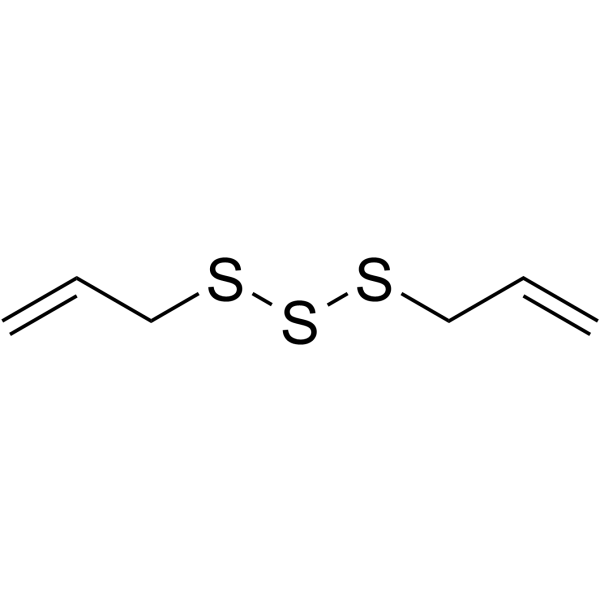
Physicochemical Properties
| Molecular Formula | C6H10S3 |
| Molecular Weight | 178.3386 |
| Exact Mass | 177.994 |
| CAS # | 2050-87-5 |
| PubChem CID | 16315 |
| Appearance | Colorless to light yellow liquid |
| Density | 1.1±0.1 g/cm3 |
| Boiling Point | 229.5±43.0 °C at 760 mmHg |
| Flash Point | 87.8±25.2 °C |
| Vapour Pressure | 0.1±0.4 mmHg at 25°C |
| Index of Refraction | 1.582 |
| LogP | 4.59 |
| Hydrogen Bond Donor Count | 0 |
| Hydrogen Bond Acceptor Count | 3 |
| Rotatable Bond Count | 6 |
| Heavy Atom Count | 9 |
| Complexity | 70.4 |
| Defined Atom Stereocenter Count | 0 |
| SMILES | S(C([H])([H])C([H])=C([H])[H])SSC([H])([H])C([H])=C([H])[H] |
| InChi Key | UBAXRAHSPKWNCX-UHFFFAOYSA-N |
| InChi Code | InChI=1S/C6H10S3/c1-3-5-7-9-8-6-4-2/h3-4H,1-2,5-6H2 |
| Chemical Name | 3-(prop-2-enyltrisulfanyl)prop-1-ene |
| HS Tariff Code | 2934.99.9001 |
| Storage |
Powder-20°C 3 years 4°C 2 years In solvent -80°C 6 months -20°C 1 month Note: Please store this product in a sealed and protected environment (e.g. under nitrogen), avoid exposure to moisture. |
| Shipping Condition | Room temperature (This product is stable at ambient temperature for a few days during ordinary shipping and time spent in Customs) |
Biological Activity
| Toxicity/Toxicokinetics |
Effects During Pregnancy and Lactation ◉ Summary of Use during Lactation Garlic (Allium sativum) contains alliin, which is metabolized by the enzyme alliinase to allicin, thought to be responsible for most of garlic's medicinal properties and odor. Garlic’s odor in milk is attributed to allyl methyl sulfide. Garlic has been used to lower cholesterol and blood pressure. It has no specific indications for use during lactation in western countries. Garlic has been used as a galactogogue in India and Türkiye, although no good scientific data could be located on its use alone as a galactogogue. Galactogogues should never replace evaluation and counseling on modifiable factors that affect milk production. Garlic has a long history of use as a food and medicine and is "generally recognized as safe" (GRAS) as a food flavoring by the U.S. Food and Drug Administration, including during lactation. Garlic's odor is transmitted to breastmilk, which may increase infant sucking time acutely and might enhance the breastfed infant's food choices in the long term. Some mothers in Türkiye reportedly use garlic to improve the taste and quality of their milk. Limited scientific data found that a few days of oral garlic supplementation caused no adverse effects in nursing mothers or infants. When used as a medicinal, garlic is generally well tolerated in adults, but gastrointestinal side effects and bad breath and body odor may occur. Garlic has anti-platelet effects and should be used cautiously by women at risk for bleeding. Garlic can cause allergies and should be avoided by persons allergic to garlic or other members of the lily family, such as hyacinth, tulip, onion, leek, and chives. Topical application of garlic can cause dermatitis and burns and should be used with caution, especially in infants. One nursing mother received severe burns to the breast from prolonged (2 days) application of a poultice of raw, crushed garlic to treat a self-diagnosed Candida infection. Dietary supplements do not require extensive pre-marketing approval from the U.S. Food and Drug Administration. Manufacturers are responsible to ensure the safety, but do not need to prove the safety and effectiveness of dietary supplements before they are marketed. Dietary supplements may contain multiple ingredients, and differences are often found between labeled and actual ingredients or their amounts. A manufacturer may contract with an independent organization to verify the quality of a product or its ingredients, but that does not certify the safety or effectiveness of a product. Because of the above issues, clinical testing results on one product may not be applicable to other products. More detailed information about dietary supplements is available elsewhere on the LactMed Web site. ◉ Effects in Breastfed Infants Maternal garlic ingestion has a reputation for causing colic in breastfed infants. Two papers tend to refute this claim. In one, 153 mothers who answered a questionnaire were no more likely to report colic in their infants in the previous week if they had ingested garlic than if they had not. In another study, mothers who were given either 1.5 grams of garlic or placebo capsules once daily in a blinded fashion for 3 days were asked if their infants had exhibited any signs of colic (were fussier, cried more or had more gas) after capsule ingestion. Four of 20 women who ingested garlic thought their infants had colic; however, 4 of 10 women who received placebo thought they had received garlic and reported colic in their infants. ◉ Effects on Lactation and Breastmilk Forty women who complained of an insufficient milk supply at 5 days postpartum were given a combination herbal supplement as 2 capsules of Lactare (Pharma Private Ltd., Madras, India) 3 times daily. Each capsule contained wild asparagus 200 mg, ashwagandha (Withania somnifera) 100 mg, fenugreek 50 mg, licorice 50 mg, and garlic 20 mg. By day 4 of therapy, no infants required supplementary feeding. Infants were weighed before and after each feeding on the fifth day of maternal therapy to determine the amount of milk ingested. On the day of the test weighing, infants' milk intake averaged 388 mL, and the fluid and caloric intake was considered adequate. This study cannot be considered as valid evidence of a galactogogue effect of these herbs because it lacks randomization, blinding, a placebo control, and maternal instruction in breastfeeding technique. Additionally, infants were breastfed only 6 to 8 times daily, which is insufficient to maximize milk supply. In two studies conducted by the same investigators, capsules containing 1.5 g of garlic extract (General Nutrition Center, Pittsburgh, PA) were given to nursing mothers. In the first experiment, 8 mothers receive a garlic capsule or placebo once daily in a crossover fashion. Garlic-naive infants whose mothers ingested garlic capsules spent more time (33 vs 27 minutes) attached to the nipple during the time period of 1.5 to 3 hours after garlic ingestion when garlic odor in milk was maximal than in those whose mothers received a placebo; however, total number of nursings or total amount of milk ingestion did not differ between groups. A study randomized nursing mothers to receive garlic capsules or placebo for 3 days before testing with a single capsule as in the study above. Infants who received garlic in the milk for the first time spent 30% more time nursing than after placebo. Infants who had been previously exposed to garlic in milk, did not spend more time nursing after subsequent garlic exposure in milk. The authors interpreted the results of these studies as having a positive effect on infants' later food choices (i.e., being less "picky" about foods). |
| References |
[1]. Diallyl trisulfide induces apoptosis and inhibits proliferation of A549 cells in vitro and in vivo. Acta Biochim Biophys Sin (Shanghai). 2012 Jul;44(7):577-83. [2]. Diallyl trisulfide inhibits naphthalene-induced oxidative injury and the production of inflammatory responses in A549 cells and mice. Int Immunopharmacol. 2015 Dec;29(2):326-333. [3]. Antiviral activity of diallyl trisulfide against H9N2 avian influenza virus infection in vitro and in vivo. Virol J. 2021 Aug 19;18(1):171. [4]. Diallyl trisulfide (DATS) effectively induced apoptosis of postharvest diseasePenicillium expansum of citrus. Annals of Microbiology. December 2009, Volume 59, Issue 4, pp 675-679. |
| Additional Infomation |
Diallyl trisulfide is an organic trisulfide that is trisulfane in which both of the hydrogens are replaced by allyl groups. A component of the essential oil of garlic and a major component of the traditional Chinese medicine allitridium, it exhibits antifungal, antitumour and antioxidant activity It has a role as an apoptosis inducer, an estrogen receptor antagonist, an antineoplastic agent, a vasodilator agent, an antioxidant, an anti-inflammatory agent, an insecticide, an antiprotozoal drug, a platelet aggregation inhibitor and an antilipemic drug. Diallyl trisulfide has been reported in Allium ursinum, Allium victorialis, and other organisms with data available. |
Solubility Data
| Solubility (In Vitro) | DMSO : ~100 mg/mL (~560.73 mM) |
| Solubility (In Vivo) |
Solubility in Formulation 1: 2.5 mg/mL (14.02 mM) in 10% DMSO + 40% PEG300 + 5% Tween80 + 45% Saline (add these co-solvents sequentially from left to right, and one by one), suspension solution; with sonication. For example, if 1 mL of working solution is to be prepared, you can add 100 μL of 25.0 mg/mL clear DMSO stock solution to 400 μL PEG300 and mix evenly; then add 50 μL Tween-80 to the above solution and mix evenly; then add 450 μL normal saline to adjust the volume to 1 mL. Preparation of saline: Dissolve 0.9 g of sodium chloride in 100 mL ddH₂ O to obtain a clear solution. Solubility in Formulation 2: ≥ 2.5 mg/mL (14.02 mM) (saturation unknown) in 10% DMSO + 90% (20% SBE-β-CD in Saline) (add these co-solvents sequentially from left to right, and one by one), clear solution. For example, if 1 mL of working solution is to be prepared, you can add 100 μL of 25.0 mg/mL clear DMSO stock solution to 900 μL of 20% SBE-β-CD physiological saline solution and mix evenly. Preparation of 20% SBE-β-CD in Saline (4°C,1 week): Dissolve 2 g SBE-β-CD in 10 mL saline to obtain a clear solution. Solubility in Formulation 3: ≥ 2.5 mg/mL (14.02 mM) (saturation unknown) in 10% DMSO + 90% Corn Oil (add these co-solvents sequentially from left to right, and one by one), clear solution. For example, if 1 mL of working solution is to be prepared, you can add 100 μL of 25.0 mg/mL clear DMSO stock solution to 900 μL of corn oil and mix evenly. (Please use freshly prepared in vivo formulations for optimal results.) |
| Preparing Stock Solutions | 1 mg | 5 mg | 10 mg | |
| 1 mM | 5.6073 mL | 28.0363 mL | 56.0727 mL | |
| 5 mM | 1.1215 mL | 5.6073 mL | 11.2145 mL | |
| 10 mM | 0.5607 mL | 2.8036 mL | 5.6073 mL |