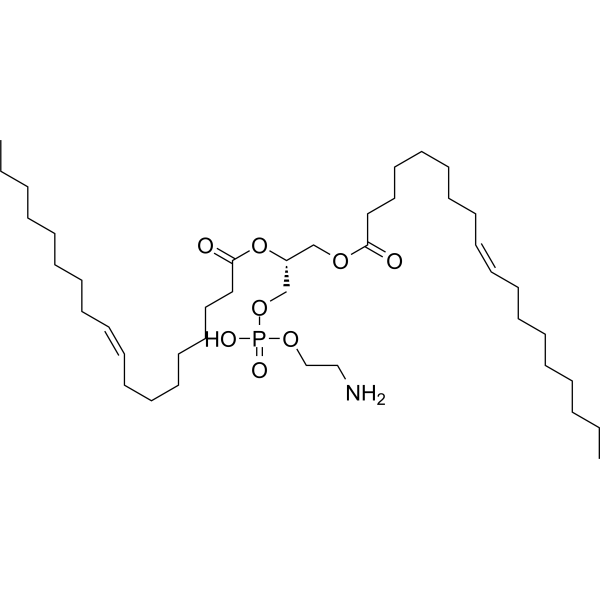
Physicochemical Properties
| Molecular Formula | C₄₁H₇₈NO₈P |
| Molecular Weight | 744.03 |
| Exact Mass | 743.546 |
| CAS # | 4004-05-1 |
| PubChem CID | 9546757 |
| Appearance | White to light yellow solid powder |
| Density | 1.008g/cm3 |
| Boiling Point | 759.2±70.0 °C at 760 mmHg |
| Melting Point | 200 °C |
| Flash Point | 413.0±35.7 °C |
| Vapour Pressure | 0.0±5.5 mmHg at 25°C |
| Index of Refraction | 1.484 |
| LogP | 14.79 |
| Hydrogen Bond Donor Count | 2 |
| Hydrogen Bond Acceptor Count | 9 |
| Rotatable Bond Count | 41 |
| Heavy Atom Count | 51 |
| Complexity | 897 |
| Defined Atom Stereocenter Count | 1 |
| SMILES | P(=O)(O[H])(OC([H])([H])C([H])([H])N([H])[H])OC([H])([H])C([H])(C([H])([H])OC(C([H])([H])C([H])([H])C([H])([H])C([H])([H])C([H])([H])C([H])([H])C([H])([H])/C(/[H])=C(/[H])\C([H])([H])C([H])([H])C([H])([H])C([H])([H])C([H])([H])C([H])([H])C([H])([H])C([H])([H])[H])=O)OC(C([H])([H])C([H])([H])C([H])([H])C([H])([H])C([H])([H])C([H])([H])C([H])([H])/C(/[H])=C(/[H])\C([H])([H])C([H])([H])C([H])([H])C([H])([H])C([H])([H])C([H])([H])C([H])([H])C([H])([H])[H])=O |
| InChi Key | MWRBNPKJOOWZPW-NYVOMTAGSA-N |
| InChi Code | InChI=1S/C41H78NO8P/c1-3-5-7-9-11-13-15-17-19-21-23-25-27-29-31-33-40(43)47-37-39(38-49-51(45,46)48-36-35-42)50-41(44)34-32-30-28-26-24-22-20-18-16-14-12-10-8-6-4-2/h17-20,39H,3-16,21-38,42H2,1-2H3,(H,45,46)/b19-17-,20-18-/t39-/m1/s1 |
| Chemical Name | [(2R)-3-[2-aminoethoxy(hydroxy)phosphoryl]oxy-2-[(Z)-octadec-9-enoyl]oxypropyl] (Z)-octadec-9-enoate |
| Synonyms | 1,2Dioleoylsnglycero3phosphoethanolamine; 1,2 Dioleoyl sn glycero 3 phosphoethanolamine |
| HS Tariff Code | 2934.99.9001 |
| Storage |
Powder-20°C 3 years 4°C 2 years In solvent -80°C 6 months -20°C 1 month |
| Shipping Condition | Room temperature (This product is stable at ambient temperature for a few days during ordinary shipping and time spent in Customs) |
Biological Activity
| ln Vitro | In this investigation, every single siRNA was encapsulated in LNP (cationic tray-A: PEG2000-DMPE: DOPE molar percentage of 47.8: 5.18: 47.1) [1]. The knockdown (KD) effect is exhibited by macrophages and DCs, while fusion is observed in DOPE that contains liposomes. Instead,Monocytes, neutrophils, plasmacytoid DCs, and B cells are not inhibited by LNP/siRNA, but it dramatically reduces the expression of CD45 protein, causing a 30% reduction in macrophage and DC activity [1]. Human giant cell eroded cells and DCs, as well as cells, may use LNP as a siRNA suspension system [1]. |
| References | [1]. Uemura Y, et al. The efficiency of lipid nanoparticles with an original cationic lipid as a siRNA delivery system for macrophages and dendritic cells.Pharm Dev Technol. 2019 Mar;24(3):263-268. |
| Additional Infomation |
1,2-di-[(9Z)-octadecenoyl]-sn-glycero-3-phosphoethanolamine is a 1,2-diacyl-sn-glycero-3-phosphoethanolamine in which the acyl substituent both at positions 1 and 2 is specified as (9Z)-octadecenoyl respectively. It has a role as a mouse metabolite. It is functionally related to an oleic acid. PE(18:1(9Z)/18:1(9Z)) is a metabolite found in or produced by Escherichia coli (strain K12, MG1655). |
Solubility Data
| Solubility (In Vitro) | Ethanol : ~10 mg/mL (~13.44 mM) |
| Solubility (In Vivo) |
Solubility in Formulation 1: ≥ 2 mg/mL (2.69 mM) (saturation unknown) in 10% EtOH + 40% PEG300 + 5% Tween80 + 45% Saline (add these co-solvents sequentially from left to right, and one by one), clear solution. For example, if 1 mL of working solution is to be prepared, you can add 100 μL of 20.0 mg/mL clear EtOH stock solution to 400 μL PEG300 and mix evenly; then add 50 μL Tween-80 to the above solution and mix evenly; then add 450 μL normal saline to adjust the volume to 1 mL. Preparation of saline: Dissolve 0.9 g of sodium chloride in 100 mL ddH₂ O to obtain a clear solution. Solubility in Formulation 2: 2 mg/mL (2.69 mM) in 10% EtOH + 90% (20% SBE-β-CD in Saline) (add these co-solvents sequentially from left to right, and one by one), suspension solution; with ultrasonication. For example, if 1 mL of working solution is to be prepared, you can add 100 μL of 20.0 mg/mL clear EtOH stock solution to 900 μL of 20% SBE-β-CD physiological saline solution and mix evenly. Preparation of 20% SBE-β-CD in Saline (4°C,1 week): Dissolve 2 g SBE-β-CD in 10 mL saline to obtain a clear solution. Solubility in Formulation 3: ≥ 2 mg/mL (2.69 mM) (saturation unknown) in 10% EtOH + 90% Corn Oil (add these co-solvents sequentially from left to right, and one by one), clear solution. For example, if 1 mL of working solution is to be prepared, you can add 100 μL of 20.0 mg/mL clear EtOH stock solution to 900 μL of corn oil and mix evenly. (Please use freshly prepared in vivo formulations for optimal results.) |
| Preparing Stock Solutions | 1 mg | 5 mg | 10 mg | |
| 1 mM | 1.3440 mL | 6.7202 mL | 13.4403 mL | |
| 5 mM | 0.2688 mL | 1.3440 mL | 2.6881 mL | |
| 10 mM | 0.1344 mL | 0.6720 mL | 1.3440 mL |