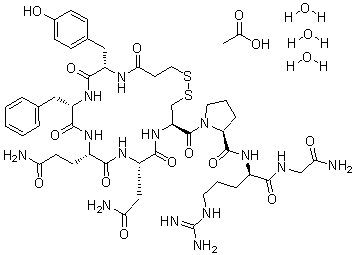
Desmopressin acetate, the acetate salt of desmopressin (also known as DDAVP), is a synthetic octapeptide and an analogue of the human antidiuretic hormone arginine vasopressin. Compare with vasopressin, Desmopressin has improved pharmacokinetics such as prolonged half life and better pharmacodynamics such as higher selectivity for the V2 membrane receptor. Vasopressin is a hormone that reduces the production of urine and desmopressin is a synthetic version for vasopressin. The antidiuretic properties of desmopressin have led to its use in polyuric conditions including primary nocturnal enuresis, nocturia, and diabetes insipidus. Desmopressin works by limiting the amount of water eliminated in the urine. Desmopressin binds to V2 receptors in renal collecting ducts, increasing water reabsorption. It also stimulates release of von Willebrand factor from endothelial cells by acting on the V2 receptor. Desmopressin is most frequently prescribed for treatment of diabetes insipidus or nocturnal enuresis.
Physicochemical Properties
| Molecular Formula | C46H64N14O12S2.C2H4O2.3[H2O] |
| Molecular Weight | 1183.31476 |
| Exact Mass | 1182.48 |
| CAS # | 62357-86-2 |
| Related CAS # | 62357-86-2 (acetate trihydrate);69-25-0;62288-83-9 (acetate);16679-58-6; 16679-58-6; |
| PubChem CID | 46783812 |
| Appearance | Typically exists as solid at room temperature |
| LogP | 1.421 |
| Hydrogen Bond Donor Count | 17 |
| Hydrogen Bond Acceptor Count | 20 |
| Rotatable Bond Count | 19 |
| Heavy Atom Count | 81 |
| Complexity | 2070 |
| Defined Atom Stereocenter Count | 7 |
| SMILES | N/C(=N/CCCC(NC(C1CCCN1C(C1CSSCCC(=O)NC(CC2C=CC(O)=CC=2)C(=O)NC(CC2C=CC=CC=2)C(=O)NC(CCC(=O)N)C(=O)NC(CC(=O)N)C(=O)N1)=O)=O)C(NCC(=O)N)=O)/N |
| InChi Key | YNKFCNRZZPFMEX-XHPDKPNGSA-N |
| InChi Code | InChI=1S/C46H64N14O12S2.C2H4O2.3H2O/c47-35(62)15-14-29-40(67)58-32(22-36(48)63)43(70)59-33(45(72)60-18-5-9-34(60)44(71)56-28(8-4-17-52-46(50)51)39(66)53-23-37(49)64)24-74-73-19-16-38(65)54-30(21-26-10-12-27(61)13-11-26)41(68)57-31(42(69)55-29)20-25-6-2-1-3-7-25;1-2(3)4;;;/h1-3,6-7,10-13,28-34,61H,4-5,8-9,14-24H2,(H2,47,62)(H2,48,63)(H2,49,64)(H,53,66)(H,54,65)(H,55,69)(H,56,71)(H,57,68)(H,58,67)(H,59,70)(H4,50,51,52);1H3,(H,3,4);3*1H2/t28-,29+,30+,31+,32+,33+,34+;;;;/m1..../s1 |
| Chemical Name | acetic acid;(2S)-N-[(2R)-1-[(2-amino-2-oxoethyl)amino]-5-(diaminomethylideneamino)-1-oxopentan-2-yl]-1-[(4R,7S,10S,13S,16S)-7-(2-amino-2-oxoethyl)-10-(3-amino-3-oxopropyl)-13-benzyl-16-[(4-hydroxyphenyl)methyl]-6,9,12,15,18-pentaoxo-1,2-dithia-5,8,11,14,17-pentazacycloicosane-4-carbonyl]pyrrolidine-2-carboxamide;trihydrate |
| Synonyms | DDAVP; Adiuretin; Deamino Arginine Vasopressin; Desmogalen; Vasopressin 1-Desamino-8-arginine |
| HS Tariff Code | 2934.99.9001 |
| Storage |
Powder-20°C 3 years 4°C 2 years In solvent -80°C 6 months -20°C 1 month |
| Shipping Condition | Room temperature (This product is stable at ambient temperature for a few days during ordinary shipping and time spent in Customs) |
Biological Activity
| ln Vitro |
|
||
| ln Vivo |
|
||
| Animal Protocol |
|
||
| References | Thromb Haemost.2010 Nov;104(5):984-9;Curr Pharm Biotechnol.2011 Nov;12(11):1974-80. | ||
| Additional Infomation |
Desmopressin acetate trihydrate is the trihydrate of the acetic acid salt of desmopressin. An antidiuretic, it increases urine concentration and decreases urine production, and is used to prevent and control excessive thirst, urination, and dehydration caused by injury, surgery, and certain medical conditions. It is also used in the diagnosis and treatment of cranial diabetes insipidus and in tests of renal function. It contains a desmopressin acetate (anhydrous). Desmopressin Acetate is an analogue of the hormone vasopressin with antidiuretic and antihemorrhagic properties. Desmopressin acetate has selective affinity for the V2 receptor and acts on the distal kidney tubule by increasing the cellular permeability thereby stimulating water reabsorption. This antidiuretic agent is used in the treatment of central diabetes insipidus. An unrelated action of desmopressin acetate is to increases circulating factor VIII and is used in patients with haemophilia and von Willebrand's disease. A synthetic analog of the pituitary hormone, ARGININE VASOPRESSIN. Its action is mediated by the VASOPRESSIN receptor V2. It has prolonged antidiuretic activity, but little pressor effects. It also modulates levels of circulating FACTOR VIII and VON WILLEBRAND FACTOR. See also: Desmopressin Acetate (annotation moved to). |
Solubility Data
| Solubility (In Vitro) |
|
|||
| Solubility (In Vivo) |
Note: Listed below are some common formulations that may be used to formulate products with low water solubility (e.g. < 1 mg/mL), you may test these formulations using a minute amount of products to avoid loss of samples. Injection Formulations (e.g. IP/IV/IM/SC) Injection Formulation 1: DMSO : Tween 80: Saline = 10 : 5 : 85 (i.e. 100 μL DMSO stock solution → 50 μL Tween 80 → 850 μL Saline) *Preparation of saline: Dissolve 0.9 g of sodium chloride in 100 mL ddH ₂ O to obtain a clear solution. Injection Formulation 2: DMSO : PEG300 :Tween 80 : Saline = 10 : 40 : 5 : 45 (i.e. 100 μL DMSO → 400 μLPEG300 → 50 μL Tween 80 → 450 μL Saline) Injection Formulation 3: DMSO : Corn oil = 10 : 90 (i.e. 100 μL DMSO → 900 μL Corn oil) Example: Take the Injection Formulation 3 (DMSO : Corn oil = 10 : 90) as an example, if 1 mL of 2.5 mg/mL working solution is to be prepared, you can take 100 μL 25 mg/mL DMSO stock solution and add to 900 μL corn oil, mix well to obtain a clear or suspension solution (2.5 mg/mL, ready for use in animals). Injection Formulation 4: DMSO : 20% SBE-β-CD in saline = 10 : 90 [i.e. 100 μL DMSO → 900 μL (20% SBE-β-CD in saline)] *Preparation of 20% SBE-β-CD in Saline (4°C,1 week): Dissolve 2 g SBE-β-CD in 10 mL saline to obtain a clear solution. Injection Formulation 5: 2-Hydroxypropyl-β-cyclodextrin : Saline = 50 : 50 (i.e. 500 μL 2-Hydroxypropyl-β-cyclodextrin → 500 μL Saline) Injection Formulation 6: DMSO : PEG300 : castor oil : Saline = 5 : 10 : 20 : 65 (i.e. 50 μL DMSO → 100 μLPEG300 → 200 μL castor oil → 650 μL Saline) Injection Formulation 7: Ethanol : Cremophor : Saline = 10: 10 : 80 (i.e. 100 μL Ethanol → 100 μL Cremophor → 800 μL Saline) Injection Formulation 8: Dissolve in Cremophor/Ethanol (50 : 50), then diluted by Saline Injection Formulation 9: EtOH : Corn oil = 10 : 90 (i.e. 100 μL EtOH → 900 μL Corn oil) Injection Formulation 10: EtOH : PEG300:Tween 80 : Saline = 10 : 40 : 5 : 45 (i.e. 100 μL EtOH → 400 μLPEG300 → 50 μL Tween 80 → 450 μL Saline) Oral Formulations Oral Formulation 1: Suspend in 0.5% CMC Na (carboxymethylcellulose sodium) Oral Formulation 2: Suspend in 0.5% Carboxymethyl cellulose Example: Take the Oral Formulation 1 (Suspend in 0.5% CMC Na) as an example, if 100 mL of 2.5 mg/mL working solution is to be prepared, you can first prepare 0.5% CMC Na solution by measuring 0.5 g CMC Na and dissolve it in 100 mL ddH2O to obtain a clear solution; then add 250 mg of the product to 100 mL 0.5% CMC Na solution, to make the suspension solution (2.5 mg/mL, ready for use in animals). Oral Formulation 3: Dissolved in PEG400 Oral Formulation 4: Suspend in 0.2% Carboxymethyl cellulose Oral Formulation 5: Dissolve in 0.25% Tween 80 and 0.5% Carboxymethyl cellulose Oral Formulation 6: Mixing with food powders Note: Please be aware that the above formulations are for reference only. InvivoChem strongly recommends customers to read literature methods/protocols carefully before determining which formulation you should use for in vivo studies, as different compounds have different solubility properties and have to be formulated differently. (Please use freshly prepared in vivo formulations for optimal results.) |
| Preparing Stock Solutions | 1 mg | 5 mg | 10 mg | |
| 1 mM | 0.8451 mL | 4.2254 mL | 8.4508 mL | |
| 5 mM | 0.1690 mL | 0.8451 mL | 1.6902 mL | |
| 10 mM | 0.0845 mL | 0.4225 mL | 0.8451 mL |