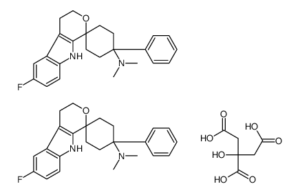
Cebranopadol hemicitrate, the hemicitrate salt of Cebranopadol (also known as GRT-6005), is a novel, first in class compound with potent agonist activity on ORL-1 (opioid receptor like -1) and the well established mu opioid receptor. Cebranopadol is an analgesic nociceptin/orphanin FQ peptide (NOP) that exhibits high potency and efficacy in several rat models of acute and chronic pain (tail-flick, rheumatoid arthritis, bone cancer, spinal nerve ligation, diabetic neuropathy) with ED50 values of 0.5-5.6 µg/kg after intravenous and 25.1 µg/kg after oral administration. It is being evaluated in clinical Phase 2 and Phase 3 trials for the treatment of chronic and acute pain. Recent evidence indicates that the combination of opioid and NOP receptor agonism may be a new treatment strategy for cocaine addiction.
Physicochemical Properties
| Molecular Formula | C54H62F2N4O9 |
| Molecular Weight | 949.088302135468 |
| Exact Mass | 948.448 |
| Elemental Analysis | C, 68.34; H, 6.58; F, 4.00; N, 5.90; O, 15.17 |
| CAS # | 863513-92-2 |
| Related CAS # | 863513-91-1 (free); 863513-93-3 ((1α,4α)stereoisomer) |
| PubChem CID | 24765715 |
| Appearance | Typically exists as solid at room temperature |
| LogP | 8.963 |
| Hydrogen Bond Donor Count | 6 |
| Hydrogen Bond Acceptor Count | 13 |
| Rotatable Bond Count | 9 |
| Heavy Atom Count | 69 |
| Complexity | 780 |
| Defined Atom Stereocenter Count | 0 |
| SMILES | FC1C=CC2=C(C=1)C1CCOC3(C=1N2)CCC(C1C=CC=CC=1)(CC3)N(C)C.FC1C=CC2=C(C=1)C1CCOC3(C=1N2)CCC(C1C=CC=CC=1)(CC3)N(C)C.OC(C(=O)O)(CC(=O)O)CC(=O)O |
| InChi Key | QNIWUQOXLTXKTG-UHFFFAOYSA-N |
| InChi Code | InChI=1S/2C24H27FN2O.C6H8O7/c2*1-27(2)23(17-6-4-3-5-7-17)11-13-24(14-12-23)22-19(10-15-28-24)20-16-18(25)8-9-21(20)26-22;7-3(8)1-6(13,5(11)12)2-4(9)10/h2*3-9,16,26H,10-15H2,1-2H3;13H,1-2H2,(H,7,8)(H,9,10)(H,11,12) |
| Chemical Name | 6-fluoro-N,N-dimethyl-1'-phenylspiro[4,9-dihydro-3H-pyrano[3,4-b]indole-1,4'-cyclohexane]-1'-amine;2-hydroxypropane-1,2,3-tricarboxylic acid |
| Synonyms | Cebranopadol;GRT6005 hemicitrate; GRT 6005 hemicitrate; GRT-6005 hemicitrate; Cebranopadol hemicitrate; Cebranopadol hemicitrate; 863513-92-2; UNII-S5PYO26J10; S5PYO26J10; 6-fluoro-N,N-dimethyl-1'-phenylspiro[4,9-dihydro-3H-pyrano[3,4-b]indole-1,4'-cyclohexane]-1'-amine;2-hydroxypropane-1,2,3-tricarboxylic acid; GRT-6005 HEMICITRATE; SB16532; Q27288688; GRT-6005; GRT 6005; GRT6005; |
| HS Tariff Code | 2934.99.9001 |
| Storage |
Powder-20°C 3 years 4°C 2 years In solvent -80°C 6 months -20°C 1 month |
| Shipping Condition | Room temperature (This product is stable at ambient temperature for a few days during ordinary shipping and time spent in Customs) |
Biological Activity
| Targets |
ORL-1 (opioid receptor like -1); mu opioid receptor; hNOP receptor (EC50 = 13 nM); hMOP receptor (EC50 = 1.2 nM); hKOP receptor (EC50 = 17 nM); hDOP receptor (EC50 = 110 nM)
Cebranopadol hemicitrate (Cebranopadol): human nociceptin/orphanin FQ peptide (NOP) receptor (Ki=0.9 nM, EC50=13.0 nM, relative efficacy=89%); human mu-opioid peptide (MOP) receptor (Ki=0.7 nM, EC50=1.2 nM, relative efficacy=104%); human kappa-opioid peptide receptor (Ki=2.6 nM, EC50=17 nM, relative efficacy=67%); human delta-opioid peptide receptor (Ki=18 nM, EC50=110 nM, relative efficacy=105%) [1] |
||
| ln Vitro |
In vitro activity: Cebranopadol (also known as GRT-6005) is a novel, first in class compound with potent agonist activity on ORL-1 (opioid receptor like -1) and the well established mu opioid receptor. Cebranopadol is an analgesic nociceptin/orphanin FQ peptide (NOP) that exhibits high potency and efficacy in several rat models of acute and chronic pain (tail-flick, rheumatoid arthritis, bone cancer, spinal nerve ligation, diabetic neuropathy) with ED50 values of 0.5-5.6 µg/kg after intravenous and 25.1 µg/kg after oral administration. It is being evaluated in clinical Phase 2 and Phase 3 trials for the treatment of chronic and acute pain. Recent evidence indicates that the combination of opioid and NOP receptor agonism may be a new treatment strategy for cocaine addiction. Kinase Assay: Human MOP, DOP, KOP, and NOP receptor binding assays were run in microtiter plates (Costar 3632; Corning Life Sciences, Tewksbury, MA) with wheat germ agglutinin-coated scintillation proximity assay beads. Cell membrane preparations of Chinese hamster ovary K1 cells transfected with the human MOP receptor (Art.-No. RBHOMM, lot-No. 307-065-A) or the human DOP receptor (Art.-No. RBHODM, lot-No. 423-553-B), and human embryonic kidney cell line 293 cells transfected with the human NOP receptor (Art.-No. RBHORLM, lot-No. 1956) or the human KOP receptor (Art.-No. 6110558, lot-No. 295-769-A) were purchased from PerkinElmer Life and Analytical Sciences. [N-allyl-2,3-3H]naloxone and [tyrosyl-3,5-3H]deltorphin II (both purchased from PerkinElmer Life and Analytical Sciences), [3H]Ci-977, and [leucyl-3H]nociceptin] were used as ligands for the MOP, DOP, KOP, and NOP receptor binding studies, respectively. Cell Assay: To test the agonistic activity of cebranopadol on human recombinant MOP, DOP, or NOP receptor-expressing cell membranes from Chinese hamster ovary K1 cells, or KOP receptor-expressing cell membranes from human embryonic kidney cell line 293 cells, 10 µg of membrane proteins per assay was incubated with 0.4 nM [35S]GTPγS and different concentrations of agonists in buffer containing 20 mM HEPES (pH 7.4), 100 mM NaCl, 10 mM MgCl2, 1 mM EDTA, 1 mM dithiothreitol, 1.28 mM NaN3, and 10 µM guanosine diphosphate for 45 minutes at 25°C. The bound radioactivity was determined as previously described. 1. Cebranopadol acts as a potent agonist at both human NOP and opioid receptors (MOP, kappa, delta), with high binding affinity (Ki values ranging from 0.7 to 18 nM) and varying levels of functional activation (EC50 values from 1.2 to 110 nM, relative efficacy from 67% to 105%) [1] |
||
| ln Vivo |
Behavioral studies in pain models and pharmacokinetic evaluations were conducted in Sprague-Dawley rats (weight range 134−423 g; tail-flick model; bone cancer model:; all other pain models and pharmacokinetics); male rats were used for most of the experiments, except for the tail-flick and bone cancer models, for which female Sprague-Dawley rats were used. Studies in side effect models were conducted in male Wistar rats (weight range 150−375 g). Rats were housed under standard conditions (room temperature 20−24°C, 12 hour light/dark cycle, relative air humidity 35−70%, 10−15 air changes per hour, air movement<0.2 m/s) with food and water available ad libitum in the home cage. Animals were used only once in all in vivo models, except for models of mononeuropathy, for which they were tested repeatedly with a washout period of at least 1 week between tests. Apart from the exceptions mentioned below, animal testing was performed in accordance with the recommendations and policies of the International Association for the Study of Pain and the German Animal Welfare Law. All study protocols were approved by the local government committee for animal research, which is advised by an independent ethics committee. Animals were assigned randomly to treatment groups. Different doses and vehicles were tested in a randomized fashion. Although the operators performing the behavioral tests were not formally ''''blinded'''' with respect to the treatment, they were not aware of the study hypothesis or the nature of differences between drugs. 1. In rat models of acute and chronic pain (tail-flick, rheumatoid arthritis, bone cancer, spinal nerve ligation, diabetic neuropathy), Cebranopadol exhibited potent antinociceptive and antihypersensitive effects with ED50 values of 0.5–5.6 µg/kg (intravenous) and 25.1 µg/kg (oral administration); it was more potent in chronic neuropathic pain models than acute nociceptive pain models compared with selective MOP receptor agonists [1] 2. Cebranopadol had a long duration of action: up to 7 hours after intravenous administration of 12 µg/kg and >9 hours after oral administration of 55 µg/kg in the rat tail-flick test [1] 3. Pretreatment with the selective NOP receptor antagonist J-113397 or the opioid receptor antagonist naloxone partially reversed the antihypersensitive activity of Cebranopadol in the spinal nerve ligation model, confirming the involvement of both NOP and opioid receptor agonism [1] 4. In the chronic constriction injury model, the development of analgesic tolerance to Cebranopadol was delayed (complete tolerance on day 26) compared with an equianalgesic dose of morphine (complete tolerance on day 11) [1] 5. Oral administration of Cebranopadol (25 and 50 μg/kg) reversed the escalation of cocaine self-administration (0.5 mg/kg/infusion) in rats with extended (6-hour) access to cocaine, but did not affect the self-administration of sweetened condensed milk (SCM) [2] 6. Cebranopadol induced conditioned place preference in rats but did not affect locomotor activity during conditioning sessions [2] 7. Cebranopadol (50 μg/kg, oral) blocked the conditioned reinstatement of cocaine seeking in rats, while the 25 μg/kg dose had a weaker effect [2] |
||
| Enzyme Assay |
Cebranopadol (trans-6'-fluoro-4',9'-dihydro-N,N-dimethyl-4-phenyl-spiro[cyclohexane-1,1'(3'H)-pyrano[3,4-b]indol]-4-amine) is a novel analgesic nociceptin/orphanin FQ peptide (NOP) and opioid receptor agonist [Ki (nM)/EC50 (nM)/relative efficacy (%): human NOP receptor 0.9/13.0/89; human mu-opioid peptide (MOP) receptor 0.7/1.2/104; human kappa-opioid peptide receptor 2.6/17/67; human delta-opioid peptide receptor 18/110/105].[1] Human MOP, DOP, KOP, and NOP receptor binding assays were run in microtiter plates with wheat germ agglutinin-coated scintillation proximity assay beads. [N-allyl-2,3-3H]naloxone and [tyrosyl-3,5-3H]deltorphin II, [3H]Ci-977, and [leucyl-3H]nociceptin were used as ligands for the MOP, DOP, KOP, and NOP receptor binding studies, respectively. The KD values of the radioligands used for the calculation of Ki values were provided as supplemental information. The assay buffer used for the MOP, DOP, and KOP receptor binding studies was 50 mM Tris-HCl (pH 7.4) supplemented with 0.052 mg/mL bovine serum albumin. For the NOP receptor binding studies, the assay buffer used was 50 mM HEPES, 10 mM MgCl2, 1 mM EDTA (pH 7.4). The final assay volume of 250 μL/well included 1 nM [3H]naloxone, 1 nM [3H]deltorphin II, 1 nM [3H]Ci-977, or 0.5 nM [3H]nociceptin as a ligand and cebranopadol in dilution series. Cebranopadol was diluted with 25% DMSO in water to yield a final 0.5% DMSO concentration, which also served as a respective vehicle control. Assays were started by the addition of beads (1 mg beads/well), which had been preloaded for 15 minutes at room temperature with 23.4 μg of human MOP membranes, 12.5 μg of human DOP membrane, 45 μg of human KOP membranes, or 25.4 µg of human NOP membranes per 250 µL of final assay volume. After short mixing, the assays were run for 90 minutes at room temperature. The microtiter plates were then centrifuged for 20 minutes at 500 rpm, and the signal rate was measured by means of a 1450 MicroBeta Trilux. IC50 values reflecting 50% displacement of [3H]naloxone-, [3H]deltorphin II-, [3H]Ci-977-, or [3H]nociceptin-specific receptor binding were calculated by nonlinear regression analysis. Individual experiments were run in duplicate and were repeated three times in independent experiments[1]. 1. To determine the binding affinity of Cebranopadol to human NOP and opioid receptors (MOP, kappa, delta), radioligand binding assays were performed; the Ki values were calculated to reflect the affinity of the drug for each receptor subtype, with lower values indicating stronger binding [1] 2. Functional activity assays were conducted to measure the efficacy and potency of Cebranopadol at activating human NOP and opioid receptors; EC50 values (concentration for 50% maximal effect) and relative efficacy (compared with full agonists) were determined to characterize the drug’s agonistic activity at each receptor [1] |
||
| Cell Assay |
Cebranopadol was tested for its agonistic activity on human recombinant MOP, DOP, or NOP receptor-expressing cell membranes from Chinese hamster ovary K1 cells, or KOP receptor-expressing cell membranes from human embryonic kidney cell line 293 cells. For each assay, 10 µg of membrane proteins was incubated for 45 minutes at 25°C with 0.4 nM [35S]GTPγS and various concentrations of agonists in a buffer containing 20 mM HEPES (pH 7.4), 100 mM NaCl, 10 mM MgCl2, 1 mM EDTA, 1 mM dithiothreitol, 1.28 mM NaN3, and 10 µM guanosine diphosphate. The bound radioactivity was calculated using the methods previously mentioned. 1. Mammalian cell lines expressing human NOP, MOP, kappa, and delta opioid receptors (including CHO cells) were used to evaluate the receptor-binding and functional activation properties of Cebranopadol; the cells were incubated with varying concentrations of Cebranopadol, and receptor activation was measured using functional readouts to calculate EC50 and relative efficacy [1] |
||
| Animal Protocol |
|
||
| Toxicity/Toxicokinetics |
1. Unlike morphine, Cebranopadol did not disrupt motor coordination or respiration in rats at doses within and exceeding the analgesic dose range [1] 2. The development of analgesic tolerance to Cebranopadol was significantly delayed compared with morphine in the chronic constriction injury model, indicating a more favorable tolerance profile [1] |
||
| References |
[1]. J Pharmacol Exp Ther. 2014 Jun;349(3):535-48. [2]. J Pharmacol Exp Ther. 2017 Sep;362(3):378-384. |
||
| Additional Infomation |
Cebranopadol (trans-6'-fluoro-4',9'-dihydro-N,N-dimethyl-4-phenyl-spiro[cyclohexane-1,1'(3'H)-pyrano[3,4-b]indol]-4-amine) is a novel analgesic nociceptin/orphanin FQ peptide (NOP) and opioid receptor agonist [Ki (nM)/EC50 (nM)/relative efficacy (%): human NOP receptor 0.9/13.0/89; human mu-opioid peptide (MOP) receptor 0.7/1.2/104; human kappa-opioid peptide receptor 2.6/17/67; human delta-opioid peptide receptor 18/110/105]. Cebranopadol exhibits highly potent and efficacious antinociceptive and antihypersensitive effects in several rat models of acute and chronic pain (tail-flick, rheumatoid arthritis, bone cancer, spinal nerve ligation, diabetic neuropathy) with ED50 values of 0.5-5.6 µg/kg after intravenous and 25.1 µg/kg after oral administration. In comparison with selective MOP receptor agonists, cebranopadol was more potent in models of chronic neuropathic than acute nociceptive pain. Cebranopadol's duration of action is long (up to 7 hours after intravenous 12 µg/kg; >9 hours after oral 55 µg/kg in the rat tail-flick test). The antihypersensitive activity of cebranopadol in the spinal nerve ligation model was partially reversed by pretreatment with the selective NOP receptor antagonist J-113397[1-[(3R,4R)-1-cyclooctylmethyl-3-hydroxymethyl-4-piperidyl]-3-ethyl-1,3-dihydro-2H-benzimidazol-2-one] or the opioid receptor antagonist naloxone, indicating that both NOP and opioid receptor agonism are involved in this activity. Development of analgesic tolerance in the chronic constriction injury model was clearly delayed compared with that from an equianalgesic dose of morphine (complete tolerance on day 26 versus day 11, respectively). Unlike morphine, cebranopadol did not disrupt motor coordination and respiration at doses within and exceeding the analgesic dose range. Cebranopadol, by its combination of agonism at NOP and opioid receptors, affords highly potent and efficacious analgesia in various pain models with a favorable side effect profile.[1] \n\nCebranopadol is a novel agonist of nociceptin/orphanin FQ peptide (NOP) and opioid receptors with analgesic properties that is being evaluated in clinical Phase 2 and Phase 3 trials for the treatment of chronic and acute pain. Recent evidence indicates that the combination of opioid and NOP receptor agonism may be a new treatment strategy for cocaine addiction. We sought to extend these findings by examining the effects of cebranopadol on cocaine self-administration (0.5 mg/kg/infusion) and cocaine conditioned reinstatement in rats with extended access to cocaine. Oral administration of cebranopadol (0, 25, and 50 μg/kg) reversed the escalation of cocaine self-administration in rats that were given extended (6 hour) access to cocaine, whereas it did not affect the self-administration of sweetened condensed milk (SCM). Cebranopadol induced conditioned place preference but did not affect locomotor activity during the conditioning sessions. Finally, cebranopadol blocked the conditioned reinstatement of cocaine seeking. These results show that oral cebranopadol treatment prevented addiction-like behaviors (i.e., the escalation of intake and reinstatement), suggesting that it may be a novel strategy for the treatment of cocaine use disorder. However, the conditioned place preference that was observed after cebranopadol administration suggests that this compound may have some intrinsic rewarding effects.[2] \n\nOne limitation of the present study was the lack of full characterization of the pharmacokinetics and pharmacodynamics of cebranopadol. We also did not evaluate the effects of cebranopadol on the pharmacokinetics of cocaine. However, we do not believe that the reduction of cocaine escalation was related to possible pharmacokinetic effects on blood cocaine levels because cebranopadol effectively reduced conditioned reinstatement. In this case, cocaine was unavailable, thus excluding possible effects on blood cocaine levels. We also did not identify shifts in the dose-response curve or specific receptors that mediate its preclinical efficacy. Follow-up studies are needed to fully characterize the reinforcing properties and possible abuse potential of cebranopadol, particularly considering that we found that cebranopadol produced conditioned place preference. However, although such characterization studies are important from a theoretical perspective to understand the precise mechanisms of action and facilitate medication development, cebranopadol has already been shown to be well tolerated in humans and is already being tested in several clinical trials for the treatment of pain.\n\nIn summary, the present study provides preclinical evidence of the efficacy of cebranopadol in reversing compulsive-like responding for cocaine and cue-induced reinstatement of cocaine seeking. Cebranopadol may be a new therapeutic option for the prevention of cocaine abuse and relapse.[2] 1. Cebranopadol has the chemical name trans-6'-fluoro-4',9'-dihydro-N,N-dimethyl-4-phenyl-spiro[cyclohexane-1,1'(3'H)-pyrano[3,4-b]indol]-4-amine and is a novel analgesic acting as a dual agonist of NOP and opioid receptors [1] 2. Cebranopadol was being evaluated in clinical Phase 2 and Phase 3 trials for the treatment of chronic and acute pain at the time of the second study [2] 3. The combination of NOP and opioid receptor agonism by Cebranopadol suggests it may be a novel strategy for the treatment of cocaine use disorder, although it exhibits intrinsic rewarding effects (conditioned place preference) in rats [2] |
Solubility Data
| Solubility (In Vitro) |
|
|||
| Solubility (In Vivo) |
Note: Listed below are some common formulations that may be used to formulate products with low water solubility (e.g. < 1 mg/mL), you may test these formulations using a minute amount of products to avoid loss of samples. Injection Formulations (e.g. IP/IV/IM/SC) Injection Formulation 1: DMSO : Tween 80: Saline = 10 : 5 : 85 (i.e. 100 μL DMSO stock solution → 50 μL Tween 80 → 850 μL Saline) *Preparation of saline: Dissolve 0.9 g of sodium chloride in 100 mL ddH ₂ O to obtain a clear solution. Injection Formulation 2: DMSO : PEG300 :Tween 80 : Saline = 10 : 40 : 5 : 45 (i.e. 100 μL DMSO → 400 μLPEG300 → 50 μL Tween 80 → 450 μL Saline) Injection Formulation 3: DMSO : Corn oil = 10 : 90 (i.e. 100 μL DMSO → 900 μL Corn oil) Example: Take the Injection Formulation 3 (DMSO : Corn oil = 10 : 90) as an example, if 1 mL of 2.5 mg/mL working solution is to be prepared, you can take 100 μL 25 mg/mL DMSO stock solution and add to 900 μL corn oil, mix well to obtain a clear or suspension solution (2.5 mg/mL, ready for use in animals). Injection Formulation 4: DMSO : 20% SBE-β-CD in saline = 10 : 90 [i.e. 100 μL DMSO → 900 μL (20% SBE-β-CD in saline)] *Preparation of 20% SBE-β-CD in Saline (4°C,1 week): Dissolve 2 g SBE-β-CD in 10 mL saline to obtain a clear solution. Injection Formulation 5: 2-Hydroxypropyl-β-cyclodextrin : Saline = 50 : 50 (i.e. 500 μL 2-Hydroxypropyl-β-cyclodextrin → 500 μL Saline) Injection Formulation 6: DMSO : PEG300 : castor oil : Saline = 5 : 10 : 20 : 65 (i.e. 50 μL DMSO → 100 μLPEG300 → 200 μL castor oil → 650 μL Saline) Injection Formulation 7: Ethanol : Cremophor : Saline = 10: 10 : 80 (i.e. 100 μL Ethanol → 100 μL Cremophor → 800 μL Saline) Injection Formulation 8: Dissolve in Cremophor/Ethanol (50 : 50), then diluted by Saline Injection Formulation 9: EtOH : Corn oil = 10 : 90 (i.e. 100 μL EtOH → 900 μL Corn oil) Injection Formulation 10: EtOH : PEG300:Tween 80 : Saline = 10 : 40 : 5 : 45 (i.e. 100 μL EtOH → 400 μLPEG300 → 50 μL Tween 80 → 450 μL Saline) Oral Formulations Oral Formulation 1: Suspend in 0.5% CMC Na (carboxymethylcellulose sodium) Oral Formulation 2: Suspend in 0.5% Carboxymethyl cellulose Example: Take the Oral Formulation 1 (Suspend in 0.5% CMC Na) as an example, if 100 mL of 2.5 mg/mL working solution is to be prepared, you can first prepare 0.5% CMC Na solution by measuring 0.5 g CMC Na and dissolve it in 100 mL ddH2O to obtain a clear solution; then add 250 mg of the product to 100 mL 0.5% CMC Na solution, to make the suspension solution (2.5 mg/mL, ready for use in animals). Oral Formulation 3: Dissolved in PEG400 Oral Formulation 4: Suspend in 0.2% Carboxymethyl cellulose Oral Formulation 5: Dissolve in 0.25% Tween 80 and 0.5% Carboxymethyl cellulose Oral Formulation 6: Mixing with food powders Note: Please be aware that the above formulations are for reference only. InvivoChem strongly recommends customers to read literature methods/protocols carefully before determining which formulation you should use for in vivo studies, as different compounds have different solubility properties and have to be formulated differently. (Please use freshly prepared in vivo formulations for optimal results.) |
| Preparing Stock Solutions | 1 mg | 5 mg | 10 mg | |
| 1 mM | 1.0536 mL | 5.2682 mL | 10.5364 mL | |
| 5 mM | 0.2107 mL | 1.0536 mL | 2.1073 mL | |
| 10 mM | 0.1054 mL | 0.5268 mL | 1.0536 mL |