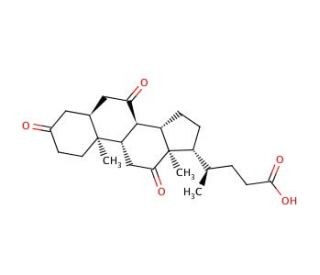
Dehydrocholic Acid (3,7,12-Trioxo-5β-cholanic acid 5β-Cholanic acid-3,5,12-trione) is a bile acid used in the production of chenodeoxycholic acid by bioconversion.
Physicochemical Properties
| Molecular Formula | C24H34O5 |
| Molecular Weight | 402.5238 |
| Exact Mass | 402.24 |
| CAS # | 81-23-2 |
| Related CAS # | 81-23-2 (acid);145-41-5 (sodium); |
| PubChem CID | 6674 |
| Appearance | White to off-white solid powder |
| Density | 1.2±0.1 g/cm3 |
| Boiling Point | 581.5±50.0 °C at 760 mmHg |
| Melting Point | 238-240 °C |
| Flash Point | 319.5±26.6 °C |
| Vapour Pressure | 0.0±3.5 mmHg at 25°C |
| Index of Refraction | 1.535 |
| LogP | 1.77 |
| Hydrogen Bond Donor Count | 1 |
| Hydrogen Bond Acceptor Count | 5 |
| Rotatable Bond Count | 4 |
| Heavy Atom Count | 29 |
| Complexity | 756 |
| Defined Atom Stereocenter Count | 8 |
| SMILES | O=C1C[C@@H]2CC(CC[C@]2(C)[C@@H]2[C@@H]1[C@@H]1CC[C@H]([C@H](C)CCC(=O)O)[C@]1(C(C2)=O)C)=O |
| InChi Key | OHXPGWPVLFPUSM-KLRNGDHRSA-N |
| InChi Code | InChI=1S/C24H34O5/c1-13(4-7-21(28)29)16-5-6-17-22-18(12-20(27)24(16,17)3)23(2)9-8-15(25)10-14(23)11-19(22)26/h13-14,16-18,22H,4-12H2,1-3H3,(H,28,29)/t13-,14+,16-,17+,18+,22+,23+,24-/m1/s1 |
| Chemical Name | (4R)-4-[(5S,8R,9S,10S,13R,14S,17R)-10,13-dimethyl-3,7,12-trioxo-1,2,4,5,6,8,9,11,14,15,16,17-dodecahydrocyclopenta[a]phenanthren-17-yl]pentanoic acid |
| HS Tariff Code | 2934.99.9001 |
| Storage |
Powder-20°C 3 years 4°C 2 years In solvent -80°C 6 months -20°C 1 month |
| Shipping Condition | Room temperature (This product is stable at ambient temperature for a few days during ordinary shipping and time spent in Customs) |
Biological Activity
| ADME/Pharmacokinetics |
Absorption, Distribution and Excretion The duodenal experiment indicates that dehydrocholic acid is absorbed from the proximal small intestine. Administered dehydrocholic acid is excreted rapidly in bile as glycine- and taurine-conjugated bile acids. No pharmacokinetic data available. No pharmacokinetic data available. Metabolism / Metabolites The major site of metabolism is proposed to be the liver. The major metabolite accounting for 70% of total detectable metabolites is dihydroxymonoketo bile acid (3α,7α-dihydroxy-12-keto-5β-cholanoic acid). About 20% of metabolites is monohydroxydiketoacid (3α-hydroxy-7,12-keto-5β-cholanoic acid) and about 10% is cholic acid. Biological Half-Life No pharmacokinetic data available. |
| Toxicity/Toxicokinetics |
Protein Binding No pharmacokinetic data available. |
| Additional Infomation |
3,7,12-trioxo-5beta-cholanic acid is an oxo-5beta-cholanic acid in which three oxo substituents are located at positions 3, 7 and 12 on the cholanic acid skeleton. It has a role as a gastrointestinal drug. It is an oxo-5beta-cholanic acid, a 7-oxo steroid, a 12-oxo steroid and a 3-oxo-5beta-steroid. It is a conjugate acid of a 3,7,12-trioxo-5beta-cholan-24-oate. Dehydrocholic acid is a synthetic bile acid that was prepared from the oxidation of cholic acid with chromic acid. It has been used for stimulation of biliary lipid secretion. The use of dehydrocholic acid in over-the-counter products has been discontinued by Health Canada. A semisynthetic bile acid made from cholic acid. It is used as a cholagogue, hydrocholeretic, diuretic, and as a diagnostic aid. Drug Indication No approved therapeutic indications. Mechanism of Action It is proposed that dehydrocholic acid induces choleresis, which is associated with biliary lipid secretion and reduced secretion of endogenous and/or exogenous biliary components. Dehydrocholic acid may decrease bile phospholipid secretion due to a lack of micelle formation by dehydrocholic acid-produced bile. A study suggests that due to enhanced permeability of tight junctions in the canalicular membranes, dehydrocholic acid facilitates direct exchange between bile and plasma. Pharmacodynamics Following infusion of dehydrocholic acid (DHCA) in rats, the secretions of all the endogenous biliary bile acids were decreased within 30-60 minutes of infusion. Phospholipid secretion as well as cholesterol levels were also declined. The bile flow was increased after administration of dehydrocholic acid. |
Solubility Data
| Solubility (In Vitro) |
DMSO : ~25 mg/mL (~62.11 mM) H2O : ~0.67 mg/mL (~1.66 mM) |
| Solubility (In Vivo) |
Solubility in Formulation 1: 2.5 mg/mL (6.21 mM) in 10% DMSO + 40% PEG300 + 5% Tween80 + 45% Saline (add these co-solvents sequentially from left to right, and one by one), suspension solution; with sonication. For example, if 1 mL of working solution is to be prepared, you can add 100 μL of 25.0 mg/mL clear DMSO stock solution to 400 μL PEG300 and mix evenly; then add 50 μL Tween-80 to the above solution and mix evenly; then add 450 μL normal saline to adjust the volume to 1 mL. Preparation of saline: Dissolve 0.9 g of sodium chloride in 100 mL ddH₂ O to obtain a clear solution. Solubility in Formulation 2: ≥ 2.5 mg/mL (6.21 mM) (saturation unknown) in 10% DMSO + 90% (20% SBE-β-CD in Saline) (add these co-solvents sequentially from left to right, and one by one), clear solution. For example, if 1 mL of working solution is to be prepared, you can add 100 μL of 25.0 mg/mL clear DMSO stock solution to 900 μL of 20% SBE-β-CD physiological saline solution and mix evenly. Preparation of 20% SBE-β-CD in Saline (4°C,1 week): Dissolve 2 g SBE-β-CD in 10 mL saline to obtain a clear solution. (Please use freshly prepared in vivo formulations for optimal results.) |
| Preparing Stock Solutions | 1 mg | 5 mg | 10 mg | |
| 1 mM | 2.4843 mL | 12.4217 mL | 24.8435 mL | |
| 5 mM | 0.4969 mL | 2.4843 mL | 4.9687 mL | |
| 10 mM | 0.2484 mL | 1.2422 mL | 2.4843 mL |