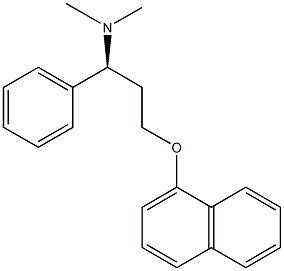
Physicochemical Properties
| Molecular Formula | MOLECULARWEIGHT |
| Molecular Weight | 305.4134 |
| Exact Mass | 305.177 |
| CAS # | 119356-77-3 |
| Related CAS # | Dapoxetine hydrochloride;129938-20-1;Dapoxetine-d7 hydrochloride;Dapoxetine-d6;1132642-58-0 |
| PubChem CID | 71353 |
| Appearance | Typically exists as solid at room temperature |
| Density | 1.1±0.1 g/cm3 |
| Boiling Point | 454.4±38.0 °C at 760 mmHg |
| Flash Point | 132.6±29.1 °C |
| Vapour Pressure | 0.0±1.1 mmHg at 25°C |
| Index of Refraction | 1.607 |
| LogP | 5.13 |
| Hydrogen Bond Donor Count | 0 |
| Hydrogen Bond Acceptor Count | 2 |
| Rotatable Bond Count | 6 |
| Heavy Atom Count | 23 |
| Complexity | 337 |
| Defined Atom Stereocenter Count | 1 |
| SMILES | O(C1=C([H])C([H])=C([H])C2=C([H])C([H])=C([H])C([H])=C12)C([H])([H])C([H])([H])[C@@]([H])(C1C([H])=C([H])C([H])=C([H])C=1[H])N(C([H])([H])[H])C([H])([H])[H] |
| InChi Key | USRHYDPUVLEVMC-FQEVSTJZSA-N |
| InChi Code | InChI=1S/C21H23NO/c1-22(2)20(18-10-4-3-5-11-18)15-16-23-21-14-8-12-17-9-6-7-13-19(17)21/h3-14,20H,15-16H2,1-2H3/t20-/m0/s1 |
| Chemical Name | (1S)-N,N-dimethyl-3-naphthalen-1-yloxy-1-phenylpropan-1-amine |
| HS Tariff Code | 2934.99.9001 |
| Storage |
Powder-20°C 3 years 4°C 2 years In solvent -80°C 6 months -20°C 1 month |
| Shipping Condition | Room temperature (This product is stable at ambient temperature for a few days during ordinary shipping and time spent in Customs) |
Biological Activity
| Targets |
Rasarfin targets Ras and ARF6 [1] |
| ln Vitro |
Dapoxetine blocks the uptake of 5-HT, norepinephrine, and dopamine by binding to the transporters that are responsible for reuptaking these chemicals. 5-HT > norepinephrine ≫ dopamine is the order of potency. Dapoxetine has an IC50 value of 202 nM for [3H] dopamine uptake and 1720 nM for [3H] norepinephrine uptake, which it inhibits via the norepinephrine reuptake transporter. Additionally, it inhibits the uptake of [3H]5-HT by the 5-HT reuptake transporter, with a value of 1.12 nM. [1] 1. Inhibits agonist-mediated internalization of GPCRs including AT1R, B2R, and β2AR at 50 μM, as detected by BRET assay and confocal microscopy [1] 2. Potently suppresses agonist-induced ERK1/2 signaling of GPCRs (AT1R, B2R, β2AR) and EGFR-mediated MAPK and Akt signaling at 50 μM, confirmed by western blot analysis [1] 3. Blocks AT1R-mediated and EGFR-mediated Ras activation, as demonstrated by GST-Raf1-RBD pull-down assays and BRET kinetics experiments at 50 μM [1] 4. Inhibits AT1R-mediated ARF6 activation, verified by GST-GGA3-PBD pull-down assays and BRET kinetics studies at 50 μM [1] 5. Reduces nucleotide exchange of purified H-Ras induced by SOS1 or EDTA in a concentration-dependent manner, measured by mant-GTP loading assays [1] 6. Prevents cancer cell proliferation [1] |
| ln Vivo | Oral Dapoxetine gavage (1–10 mg/kg; once daily) attenuates testosterone-induced prostatic hyperplasia and significantly inhibits testosterone-mediated increases in prostate weight and relative prostate weight in rats [2]. |
| Enzyme Assay |
1. Ras activation assay: GST-Raf1-RBD fusion protein is used to pull down GTP-bound Ras from cell lysates treated with or without Rasarfin (50 μM). The amount of Ras-GTP relative to total Ras is quantified by western blot to assess Ras activation inhibition [1] 2. ARF6 activation assay: GST-GGA3-PBD fusion protein is employed to pull down GTP-bound ARF6 from cell lysates exposed to Rasarfin (50 μM). Western blot is used to quantify ARF6-GTP levels relative to total ARF6 for evaluating ARF6 activation suppression [1] 3. H-Ras nucleotide exchange assay: Purified H-Ras is incubated with Rasarfin at different concentrations, followed by addition of SOS1 or EDTA to induce nucleotide exchange. mant-GTP fluorescence is measured every 30 seconds for 30 minutes to determine the inhibitory effect on H-Ras activation [1] |
| Cell Assay |
1. GPCR internalization BRET assay: Cells are transfected with GPCR (AT1R, B2R, β2AR) and endosomal trafficking sensors. After treatment with Rasarfin (50 μM) or DMSO, agonist (AngII or respective ligand) is added, and BRET signals are measured to quantify ligand-promoted receptor internalization [1] 2. β-arrestin recruitment BRET assay: Cells are transfected with AT1R and β-arrestin1/2 constructs. Rasarfin (50 μM) or DMSO is added, followed by AngII stimulation. BRET responses are recorded to assess the effect on β-arrestin recruitment to AT1R [1] 3. Western blot for signaling proteins: Cells are treated with Rasarfin (50 μM) or DMSO, then stimulated with AngII (for GPCRs) or EGF (for EGFR). Cell lysates are prepared, and western blot is performed to detect phosphorylated ERK1/2 and Akt, with total ERK1/2 and Akt as loading controls [1] 4. Confocal microscopy for cell localization: Cells transfected with YFP-tagged AT1R or β-arrestin2 are treated with Rasarfin (50 μM) or DMSO, then stimulated with AngII. Confocal images are captured to observe the internalization and localization of the receptors or β-arrestin2 [1] 5. Small GTPase activation BRET kinetics assay: Cells are transfected with constructs for AT1R and BRET sensors specific for Ras, ARF, Rho, or Rac. Rasarfin (50 μM) or DMSO is added, followed by AngII stimulation. BRET signals are recorded over time to analyze the kinetics of small GTPase activation [1] |
| Animal Protocol |
Animal/Disease Models: Adult male Wistar rat [2] Doses: 1 mg/kg, 5 mg/kg, 10 mg/kg Route of Administration: po (oral gavage); 1-10 mg/kg; one time/day Experimental Results: Testosterone injection resumed brought about most of the changes. |
| ADME/Pharmacokinetics |
Absorption, Distribution and Excretion Rapidly absorbed. Biological Half-Life Initial half-life of 1-2 hours. |
| References |
[1]. Dapoxetine, a novel selective serotonin transport inhibitor for the treatment of premature ejaculation. Ther Clin Risk Manag. 2007 Jun;3(2):277-89. [2]. Dapoxetine attenuates testosterone-induced prostatic hyperplasia in rats by the regulation of inflammatory and apoptotic proteins. Toxicol Appl Pharmacol. 2016 Nov 15;311:52-60. |
| Additional Infomation |
Dapoxetine is a member of naphthalenes. Dapoxetine is a selective serotonin reuptake inhibitor, for the treatment of premature ejaculation. In a phase II proof-of-concept study conducted by PPD, dapoxetine demonstrated a statistically significant increase in ejaculatory latency when compared to placebo. Alza submitted a NDA to the FDA for dapoxetine for the treatment of premature ejaculation in December 2004. In October 2005, the company received a FDA Non-Approvable letter from the FDA, at which time they planned to work with regulators to address outstanding questions. Drug Indication For the treatment of premature ejaculation. Mechanism of Action The drug's mechanism of action is thought to be related to inhibition of neuronal reuptake of serotonin and subsequent potentiation of serotonin activity. The central ejaculatory neural circuit comprises spinal and cerebral areas that form a highly interconnected network. The sympathetic, parasympathetic, and somatic spinal centers, under the influence of sensory genital and cerebral stimuli integrated and processed at the spinal cord level, act in synergy to command physiologic events occurring during ejaculation. Experimental evidence indicates that serotonin (5-HT), throughout brain descending pathways, exerts an inhibitory role on ejaculation. To date, three 5-HT receptor subtypes (5-HT(1A), 5-HT(1B), and 5-HT(2C)) have been postulated to mediate 5-HT's modulating activity on ejaculation. Pharmacodynamics Dapoxetine is a selective serotonin reuptake inhibitor currently undergoing trials through Alza (under license from GenuPro, a collaboration between Eli Lilly and PPD). Dapoxetine is a short-acting SSRI drug currently being considered for approval by the Food and Drug Administration (FDA) for the treatment of premature ejaculation in men, which would make it the first drug approved for such treatment. Despite two clinical trials finished in 2006, experts doubt it will be approved by the FDA soon because SSRIs come with undesirable side-effects after long-term use, such as psychiatric problems, dermatological reactions, increase in body weight, lower sex-drive, nausea, headache, upset stomach and weakness, thus not significantly outweighing the benefit of premature ejaculation medication versus the risks. By contrast with SSRIs approved for depression, which take 2 weeks or longer to reach steady-state concentration, dapoxetine has a unique pharmacokinetic profile, with a short time to maximum serum concentration (about 1 h) and rapid elimination (initial half-life of 1-2 h). 1. Rasarfin is a novel dual small G protein inhibitor identified from a high-throughput screen of ~115,000 small molecules using an endosomal BRET-based assay with AT1R [1] 2. It binds to the SOS-binding domain of Ras, occupying the cavity normally occupied by SOS residues His911 and Lys939, as revealed by in silico docking and molecular dynamics simulations [1] 3. The binding mode of Rasarfin involves interactions with Ras residues via aromatic features, hydrophobic features, hydrogen bond acceptors/donors, and a halogen bond donor [1] 4. It exhibits functional selectivity, as its analogs show varying effects on GPCR internalization, ERK1/2 activation, and H-Ras nucleotide exchange [1] 5. Rasarfin is useful for inhibiting oncogenic cellular responses by targeting both Ras and ARF6 signaling pathways [1] |
Solubility Data
| Solubility (In Vitro) | May dissolve in DMSO (in most cases), if not, try other solvents such as H2O, Ethanol, or DMF with a minute amount of products to avoid loss of samples |
| Solubility (In Vivo) |
Note: Listed below are some common formulations that may be used to formulate products with low water solubility (e.g. < 1 mg/mL), you may test these formulations using a minute amount of products to avoid loss of samples. Injection Formulations (e.g. IP/IV/IM/SC) Injection Formulation 1: DMSO : Tween 80: Saline = 10 : 5 : 85 (i.e. 100 μL DMSO stock solution → 50 μL Tween 80 → 850 μL Saline) *Preparation of saline: Dissolve 0.9 g of sodium chloride in 100 mL ddH ₂ O to obtain a clear solution. Injection Formulation 2: DMSO : PEG300 :Tween 80 : Saline = 10 : 40 : 5 : 45 (i.e. 100 μL DMSO → 400 μLPEG300 → 50 μL Tween 80 → 450 μL Saline) Injection Formulation 3: DMSO : Corn oil = 10 : 90 (i.e. 100 μL DMSO → 900 μL Corn oil) Example: Take the Injection Formulation 3 (DMSO : Corn oil = 10 : 90) as an example, if 1 mL of 2.5 mg/mL working solution is to be prepared, you can take 100 μL 25 mg/mL DMSO stock solution and add to 900 μL corn oil, mix well to obtain a clear or suspension solution (2.5 mg/mL, ready for use in animals). Injection Formulation 4: DMSO : 20% SBE-β-CD in saline = 10 : 90 [i.e. 100 μL DMSO → 900 μL (20% SBE-β-CD in saline)] *Preparation of 20% SBE-β-CD in Saline (4°C,1 week): Dissolve 2 g SBE-β-CD in 10 mL saline to obtain a clear solution. Injection Formulation 5: 2-Hydroxypropyl-β-cyclodextrin : Saline = 50 : 50 (i.e. 500 μL 2-Hydroxypropyl-β-cyclodextrin → 500 μL Saline) Injection Formulation 6: DMSO : PEG300 : castor oil : Saline = 5 : 10 : 20 : 65 (i.e. 50 μL DMSO → 100 μLPEG300 → 200 μL castor oil → 650 μL Saline) Injection Formulation 7: Ethanol : Cremophor : Saline = 10: 10 : 80 (i.e. 100 μL Ethanol → 100 μL Cremophor → 800 μL Saline) Injection Formulation 8: Dissolve in Cremophor/Ethanol (50 : 50), then diluted by Saline Injection Formulation 9: EtOH : Corn oil = 10 : 90 (i.e. 100 μL EtOH → 900 μL Corn oil) Injection Formulation 10: EtOH : PEG300:Tween 80 : Saline = 10 : 40 : 5 : 45 (i.e. 100 μL EtOH → 400 μLPEG300 → 50 μL Tween 80 → 450 μL Saline) Oral Formulations Oral Formulation 1: Suspend in 0.5% CMC Na (carboxymethylcellulose sodium) Oral Formulation 2: Suspend in 0.5% Carboxymethyl cellulose Example: Take the Oral Formulation 1 (Suspend in 0.5% CMC Na) as an example, if 100 mL of 2.5 mg/mL working solution is to be prepared, you can first prepare 0.5% CMC Na solution by measuring 0.5 g CMC Na and dissolve it in 100 mL ddH2O to obtain a clear solution; then add 250 mg of the product to 100 mL 0.5% CMC Na solution, to make the suspension solution (2.5 mg/mL, ready for use in animals). Oral Formulation 3: Dissolved in PEG400 Oral Formulation 4: Suspend in 0.2% Carboxymethyl cellulose Oral Formulation 5: Dissolve in 0.25% Tween 80 and 0.5% Carboxymethyl cellulose Oral Formulation 6: Mixing with food powders Note: Please be aware that the above formulations are for reference only. InvivoChem strongly recommends customers to read literature methods/protocols carefully before determining which formulation you should use for in vivo studies, as different compounds have different solubility properties and have to be formulated differently. (Please use freshly prepared in vivo formulations for optimal results.) |
| Preparing Stock Solutions | 1 mg | 5 mg | 10 mg | |
| 1 mM | 3.2743 mL | 16.3714 mL | 32.7429 mL | |
| 5 mM | 0.6549 mL | 3.2743 mL | 6.5486 mL | |
| 10 mM | 0.3274 mL | 1.6371 mL | 3.2743 mL |