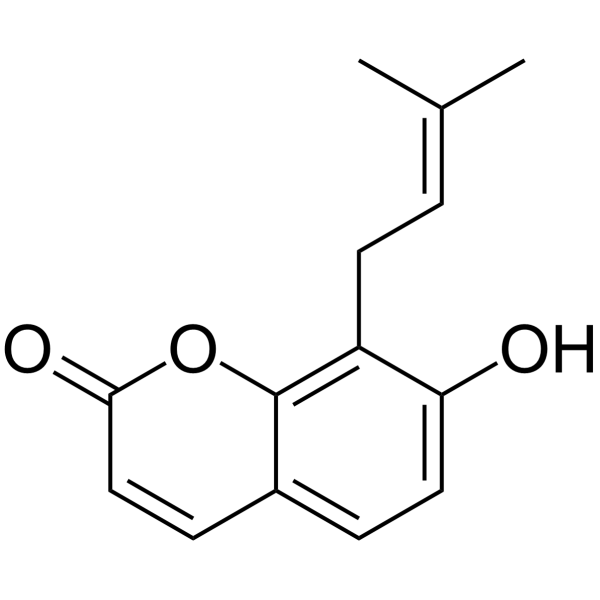
Physicochemical Properties
| Molecular Formula | C14H14O3 |
| Molecular Weight | 230.25900 |
| Exact Mass | 230.094 |
| CAS # | 484-14-0 |
| PubChem CID | 5320318 |
| Appearance | White to yellow solid powder |
| Density | 1.203g/cm3 |
| Boiling Point | 422.8ºC at 760 mmHg |
| Melting Point | 124 - 125 °C |
| Flash Point | 184.1ºC |
| Vapour Pressure | 9.53E-08mmHg at 25°C |
| Index of Refraction | 1.595 |
| LogP | 3.007 |
| Hydrogen Bond Donor Count | 1 |
| Hydrogen Bond Acceptor Count | 3 |
| Rotatable Bond Count | 2 |
| Heavy Atom Count | 17 |
| Complexity | 353 |
| Defined Atom Stereocenter Count | 0 |
| InChi Key | RAKJVIPCCGXHHS-UHFFFAOYSA-N |
| InChi Code | InChI=1S/C14H14O3/c1-9(2)3-6-11-12(15)7-4-10-5-8-13(16)17-14(10)11/h3-5,7-8,15H,6H2,1-2H3 |
| Chemical Name | 7-hydroxy-8-(3-methylbut-2-enyl)chromen-2-one |
| HS Tariff Code | 2934.99.9001 |
| Storage |
Powder-20°C 3 years 4°C 2 years In solvent -80°C 6 months -20°C 1 month |
| Shipping Condition | Room temperature (This product is stable at ambient temperature for a few days during ordinary shipping and time spent in Customs) |
Biological Activity
| Targets | The target of Osthenol is monoamine oxidase A (MAO-A), with a Ki value of 0.012 μM; it shows high selectivity for MAO-A, and the Ki value for monoamine oxidase B (MAO-B) is greater than 10 μM [1] |
| ln Vitro |
In vitro experiments showed that Osthenol exhibited significant inhibitory activity against MAO-A. At a concentration of 0.1 μM, the inhibition rate of MAO-A was more than 90%, while the inhibition rate of MAO-B was less than 10% at the same concentration, indicating high selectivity for MAO-A [1] |
| Enzyme Assay | For the MAO activity assay, the reaction system was prepared by mixing the enzyme solution (MAO-A or MAO-B), the substrate (tyramine or kynuramine), and different concentrations of Osthenol. The reaction mixture was incubated at 37°C for 30 minutes, and then the reaction was terminated by adding a stop solution. The amount of reaction product was detected by a spectrophotometer at a specific wavelength (e.g., 405 nm for tyramine metabolites), and the inhibition rate of Osthenol on MAO was calculated based on the absorbance value. The Ki value was determined by fitting the inhibition curve using the Lineweaver-Burk double reciprocal plot method [1] |
| References |
[1]. Osthenol, a prenylated coumarin, as a monoamine oxidase A inhibitor with high selectivity. Bioorg Med Chem Lett. 2019;29(6):839-843. [2]. Zhongguo Zhong Yao Za Zhi. 2017;42(15):2999-3003. |
| Additional Infomation |
Osthenol is a hydroxycoumarin that is umbelliferone in which the hydrogen at position 8 has been replaced by a prenyl group. It has a role as a plant metabolite and an antifungal agent. It is functionally related to an umbelliferone. Osthenol has been reported in Citrus sulcata, Melicope semecarpifolia, and other organisms with data available. Osthenol is a prenylated coumarin compound. Prenylated coumarins are a class of natural products with diverse biological activities, and their inhibitory effect on MAO has potential application value in the treatment of neurological diseases (such as depression) [1] This literature focuses on the research of traditional Chinese medicine components, but no additional information related to Osthenol (such as its source in traditional Chinese medicine or potential traditional medicinal uses) was clearly described [2] |
Solubility Data
| Solubility (In Vitro) | DMSO : ~100 mg/mL (~434.29 mM) |
| Solubility (In Vivo) |
Solubility in Formulation 1: 2.5 mg/mL (10.86 mM) in 10% DMSO + 40% PEG300 + 5% Tween80 + 45% Saline (add these co-solvents sequentially from left to right, and one by one), suspension solution; with sonication. For example, if 1 mL of working solution is to be prepared, you can add 100 μL of 25.0 mg/mL clear DMSO stock solution to 400 μL PEG300 and mix evenly; then add 50 μL Tween-80 to the above solution and mix evenly; then add 450 μL normal saline to adjust the volume to 1 mL. Preparation of saline: Dissolve 0.9 g of sodium chloride in 100 mL ddH₂ O to obtain a clear solution. Solubility in Formulation 2: ≥ 2.5 mg/mL (10.86 mM) (saturation unknown) in 10% DMSO + 90% (20% SBE-β-CD in Saline) (add these co-solvents sequentially from left to right, and one by one), clear solution. For example, if 1 mL of working solution is to be prepared, you can add 100 μL of 25.0 mg/mL clear DMSO stock solution to 900 μL of 20% SBE-β-CD physiological saline solution and mix evenly. Preparation of 20% SBE-β-CD in Saline (4°C,1 week): Dissolve 2 g SBE-β-CD in 10 mL saline to obtain a clear solution. Solubility in Formulation 3: ≥ 2.5 mg/mL (10.86 mM) (saturation unknown) in 10% DMSO + 90% Corn Oil (add these co-solvents sequentially from left to right, and one by one), clear solution. For example, if 1 mL of working solution is to be prepared, you can add 100 μL of 25.0 mg/mL clear DMSO stock solution to 900 μL of corn oil and mix evenly. (Please use freshly prepared in vivo formulations for optimal results.) |
| Preparing Stock Solutions | 1 mg | 5 mg | 10 mg | |
| 1 mM | 4.3429 mL | 21.7146 mL | 43.4292 mL | |
| 5 mM | 0.8686 mL | 4.3429 mL | 8.6858 mL | |
| 10 mM | 0.4343 mL | 2.1715 mL | 4.3429 mL |