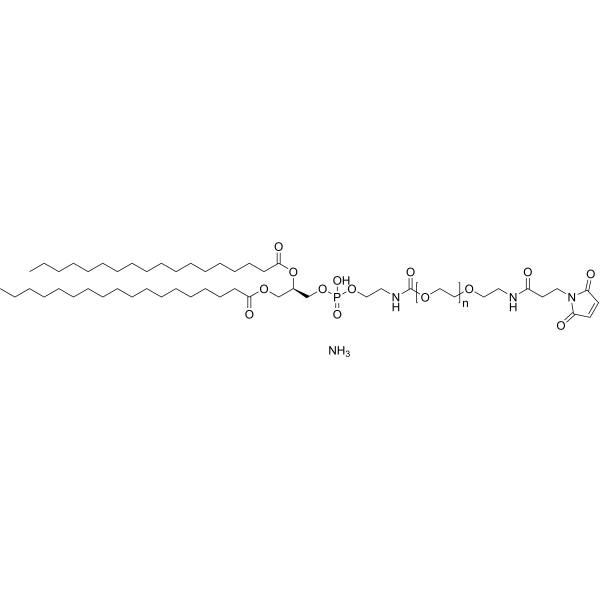
Physicochemical Properties
| Molecular Formula | (C2H4O)NC51H92N3O13P.H3N |
| Molecular Weight | 2000 |
| Exact Mass | 1046.689 |
| CAS # | 474922-22-0 |
| Related CAS # | DSPE-PEG2000-Mal ammonium;474922-22-0 |
| PubChem CID | 163341983 |
| Appearance | White to off-white solid powder |
| Hydrogen Bond Donor Count | 3 |
| Hydrogen Bond Acceptor Count | 14 |
| Rotatable Bond Count | 54 |
| Heavy Atom Count | 72 |
| Complexity | 1460 |
| Defined Atom Stereocenter Count | 0 |
| SMILES | CCCCCCCCCCCCCCCCCC(=O)OCC(COP(=O)(O)OCCNC(=O)OCCOCCNC(=O)CCN1C(=O)C=CC1=O)OC(=O)CCCCCCCCCCCCCCCCC.N |
| InChi Key | HMLYGTOVHVFLDS-UHFFFAOYSA-N |
| InChi Code | InChI=1S/C53H96N3O14P.H3N/c1-3-5-7-9-11-13-15-17-19-21-23-25-27-29-31-33-51(60)67-45-47(70-52(61)34-32-30-28-26-24-22-20-18-16-14-12-10-8-6-4-2)46-69-71(63,64)68-42-39-55-53(62)66-44-43-65-41-38-54-48(57)37-40-56-49(58)35-36-50(56)59;/h35-36,47H,3-34,37-46H2,1-2H3,(H,54,57)(H,55,62)(H,63,64);1H3 |
| Chemical Name | azanium;2,3-di(octadecanoyloxy)propyl 2-[2-[2-[3-(2,5-dioxopyrrol-1-yl)propanoylamino]ethoxy]ethoxycarbonylamino]ethyl phosphate |
| Synonyms | 474922-22-0; DSPE-PEG2000-MAL; DSPE-PEG(2000) Maleimide; DSPE-PEG(2000)-MAL; azane;[3-[2-[2-[2-[3-(2,5-dioxopyrrol-1-yl)propanoylamino]ethoxy]ethoxycarbonylamino]ethoxy-hydroxyphosphoryl]oxy-2-octadecanoyloxypropyl] octadecanoate |
| HS Tariff Code | 2934.99.9001 |
| Storage |
Powder-20°C 3 years 4°C 2 years In solvent -80°C 6 months -20°C 1 month Note: Please store this product in a sealed and protected environment, avoid exposure to moisture. |
| Shipping Condition | Room temperature (This product is stable at ambient temperature for a few days during ordinary shipping and time spent in Customs) |
Biological Activity
| Targets | DSPE phospholipid for synthesis of lipid carrier |
| ln Vitro | Despite the therapeutic promise of phospholipid-based nanocarriers, a major obstacle to their widespread clinical translation is a susceptibility to fatty acid ester hydrolysis, leading to lack of quality control and inconsistencies in self-assembly formulations. Using electrospray ionization mass spectrometry fragmentation in combination with matrix-assisted laser desorption/ionization time-of-flight mass spectrometry, we have demonstrated a method to detect hydrolysis of one or both of the fatty acid esters in a PEGylated phospholipid, DSPE-PEG, in conditions commonly applied during nanocarrier production. Because such carriers are increasingly being used to deliver peptide-based therapeutics, we further investigated the hydrolysis of phospholipid esters in conditions used for solid-phase peptide synthesis and high-performance liquid chromatography of peptides. We ultimately detail a synthetic strategy to reliably produce pure phospholipid-peptide bioconjugates (peptide amphiphiles), while avoiding unintended or unnoticed hydrolyzed byproducts that could lead to polymorphic nanotherapeutics with dampened therapeutic efficacy. We believe that such an approach could help standardize phospholipid-peptide-based therapeutic development, testing, and clinical translation. [1] |
| References |
[1]. Synthesis and Purification of Homogeneous Lipid-Based Peptide Nanocarriers by Overcoming Phospholipid Ester Hydrolysis. ACS Omega. 2018 Oct 31;3(10):14144-14150. [2]. Brain drug delivery of small molecules using immunoliposomes. Proc Natl Acad Sci U S A. 1996 Nov 26;93(24):14164-9. |
| Additional Infomation | Immunoliposomes (antibody-directed liposomes) were used in the present study for delivery of the antineoplastic agent daunomycin to the rat brain. A coupling procedure was introduced, which allows conjugation of a thiolated antibody to maleimide-grafted 85-nm liposomes sterically stabilized with PEG. Antibody was thereby coupled to the terminal end of a PEG-conjugated linker lipid. No brain uptake of PEG-conjugated liposomes carrying [3H]daunomycin was observed. However, brain targeting of immunoliposomes carrying [3H]daunomycin was mediated by the OX26 monoclonal antibody to the rat transferrin receptor, which is selectively enriched at the brain microvascular endothelium that comprises the blood-brain barrier in vivo. Coupling of 30 OX26 antibodies per liposome resulted in optimal brain delivery. Saturation of delivery was observed at higher antibody densities. Determination of brain levels of immunoliposomes over 24 h revealed that immunoliposomes accumulate in brain tissue. Brain targeting of immunoliposomes was not observed in immunoliposomes conjugated with a mouse IgG2a isotype control. In addition, coinjection of free OX26 saturated plasma clearance of immunoliposomes. Since a single liposome may carry > or = 10,000 drug molecules, the use of PEG-conjugated immunoliposomes increases the drug carrying capacity of the monoclonal antibody by up to 4 logarithmic orders in magnitude. In summary, specific OX26-mediated targeting of daunomycin to the rat brain was achieved by the use of an immunoliposome-based drug delivery system. [1] |
Solubility Data
| Solubility (In Vitro) |
Ethanol : ~25 mg/mL DMF : 10 mg/mL |
| Solubility (In Vivo) |
Solubility in Formulation 1: ≥ 2 mg/mL (Infinity mM) (saturation unknown) in 10% EtOH + 40% PEG300 + 5% Tween80 + 45% Saline (add these co-solvents sequentially from left to right, and one by one), clear solution. For example, if 1 mL of working solution is to be prepared, you can add 100 μL of 20.0 mg/mL clear EtOH stock solution to 400 μL PEG300 and mix evenly; then add 50 μL Tween-80 to the above solution and mix evenly; then add 450 μL normal saline to adjust the volume to 1 mL. Preparation of saline: Dissolve 0.9 g of sodium chloride in 100 mL ddH₂ O to obtain a clear solution. Solubility in Formulation 2: ≥ 2 mg/mL (Infinity mM) (saturation unknown) in 10% EtOH + 90% (20% SBE-β-CD in Saline) (add these co-solvents sequentially from left to right, and one by one), clear solution. For example, if 1 mL of working solution is to be prepared, you can add 100 μL of 20.0 mg/mL clear EtOH stock solution to 900 μL of 20% SBE-β-CD physiological saline solution and mix evenly. Preparation of 20% SBE-β-CD in Saline (4°C,1 week): Dissolve 2 g SBE-β-CD in 10 mL saline to obtain a clear solution. (Please use freshly prepared in vivo formulations for optimal results.) |
| Preparing Stock Solutions | 1 mg | 5 mg | 10 mg | |
| 1 mM | 0.5000 mL | 2.5000 mL | 5.0000 mL | |
| 5 mM | 0.1000 mL | 0.5000 mL | 1.0000 mL | |
| 10 mM | 0.0500 mL | 0.2500 mL | 0.5000 mL |