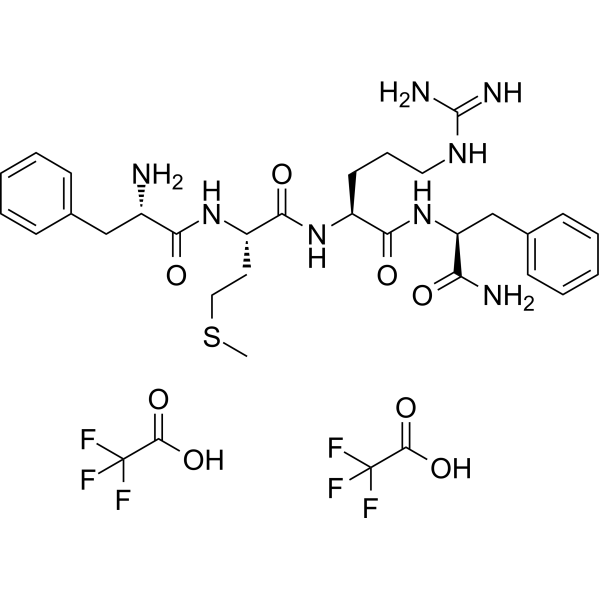
Physicochemical Properties
| Molecular Formula | C33H44F6N8O8S |
| Molecular Weight | 826.806687355042 |
| Exact Mass | 826.29 |
| CAS # | 159237-99-7 |
| Related CAS # | Phe-Met-Arg-Phe, amide;64190-70-1;Phe-Met-Arg-Phe, amide acetate;152165-14-5 |
| PubChem CID | 131704523 |
| Appearance | White to off-white solid powder |
| Hydrogen Bond Donor Count | 9 |
| Hydrogen Bond Acceptor Count | 17 |
| Rotatable Bond Count | 18 |
| Heavy Atom Count | 56 |
| Complexity | 972 |
| Defined Atom Stereocenter Count | 4 |
| SMILES | S(C)CC[C@@H](C(N[C@H](C(N[C@H](C(N)=O)CC1C=CC=CC=1)=O)CCC/N=C(\N)/N)=O)NC([C@H](CC1C=CC=CC=1)N)=O.FC(C(=O)O)(F)F.FC(C(=O)O)(F)F |
| InChi Key | XVODPBULIXCTET-PAHQJZCISA-N |
| InChi Code | InChI=1S/C29H42N8O4S.2C2HF3O2/c1-42-16-14-23(35-26(39)21(30)17-19-9-4-2-5-10-19)28(41)36-22(13-8-15-34-29(32)33)27(40)37-24(25(31)38)18-20-11-6-3-7-12-20;2*3-2(4,5)1(6)7/h2-7,9-12,21-24H,8,13-18,30H2,1H3,(H2,31,38)(H,35,39)(H,36,41)(H,37,40)(H4,32,33,34);2*(H,6,7)/t21-,22-,23-,24-;;/m0../s1 |
| Chemical Name | (2S)-N-[(2S)-1-amino-1-oxo-3-phenylpropan-2-yl]-2-[[(2S)-2-[[(2S)-2-amino-3-phenylpropanoyl]amino]-4-methylsulfanylbutanoyl]amino]-5-(diaminomethylideneamino)pentanamide;2,2,2-trifluoroacetic acid |
| HS Tariff Code | 2934.99.9001 |
| Storage |
Powder-20°C 3 years 4°C 2 years In solvent -80°C 6 months -20°C 1 month Note: Please store this product in a sealed and protected environment, avoid exposure to moisture. |
| Shipping Condition | Room temperature (This product is stable at ambient temperature for a few days during ordinary shipping and time spent in Customs) |
Biological Activity
| ln Vitro | In the mollusk central nervous system, Phe-Met-Arg-Phe amide (FMRFa) works on K+ channels in sensory neurons, motor neurons, and neuroendocrine neurons. Phe-Met-Arg-Phe amide triggers a unique K+ current characterized by a mix of voltage and receptor-dependent gating mechanisms, both of which are required to open the channel [1]. Phe-Met-Arg-Phe amide (1 μM) significantly reduced glucose-stimulated (300 mg/dL) insulin release (p<0.005) and somatostatin release from isolated perfused pancreas (p<0.01). Phe-Met-Arg-Phe amide (FMRF-NH2) (1 and 10 μM) has no influence on glucagon secretion during hypoglycemia (50 mg/dL), hyperglycemia (300 mg/dL), or arginine stimulation influence (5 mM)[2]. |
| ln Vivo | Phe-Met-Arg-Phe amide (FMRFamide) enhances growth hormone production in conscious OVX rats. The presence of Phe-Met-Arg-Phe amide-like immunoreactivity in hypothalamic neurons suggests a role in hypothalamic control of anterior pituitary function. 15 minutes after injection, a 200 ng (313.8 pmol) FMRFamide (2 uL) infusion dramatically raised plasma GH. After 5 minutes and continuing for up to 30 minutes, 400–800 ng (627–1255) of FMRFamide are shown to increase growth hormone [3]. |
| References |
[1]. Phe-Met-Arg-Phe-amide activates a novel voltage-dependent K+ current through a lipoxygenasepathway in molluscan neurones. J Gen Physiol. 1997 Nov;110(5):611-28. [2]. Phe-met-arg-phe-amide (FMRF-NH2) inhibits insulin and somatostatin secretion and anti-FMRF-NH2 sera detects pancreatic polypeptide cells in the rat islet. Peptides. 1984 Jul-Aug;5(4):777-82. [3]. Phe-Met-Arg-Phe-amide (FMRFamide) stimulated growth hormone secretion in conscious OVX rats. Neuropeptides. 1987 Feb-Mar;9(2):161-7. |
Solubility Data
| Solubility (In Vitro) |
DMSO : ~100 mg/mL (~120.95 mM) H2O : ~20 mg/mL (~24.19 mM) |
| Solubility (In Vivo) |
Solubility in Formulation 1: ≥ 2.5 mg/mL (3.02 mM) (saturation unknown) in 10% DMSO + 40% PEG300 + 5% Tween80 + 45% Saline (add these co-solvents sequentially from left to right, and one by one), clear solution. For example, if 1 mL of working solution is to be prepared, you can add 100 μL of 25.0 mg/mL clear DMSO stock solution to 400 μL PEG300 and mix evenly; then add 50 μL Tween-80 to the above solution and mix evenly; then add 450 μL normal saline to adjust the volume to 1 mL. Preparation of saline: Dissolve 0.9 g of sodium chloride in 100 mL ddH₂ O to obtain a clear solution. Solubility in Formulation 2: ≥ 2.5 mg/mL (3.02 mM) (saturation unknown) in 10% DMSO + 90% (20% SBE-β-CD in Saline) (add these co-solvents sequentially from left to right, and one by one), clear solution. For example, if 1 mL of working solution is to be prepared, you can add 100 μL of 25.0 mg/mL clear DMSO stock solution to 900 μL of 20% SBE-β-CD physiological saline solution and mix evenly. Preparation of 20% SBE-β-CD in Saline (4°C,1 week): Dissolve 2 g SBE-β-CD in 10 mL saline to obtain a clear solution. Solubility in Formulation 3: ≥ 2.5 mg/mL (3.02 mM) (saturation unknown) in 10% DMSO + 90% Corn Oil (add these co-solvents sequentially from left to right, and one by one), clear solution. For example, if 1 mL of working solution is to be prepared, you can add 100 μL of 25.0 mg/mL clear DMSO stock solution to 900 μL of corn oil and mix evenly. (Please use freshly prepared in vivo formulations for optimal results.) |
| Preparing Stock Solutions | 1 mg | 5 mg | 10 mg | |
| 1 mM | 1.2095 mL | 6.0473 mL | 12.0947 mL | |
| 5 mM | 0.2419 mL | 1.2095 mL | 2.4189 mL | |
| 10 mM | 0.1209 mL | 0.6047 mL | 1.2095 mL |