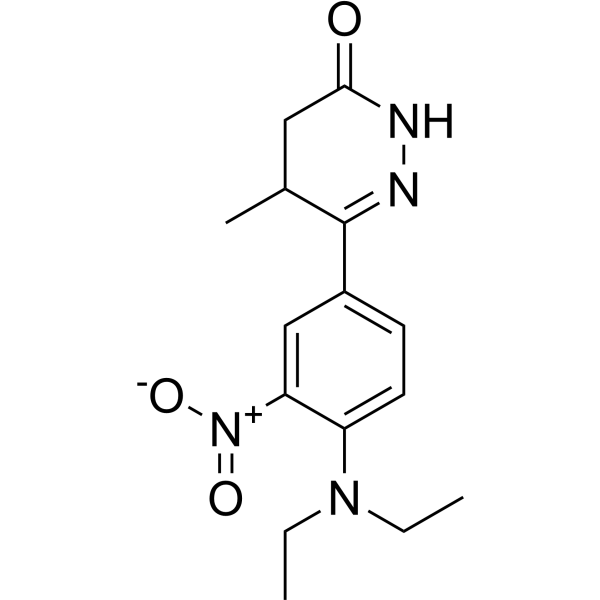
DNMDP is a novel and potent cancer-cytotoxic modulator of PDE3A. It binds to PDE3A, promotes an interaction between PDE3A and Schlafen 12 (SLFN12); coexpression of SLFN12 with PDE3A correlates with DNMDP sensitivity, whereas depletion of SLFN12 results in decreased DNMDP sensitivity.
Physicochemical Properties
| Molecular Formula | C15H20N4O3 |
| Molecular Weight | 304.344303131104 |
| Exact Mass | 304.153 |
| CAS # | 328104-79-6 |
| Related CAS # | (R)-DNMDP;1630760-60-9 |
| PubChem CID | 2874250 |
| Appearance | Orange to red solid powder |
| Density | 1.3±0.1 g/cm3 |
| Index of Refraction | 1.613 |
| LogP | 1.49 |
| Hydrogen Bond Donor Count | 1 |
| Hydrogen Bond Acceptor Count | 5 |
| Rotatable Bond Count | 4 |
| Heavy Atom Count | 22 |
| Complexity | 456 |
| Defined Atom Stereocenter Count | 0 |
| InChi Key | YOSSKNZHADPXJX-UHFFFAOYSA-N |
| InChi Code | InChI=1S/C15H20N4O3/c1-4-18(5-2)12-7-6-11(9-13(12)19(21)22)15-10(3)8-14(20)16-17-15/h6-7,9-10H,4-5,8H2,1-3H3,(H,16,20) |
| Chemical Name | 3-[4-(diethylamino)-3-nitrophenyl]-4-methyl-4,5-dihydro-1H-pyridazin-6-one |
| HS Tariff Code | 2934.99.9001 |
| Storage |
Powder-20°C 3 years 4°C 2 years In solvent -80°C 6 months -20°C 1 month |
| Shipping Condition | Room temperature (This product is stable at ambient temperature for a few days during ordinary shipping and time spent in Customs) |
Biological Activity
| ln Vitro | Within 48 hours, DNMDP (0-1000 μM) exhibits notable cell-selective cytotoxicity [1]. Following DNMDP treatment, HeLa cells exhibit apoptosis, as evidenced by cleavage of poly-ADP ribose polymerase (PARP) and caspase activity measured by the caspase-sensitive luciferase assay. DNMDP selectively inhibits PDE3A and PDE3B at a dose of 100 nM, inhibits PDE10 rather slightly, and has little to no effect on other phosphodiesterases [1]. |
| Cell Assay |
Cell Viability Assay[1] Cell Types: NCI-H1563, NCI-H2122, HeLa, A549, MCF7 and PC3 Cell Tested Concentrations: 0-1000 μM Incubation Duration: 48 hrs (hours) Experimental Results: EC50 for two additional assays ranged from 10 to 100 nM EC50 was greater than 1 µM between lung adenocarcinoma cell lines NCI-H1563 and NCI-H2122 and HeLa cervical cancer cells, but A549, MCF7 and PC3 cells. |
| References |
[1]. Identification of cancer-cytotoxic modulators of PDE3A by predictive chemogenomics. Nat Chem Biol. 2016 Feb;12(2):102-8. |
Solubility Data
| Solubility (In Vitro) | DMSO : ~50 mg/mL (~164.29 mM) |
| Solubility (In Vivo) |
Solubility in Formulation 1: ≥ 2.5 mg/mL (8.21 mM) (saturation unknown) in 10% DMSO + 90% (20% SBE-β-CD in Saline) (add these co-solvents sequentially from left to right, and one by one), clear solution. For example, if 1 mL of working solution is to be prepared, you can add 100 μL of 25.0 mg/mL clear DMSO stock solution to 900 μL of 20% SBE-β-CD physiological saline solution and mix evenly. Preparation of 20% SBE-β-CD in Saline (4°C,1 week): Dissolve 2 g SBE-β-CD in 10 mL saline to obtain a clear solution. (Please use freshly prepared in vivo formulations for optimal results.) |
| Preparing Stock Solutions | 1 mg | 5 mg | 10 mg | |
| 1 mM | 3.2858 mL | 16.4290 mL | 32.8580 mL | |
| 5 mM | 0.6572 mL | 3.2858 mL | 6.5716 mL | |
| 10 mM | 0.3286 mL | 1.6429 mL | 3.2858 mL |