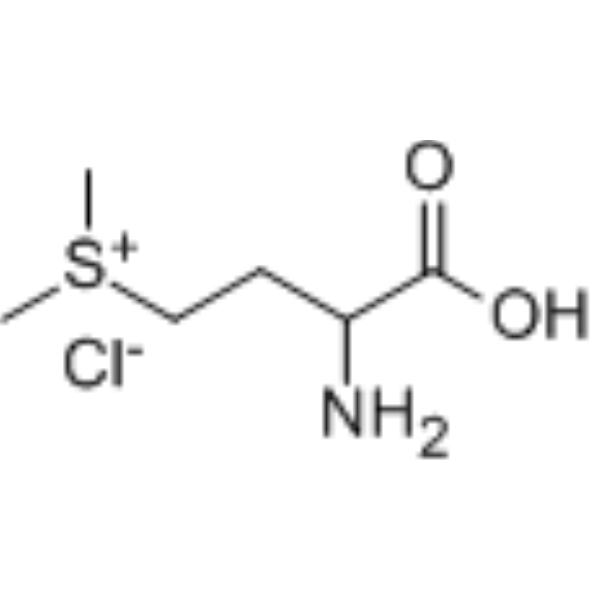
Physicochemical Properties
| Molecular Formula | C6H14CLNO2S |
| Molecular Weight | 199.6989 |
| Exact Mass | 199.043 |
| CAS # | 3493-12-7 |
| PubChem CID | 14220 |
| Appearance | White to off-white solid powder |
| Melting Point | 139ºC |
| Hydrogen Bond Donor Count | 2 |
| Hydrogen Bond Acceptor Count | 4 |
| Rotatable Bond Count | 4 |
| Heavy Atom Count | 11 |
| Complexity | 116 |
| Defined Atom Stereocenter Count | 0 |
| InChi Key | MYGVPKMVGSXPCQ-UHFFFAOYSA-N |
| InChi Code | InChI=1S/C6H13NO2S.ClH/c1-10(2)4-3-5(7)6(8)9;/h5H,3-4,7H2,1-2H3;1H |
| Chemical Name | (3-amino-3-carboxypropyl)-dimethylsulfanium;chloride |
| HS Tariff Code | 2934.99.9001 |
| Storage |
Powder-20°C 3 years 4°C 2 years In solvent -80°C 6 months -20°C 1 month Note: Please store this product in a sealed and protected environment, avoid exposure to moisture. |
| Shipping Condition | Room temperature (This product is stable at ambient temperature for a few days during ordinary shipping and time spent in Customs) |
Biological Activity
| ln Vivo |
- In rats with acetic acid-induced chronic gastric ulceration, oral administration of DL-Methionine methylsulfonium chloride at doses of 50 mg/kg and 100 mg/kg significantly accelerated ulcer healing compared with the control group. The ulcer area was reduced by approximately 40% (50 mg/kg) and 60% (100 mg/kg) after 7 days of treatment [1] - For indomethacin-induced erosive gastritis in rats, oral administration of DL-Methionine methylsulfonium chloride (50 mg/kg, 100 mg/kg) markedly reduced the number and severity of gastric erosions. The erosion score in the 100 mg/kg group was decreased by more than 50% compared with the control group [1] - Histological examination showed that DL-Methionine methylsulfonium chloride treatment promoted the regeneration of gastric mucosal epithelium and increased the thickness of the mucosal layer in both ulcer and gastritis models [1] |
| Animal Protocol |
- Chronic gastric ulcer model: Rats were anesthetized, and a 0.05 mL aliquot of 30% acetic acid was injected into the subserosal layer of the gastric antrum to induce ulcers. After 24 hours, rats were randomly divided into control group and DL-Methionine methylsulfonium chloride treatment groups (50 mg/kg and 100 mg/kg, n=6 per group) [1] - Erosive gastritis model: Rats were fasted for 24 hours, then given indomethacin (20 mg/kg) by oral gavage to induce gastric erosions. One hour later, rats were divided into control group and DL-Methionine methylsulfonium chloride treatment groups (50 mg/kg and 100 mg/kg, n=6 per group) [1] - DL-Methionine methylsulfonium chloride was dissolved in distilled water to prepare the required concentrations. The treatment groups received daily oral gavage of the drug, while the control group received an equal volume of distilled water. Treatment duration was 7 days for the ulcer model and 24 hours for the gastritis model [1] - At the end of treatment, rats were sacrificed. The stomach was removed, opened along the greater curvature, and rinsed with physiological saline. Ulcer area (measured using a planimeter) and erosion score (graded from 0 to 4 based on severity) were evaluated. Gastric tissue samples were fixed in formalin for histological examination [1] |
| References |
[1]. Salim AS. Role of sulfhydryl-containing agents in the healing of erosive gastritis and chronic gastric ulceration in the rat. J Pharm Sci. 1992 Jan;81(1):70-3. |
| Additional Infomation |
- DL-Methionine methylsulfonium chloride is a sulfhydryl-containing agent. Its gastroprotective and ulcer-healing effects are proposed to be related to the sulfhydryl group, which may scavenge free radicals, protect gastric mucosal cells from oxidative damage, and promote mucosal repair [1] - The drug showed dose-dependent efficacy in both acetic acid-induced gastric ulcer and indomethacin-induced erosive gastritis models, with the 100 mg/kg dose exhibiting more potent healing effects [1] |
Solubility Data
| Solubility (In Vitro) | H2O : ~250 mg/mL (~1251.88 mM) |
| Solubility (In Vivo) |
Solubility in Formulation 1: 100 mg/mL (500.75 mM) in PBS (add these co-solvents sequentially from left to right, and one by one), clear solution; with sonication. (Please use freshly prepared in vivo formulations for optimal results.) |
| Preparing Stock Solutions | 1 mg | 5 mg | 10 mg | |
| 1 mM | 5.0075 mL | 25.0376 mL | 50.0751 mL | |
| 5 mM | 1.0015 mL | 5.0075 mL | 10.0150 mL | |
| 10 mM | 0.5008 mL | 2.5038 mL | 5.0075 mL |