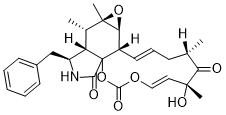
Cytochalasin E, an epoxide-
Physicochemical Properties
| Molecular Formula | C28H33NO7 |
| Molecular Weight | 495.5641 |
| Exact Mass | 495.225 |
| CAS # | 36011-19-5 |
| Related CAS # | 36011-19-5 (Cytochalasin E); 22144-77-0 (Cytochalasin D) |
| PubChem CID | 5458385 |
| Appearance | White to off-white solid powder |
| Density | 1.3±0.1 g/cm3 |
| Boiling Point | 705.1±60.0 °C at 760 mmHg |
| Melting Point | 206ºC |
| Flash Point | 380.2±32.9 °C |
| Vapour Pressure | 0.0±2.4 mmHg at 25°C |
| Index of Refraction | 1.608 |
| LogP | 1.92 |
| Hydrogen Bond Donor Count | 2 |
| Hydrogen Bond Acceptor Count | 7 |
| Rotatable Bond Count | 2 |
| Heavy Atom Count | 36 |
| Complexity | 986 |
| Defined Atom Stereocenter Count | 9 |
| SMILES | C[C@H]1C/C=C/[C@H]2[C@H]3[C@](O3)([C@H]([C@@H]4[C@]2(C(=O)N[C@H]4CC5=CC=CC=C5)OC(=O)O/C=C/[C@@](C1=O)(C)O)C)C |
| InChi Key | LAJXCUNOQSHRJO-KGDUIROVSA-N |
| InChi Code | InChI=1S/C28H33NO7/c1-16-9-8-12-19-23-27(4,35-23)17(2)21-20(15-18-10-6-5-7-11-18)29-24(31)28(19,21)36-25(32)34-14-13-26(3,33)22(16)30/h5-8,10-14,16-17,19-21,23,33H,9,15H2,1-4H3,(H,29,31)/b12-8+,14-13+/t16-,17-,19-,20-,21-,23-,26+,27+,28?/m0/s1 |
| Chemical Name | (1E,4S,6R,7E,14S,14aS,15S,15aR,16aS,16bS)-14-benzyl-6-hydroxy-4,6,15,15a-tetramethyl-3,13,14,14a,15,15a,16a,16b-octahydro-[1,3]dioxacyclotridecino[4,5-d]oxireno[2,3-f]isoindole-5,10,12(4H,6H)-trione |
| Synonyms | NSC-175151; NSC 175151; NSC175151 |
| HS Tariff Code | 2934.99.9001 |
| Storage |
Powder-20°C 3 years 4°C 2 years In solvent -80°C 6 months -20°C 1 month |
| Shipping Condition | Room temperature (This product is stable at ambient temperature for a few days during ordinary shipping and time spent in Customs) |
Biological Activity
| ln Vitro | A549 cell proliferation is dramatically suppressed by cytochalasin E in a dose-dependent manner [3]. Cytochalasin E has the ability to upregulate SQSTM1/p62 and autophagy-related proteins (LC3-II) [3]. |
| References |
[1]. Cytochalasin E, an epoxide containing Aspergillus-derived fungal metabolite, inhibits angiogenesisand tumor growth. J Pharmacol Exp Ther. 2000 Aug;294(2):421-7. [2]. Green tea extract modulates actin remodeling via Rho activity in an in vitro multistep carcinogenicmodel. Clin Cancer Res. 2005 Feb 15;11(4):1675-83. [3]. Variation in the activity of distinct cytochalasins as autophagy inhibitiors in human lung A549 cells. Biochem Biophys Res Commun. 2017 Dec 16;494(3-4):641-647. |
| Additional Infomation |
Cytochalasin E is a cytochalasan alkaloid. It has a role as a metabolite. Cytochalasin e has been reported in Mariannaea elegans, Mycotypha, and other organisms with data available. Mechanism of Action MAJOR BIOLOGICAL EFFECTS ARE THE BLOCKAGE OF CYTOPLASMIC CLEAVAGE RESULTING IN MULTINUCLEATE CELL FORMATION, THE INHIBITION OF CELL MOVEMENT, & THE INDUCTION OF NUCLEAR EXTRUSION... OTHER REPORTED EFFECTS INCLUDE THE INHIBITION OF GLUCOSE TRANSPORT, OF THYROID SECRETION, OF GROWTH HORMONE RELEASE, OF PHAGOCYTOSIS, & OF PLATELET AGGREGATION & CLOT CONTRACTION. /CYTOCHALASINS/ THE INFLUENCE OF CYTOCHALASIN B & E ON INTESTINAL DIGESTION OF MALTOSE & SUCROSE, & THEIR DIGESTION PRODUCTS AS GLUCOSE & FRUCTOSE WAS INVESTIGATED IN THE MOUSE IN VITRO. NEITHER DIGESTION OF MALTOSE OR SUCROSE NOR ACTIVITIES OF MALTASE OR SUCRASE IN EVERTED SACS OF MOUSE JEJUNUM WAS AFFECTED BY CYTOCHALASIN B OR E AT 5.0 & 10.0 MUG/ML AFTER 60 MIN INCUBATION. HOWEVER, ABSORPTION OF GLUCOSE DERIVED FROM MALTOSE OR SUCROSE DIGESTION WAS INHIBITED BY 68.5 & 65.9% DUE TO CYTOCHALASIN E (5.0 MUG/ML) & BY 29.5 & 13.1% DUE TO CYTOCHALASIN B AT THE SAME CONCN. CYTOCHALASINS B & E SEEMED TO STIMULATE ABSORPTION OF FRUCTOSE DERIVED FROM SUCROSE DIGESTION IN MOUSE JEJUNUM. THE INHIBITORY EFFECT OF CYTOCHALASIN E ON GALACTOSE ABSORPTION IN EVERTED SACS OF MOUSE JEJUNUM WAS STUDIED. CYTOCHALASIN B HAD THE HIGHEST POTENCY ON THE INHIBITION OF GALACTOSE ABSORPTION WHEN IT WAS ADDED IN THE MUCOSAL SOLN FOLLOWED BY CYTOCHALASIN E, A, C, & D, RESPECTIVELY. IN MICE Y-1 ADRENAL TUMOR CELLS, CYTOCHALASINS E, D, B, & H2B, INHIBITED STEROIDOGENESIS & PRODUCED ROUNDING OF CELLS BY INTERFERING WITH POLYMERIZATION OF ACTIN & NOT AS THE RESULT OF EFFECTS UNRELATED TO BINDING TO ACTIN. For more Mechanism of Action (Complete) data for CYTOCHALASIN E (10 total), please visit the HSDB record page. |
Solubility Data
| Solubility (In Vitro) | May dissolve in DMSO (in most cases), if not, try other solvents such as H2O, Ethanol, or DMF with a minute amount of products to avoid loss of samples |
| Solubility (In Vivo) |
Note: Listed below are some common formulations that may be used to formulate products with low water solubility (e.g. < 1 mg/mL), you may test these formulations using a minute amount of products to avoid loss of samples. Injection Formulations (e.g. IP/IV/IM/SC) Injection Formulation 1: DMSO : Tween 80: Saline = 10 : 5 : 85 (i.e. 100 μL DMSO stock solution → 50 μL Tween 80 → 850 μL Saline) *Preparation of saline: Dissolve 0.9 g of sodium chloride in 100 mL ddH ₂ O to obtain a clear solution. Injection Formulation 2: DMSO : PEG300 :Tween 80 : Saline = 10 : 40 : 5 : 45 (i.e. 100 μL DMSO → 400 μLPEG300 → 50 μL Tween 80 → 450 μL Saline) Injection Formulation 3: DMSO : Corn oil = 10 : 90 (i.e. 100 μL DMSO → 900 μL Corn oil) Example: Take the Injection Formulation 3 (DMSO : Corn oil = 10 : 90) as an example, if 1 mL of 2.5 mg/mL working solution is to be prepared, you can take 100 μL 25 mg/mL DMSO stock solution and add to 900 μL corn oil, mix well to obtain a clear or suspension solution (2.5 mg/mL, ready for use in animals). Injection Formulation 4: DMSO : 20% SBE-β-CD in saline = 10 : 90 [i.e. 100 μL DMSO → 900 μL (20% SBE-β-CD in saline)] *Preparation of 20% SBE-β-CD in Saline (4°C,1 week): Dissolve 2 g SBE-β-CD in 10 mL saline to obtain a clear solution. Injection Formulation 5: 2-Hydroxypropyl-β-cyclodextrin : Saline = 50 : 50 (i.e. 500 μL 2-Hydroxypropyl-β-cyclodextrin → 500 μL Saline) Injection Formulation 6: DMSO : PEG300 : castor oil : Saline = 5 : 10 : 20 : 65 (i.e. 50 μL DMSO → 100 μLPEG300 → 200 μL castor oil → 650 μL Saline) Injection Formulation 7: Ethanol : Cremophor : Saline = 10: 10 : 80 (i.e. 100 μL Ethanol → 100 μL Cremophor → 800 μL Saline) Injection Formulation 8: Dissolve in Cremophor/Ethanol (50 : 50), then diluted by Saline Injection Formulation 9: EtOH : Corn oil = 10 : 90 (i.e. 100 μL EtOH → 900 μL Corn oil) Injection Formulation 10: EtOH : PEG300:Tween 80 : Saline = 10 : 40 : 5 : 45 (i.e. 100 μL EtOH → 400 μLPEG300 → 50 μL Tween 80 → 450 μL Saline) Oral Formulations Oral Formulation 1: Suspend in 0.5% CMC Na (carboxymethylcellulose sodium) Oral Formulation 2: Suspend in 0.5% Carboxymethyl cellulose Example: Take the Oral Formulation 1 (Suspend in 0.5% CMC Na) as an example, if 100 mL of 2.5 mg/mL working solution is to be prepared, you can first prepare 0.5% CMC Na solution by measuring 0.5 g CMC Na and dissolve it in 100 mL ddH2O to obtain a clear solution; then add 250 mg of the product to 100 mL 0.5% CMC Na solution, to make the suspension solution (2.5 mg/mL, ready for use in animals). Oral Formulation 3: Dissolved in PEG400 Oral Formulation 4: Suspend in 0.2% Carboxymethyl cellulose Oral Formulation 5: Dissolve in 0.25% Tween 80 and 0.5% Carboxymethyl cellulose Oral Formulation 6: Mixing with food powders Note: Please be aware that the above formulations are for reference only. InvivoChem strongly recommends customers to read literature methods/protocols carefully before determining which formulation you should use for in vivo studies, as different compounds have different solubility properties and have to be formulated differently. (Please use freshly prepared in vivo formulations for optimal results.) |
| Preparing Stock Solutions | 1 mg | 5 mg | 10 mg | |
| 1 mM | 2.0179 mL | 10.0896 mL | 20.1792 mL | |
| 5 mM | 0.4036 mL | 2.0179 mL | 4.0358 mL | |
| 10 mM | 0.2018 mL | 1.0090 mL | 2.0179 mL |