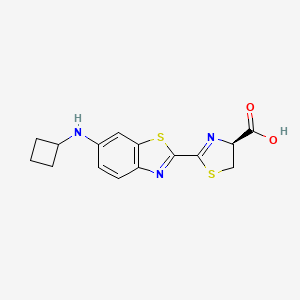
CybLuc is an aminoluciferin derivative for deep bioluminescence imaging.
The effectiveness of in vivo bioluminescence imaging (BLI) is hampered by the significant absorption and scattering of shorter wavelength light (<600 nm) by blood and tissues, which weakens the signal from conventional D-luciferin. CybLuc addresses these shortcomings by offering a red-shifted emission spectrum (max. 600 nm) for improved tissue penetration. Coupled with its greater lipophilicity and metabolic stability, these properties make CybLuc an ideal agent for in vivo studies.Physicochemical Properties
| Molecular Formula | C15H15N3O2S2 |
| Molecular Weight | 333.4 |
| Exact Mass | 333.0606 |
| Elemental Analysis | C, 54.03; H, 4.53; N, 12.60; O, 9.60; S, 19.23 |
| CAS # | 1649470-26-7 |
| PubChem CID | 139593819 |
| Appearance | Typically exists as solid at room temperature |
| LogP | 3.5 |
| Hydrogen Bond Donor Count | 2 |
| Hydrogen Bond Acceptor Count | 7 |
| Rotatable Bond Count | 4 |
| Heavy Atom Count | 22 |
| Complexity | 483 |
| Defined Atom Stereocenter Count | 1 |
| SMILES | C1CC(C1)NC2=CC3=C(C=C2)N=C(S3)C4=N[C@H](CS4)C(=O)O |
| InChi Key | DRLXXHYUKOJAOR-LLVKDONJSA-N |
| InChi Code | InChI=1S/C15H15N3O2S2/c19-15(20)11-7-21-13(18-11)14-17-10-5-4-9(6-12(10)22-14)16-8-2-1-3-8/h4-6,8,11,16H,1-3,7H2,(H,19,20)/t11-/m1/s1 |
| Chemical Name | (4S)-2-[6-(cyclobutylamino)-1,3-benzothiazol-2-yl]-4,5-dihydro-1,3-thiazole-4-carboxylic acid |
| Synonyms | Cyb-Luc; Cyb Luc; 1649470-26-7; N-Cyclobutylaminoluciferin; (4S)-2-[6-(Cyclobutylamino)benzo[d]thiazol-2-yl]-4,5-dihydrothiazole-4-carboxylic acid; orb1697634; SCHEMBL29360346; CybLuc |
| HS Tariff Code | 2934.99.9001 |
| Storage |
Powder-20°C 3 years 4°C 2 years In solvent -80°C 6 months -20°C 1 month |
| Shipping Condition | Room temperature (This product is stable at ambient temperature for a few days during ordinary shipping and time spent in Customs) |
Biological Activity
| Targets | Bioluminescence imaging agent; Firefly luciferase (enzyme substrate). Acts as a superior substrate for bioluminescence imaging compared to D-luciferin. |
| ln Vitro | In Vitro: CybLuc is an effective aminoluciferin derivative designed for deep bioluminescence imaging. It exhibits properties superior to D-luciferin. |
| ln Vivo | In Vivo: CybLuc demonstrates effectiveness in deep bioluminescence imaging applications in mouse models. It provides a rapid (4-5 minutes), long-lasting, and steady signal peak following intravenous (i.v.) injection in mice. It is shown to readily cross the blood-brain barrier and provides much improved noninvasive bioluminescence imaging (BLI) of the brain at a lower dose compared to D-luciferin. It yields about a 10-fold higher bioluminescent signal than D-luciferin in certain implanted cancer cell models (e.g., Luc2 luciferase-expressing 4T1 breast cancer cells implanted into the mammary fat pads of BABL/c mice). |
| Animal Protocol | Animal Protocol: In mouse studies, CybLuc is administered via intravenous (i.v.) injection. A rapid (4-5 min), long-lasting, and steady signal peak is observed following the injection. |
| References | [1]. cybLuc: An Effective Aminoluciferin Derivative for Deep Bioluminescence Imaging. Anal Chem. 2017 May 2;89(9):4808-4816. |
| Additional Infomation |
CybLuc (CAS: 1649470-26-7) is a synthetic aminoluciferin derivative. It binds to luciferase with higher affinity and emits about 5.7-fold more light than aminoluciferin and 3.2-fold more light than D-luciferin. Its superior light output is maintained over a wide concentration range (1-100 µM). It has been used in research related to glioma imaging and therapy development.
To enhance the efficiency of firefly luciferase/luciferin bioluminescence imaging, a series of N-cycloalkylaminoluciferins (cyaLucs) were developed by introducing lipophilic N-cycloalkylated substitutions. The experimental results demonstrate that these cyaLucs are effective substrates for native firefly luciferase (Fluc) and can produce elevated bioluminescent signals in vitro, in cellulo, and in vivo. It should be noted that, in animal studies, N-cyclobutylaminoluciferin (cybLuc) at 10 μM (0.1 mL), which is 0.01% of the standard dose of d-luciferin (dLuc) used in mouse imaging, can radiate 20-fold more bioluminescent light than d-luciferin (dLuc) or aminoluciferin (aLuc) at the same concentration. Longer in vivo emission imaging using cybLuc suggests that it can be used for long-time observation. Regarding the mechanism of cybLuc, our cocrystal structure data from firefly luciferase with oxidized cybLuc suggested that oxidized cybLuc fits into the same pocket as oxyluciferin. Most interestingly, our results demonstrate that the sensitivity of cybLuc in brain tumor imaging contributes to its extended application in deep tissues.[1] |
Solubility Data
| Solubility (In Vitro) | May dissolve in DMSO (in most cases), if not, try other solvents such as H2O, Ethanol, or DMF with a minute amount of products to avoid loss of samples |
| Solubility (In Vivo) |
Note: Listed below are some common formulations that may be used to formulate products with low water solubility (e.g. < 1 mg/mL), you may test these formulations using a minute amount of products to avoid loss of samples. Injection Formulations (e.g. IP/IV/IM/SC) Injection Formulation 1: DMSO : Tween 80: Saline = 10 : 5 : 85 (i.e. 100 μL DMSO stock solution → 50 μL Tween 80 → 850 μL Saline) *Preparation of saline: Dissolve 0.9 g of sodium chloride in 100 mL ddH ₂ O to obtain a clear solution. Injection Formulation 2: DMSO : PEG300 :Tween 80 : Saline = 10 : 40 : 5 : 45 (i.e. 100 μL DMSO → 400 μLPEG300 → 50 μL Tween 80 → 450 μL Saline) Injection Formulation 3: DMSO : Corn oil = 10 : 90 (i.e. 100 μL DMSO → 900 μL Corn oil) Example: Take the Injection Formulation 3 (DMSO : Corn oil = 10 : 90) as an example, if 1 mL of 2.5 mg/mL working solution is to be prepared, you can take 100 μL 25 mg/mL DMSO stock solution and add to 900 μL corn oil, mix well to obtain a clear or suspension solution (2.5 mg/mL, ready for use in animals). Injection Formulation 4: DMSO : 20% SBE-β-CD in saline = 10 : 90 [i.e. 100 μL DMSO → 900 μL (20% SBE-β-CD in saline)] *Preparation of 20% SBE-β-CD in Saline (4°C,1 week): Dissolve 2 g SBE-β-CD in 10 mL saline to obtain a clear solution. Injection Formulation 5: 2-Hydroxypropyl-β-cyclodextrin : Saline = 50 : 50 (i.e. 500 μL 2-Hydroxypropyl-β-cyclodextrin → 500 μL Saline) Injection Formulation 6: DMSO : PEG300 : castor oil : Saline = 5 : 10 : 20 : 65 (i.e. 50 μL DMSO → 100 μLPEG300 → 200 μL castor oil → 650 μL Saline) Injection Formulation 7: Ethanol : Cremophor : Saline = 10: 10 : 80 (i.e. 100 μL Ethanol → 100 μL Cremophor → 800 μL Saline) Injection Formulation 8: Dissolve in Cremophor/Ethanol (50 : 50), then diluted by Saline Injection Formulation 9: EtOH : Corn oil = 10 : 90 (i.e. 100 μL EtOH → 900 μL Corn oil) Injection Formulation 10: EtOH : PEG300:Tween 80 : Saline = 10 : 40 : 5 : 45 (i.e. 100 μL EtOH → 400 μLPEG300 → 50 μL Tween 80 → 450 μL Saline) Oral Formulations Oral Formulation 1: Suspend in 0.5% CMC Na (carboxymethylcellulose sodium) Oral Formulation 2: Suspend in 0.5% Carboxymethyl cellulose Example: Take the Oral Formulation 1 (Suspend in 0.5% CMC Na) as an example, if 100 mL of 2.5 mg/mL working solution is to be prepared, you can first prepare 0.5% CMC Na solution by measuring 0.5 g CMC Na and dissolve it in 100 mL ddH2O to obtain a clear solution; then add 250 mg of the product to 100 mL 0.5% CMC Na solution, to make the suspension solution (2.5 mg/mL, ready for use in animals). Oral Formulation 3: Dissolved in PEG400 Oral Formulation 4: Suspend in 0.2% Carboxymethyl cellulose Oral Formulation 5: Dissolve in 0.25% Tween 80 and 0.5% Carboxymethyl cellulose Oral Formulation 6: Mixing with food powders Note: Please be aware that the above formulations are for reference only. InvivoChem strongly recommends customers to read literature methods/protocols carefully before determining which formulation you should use for in vivo studies, as different compounds have different solubility properties and have to be formulated differently. (Please use freshly prepared in vivo formulations for optimal results.) |
| Preparing Stock Solutions | 1 mg | 5 mg | 10 mg | |
| 1 mM | 2.9994 mL | 14.9970 mL | 29.9940 mL | |
| 5 mM | 0.5999 mL | 2.9994 mL | 5.9988 mL | |
| 10 mM | 0.2999 mL | 1.4997 mL | 2.9994 mL |