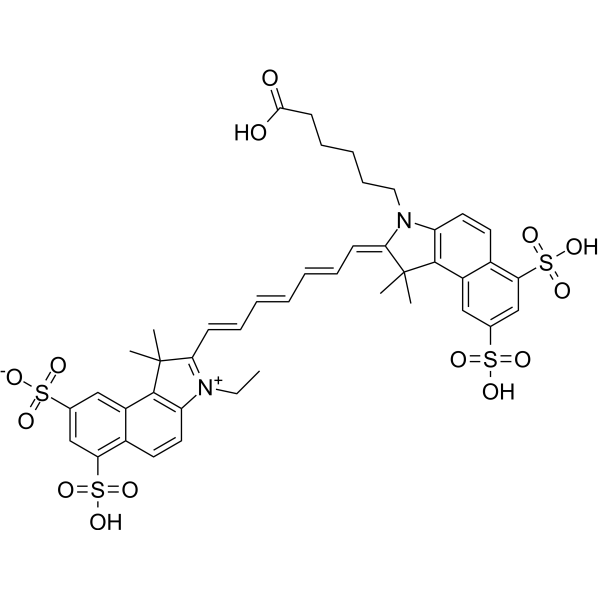
Physicochemical Properties
| Molecular Formula | C43H46N2O14S4 |
| Molecular Weight | 943.090347766876 |
| Exact Mass | 942.183 |
| CAS # | 847180-48-7 |
| PubChem CID | 131637557 |
| Appearance | Dark purple to black solid powder |
| LogP | 5.2 |
| Hydrogen Bond Donor Count | 4 |
| Hydrogen Bond Acceptor Count | 15 |
| Rotatable Bond Count | 14 |
| Heavy Atom Count | 63 |
| Complexity | 2330 |
| Defined Atom Stereocenter Count | 0 |
| SMILES | S(C1=CC(=CC2=C1C=CC1=C2C(C)(C)C(/C=C/C=C/C=C/C=C2\C(C)(C)C3C4C=C(C=C(C=4C=CC=3N\2CC)S(=O)(=O)O)S(=O)(=O)[O-])=[N+]1CCCCCC(=O)O)S(=O)(=O)O)(=O)(=O)O |
| InChi Key | ISGPOTXIUFNEFH-UHFFFAOYSA-N |
| InChi Code | InChI=1S/C43H46N2O14S4/c1-6-44-33-20-18-29-31(23-27(60(48,49)50)25-35(29)62(54,55)56)40(33)42(2,3)37(44)15-11-8-7-9-12-16-38-43(4,5)41-32-24-28(61(51,52)53)26-36(63(57,58)59)30(32)19-21-34(41)45(38)22-14-10-13-17-39(46)47/h7-9,11-12,15-16,18-21,23-26H,6,10,13-14,17,22H2,1-5H3,(H4-,46,47,48,49,50,51,52,53,54,55,56,57,58,59) |
| Chemical Name | (2Z)-2-[(2E,4E,6E)-7-[3-(5-carboxypentyl)-1,1-dimethyl-6,8-disulfobenzo[e]indol-3-ium-2-yl]hepta-2,4,6-trienylidene]-3-ethyl-1,1-dimethyl-6-sulfobenzo[e]indole-8-sulfonate |
| HS Tariff Code | 2934.99.9001 |
| Storage |
Powder-20°C 3 years 4°C 2 years In solvent -80°C 6 months -20°C 1 month Note: This product requires protection from light (avoid light exposure) during transportation and storage. |
| Shipping Condition | Room temperature (This product is stable at ambient temperature for a few days during ordinary shipping and time spent in Customs) |
Biological Activity
| ln Vitro | The optimal stock solution preparation 1. Preparing proteins Add protein (antibody) at a concentration of 2 mg/mL to get the labeling effect. 1) The protein solution's pH should be 8.5±0.5. In case the pH falls below 8.0, utilize 1 M carbon dioxide. 2) The labeling efficiency will be significantly decreased if the protein content is less than 2 mg/mL. The ideal labeling efficiency can be achieved by ensuring that the protein content ranges from 2 to 10 mg/mL. 3) To ensure optimal labeling efficacy, the protein needs to be in a clear buffer that contains primary amines (such Tris or glycine) and ammonium ions. 2. Dye preparation Mix CY dye with anhydrous DMSO to get a 10 mM stock solution. After being aliquoted, the CY storage solution should be stored in the dark at -20°C or -80°C. Mix vigorously with a glass tube or vortex. 3. The quantity of working dye solution The amount of labeled protein determines how much CY dye is needed for the labeling reaction. The following is the ideal protein and CY dye dosage: Assume that 500 μL of 2 mg/mL IgG (MW = 150,000) is the necessary labeled protein. Dissolve a tube containing 1 mg of CY dye in 100 μL of DMSO to obtain the needed CY volume of 3.95 μL. Using CY3-NHS ester as an example, the calculation procedure is as follows in detail: 1) mmol (IgG) = mg/mL (IgG) ×mL (IgG) / MW (IgG) = 2 mg/mL×0.5 mL / 150,000 mg/mmol = 6.7×10⁻⁶ mmol 2) mmol (CY3-NHS ester) = mmol (IgG) ×10 = 6.7×10⁻⁶ mmol×10 = 6.7×10⁻⁵ mmol 3) μL (methyl-ketone succinate) = mmol (ketone succinate) ×MW (ketone succinate) / mg/μL (ketone succinate) = 6.7×10⁻⁵ mmol× 590.15 mg/mmol / 0.01 mg/μL = 3.95 μL (ketone succinate succinate) Method of usage 1. Labeling response 1) Carefully measure out a fresh carrier containing 10 mg/mL of CY dye. Mix with a gentle shake to combine, then quickly gather the centrifuged sample from the bottom of the reaction tube. Add to the 0.5 mL protein sample solution. Avoid copying 2) Place the reaction tube in a dimly lit area, give it a gentle shake, and stroll for 60 minutes under the initial conditions. Every week, for ten to fifteen minutes, carefully flip the reaction tube over many times to 2. Desalting and inhibiting proteins Using SepHadex G-25 column blocked dye conjugates as an example, the methodology that follows is used. 1) As directed by the manufacturer, set up the SepHadex G-25 column. 2) Place the reaction mixture into the SepHadex G-25 column's upper section. 3) Add PBS (pH 7.2–7.4) when the sample dips below the top resin's surface. 4) To finish columnar shrinking, add more PBS (pH 7.2–7.4) right away to the intended sample. Put the parts together that contain the chosen dye-protein combination. |
| References |
[1]. Ptaszek M. Rational design of fluorophores for in vivo applications. Prog Mol Biol Transl Sci. 2013;113:59-108. [2]. In Vivo Dual-Modality Fluorescence and Magnetic Resonance Imaging-Guided Lymph Node Mapping with Good Biocompatibility Manganese Oxide Nanoparticles. Molecules. 2017 Dec 12;22(12). pii: E2208. [3]. Shindy, H. A. (2017). Fundamentals in the chemistry of cyanine dyes: A review. Dyes and Pigments, 145, 505–513. doi:10.1016/j.dyepig.2017.06.029. |
Solubility Data
| Solubility (In Vitro) | H2O : ~25 mg/mL (~26.51 mM) |
| Solubility (In Vivo) |
Solubility in Formulation 1: ≥ 2.08 mg/mL (2.21 mM) (saturation unknown) in 10% DMSO + 40% PEG300 + 5% Tween80 + 45% Saline (add these co-solvents sequentially from left to right, and one by one), clear solution. For example, if 1 mL of working solution is to be prepared, you can add 100 μL of 20.8 mg/mL clear DMSO stock solution to 400 μL PEG300 and mix evenly; then add 50 μL Tween-80 to the above solution and mix evenly; then add 450 μL normal saline to adjust the volume to 1 mL. Preparation of saline: Dissolve 0.9 g of sodium chloride in 100 mL ddH₂ O to obtain a clear solution. Solubility in Formulation 2: ≥ 2.08 mg/mL (2.21 mM) (saturation unknown) in 10% DMSO + 90% (20% SBE-β-CD in Saline) (add these co-solvents sequentially from left to right, and one by one), clear solution. For example, if 1 mL of working solution is to be prepared, you can add 100 μL of 20.8 mg/mL clear DMSO stock solution to 900 μL of 20% SBE-β-CD physiological saline solution and mix evenly. Preparation of 20% SBE-β-CD in Saline (4°C,1 week): Dissolve 2 g SBE-β-CD in 10 mL saline to obtain a clear solution. (Please use freshly prepared in vivo formulations for optimal results.) |
| Preparing Stock Solutions | 1 mg | 5 mg | 10 mg | |
| 1 mM | 1.0603 mL | 5.3017 mL | 10.6034 mL | |
| 5 mM | 0.2121 mL | 1.0603 mL | 2.1207 mL | |
| 10 mM | 0.1060 mL | 0.5302 mL | 1.0603 mL |