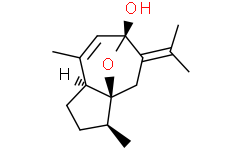
Physicochemical Properties
| Molecular Formula | C15H22O2 |
| Molecular Weight | 234.339 |
| Exact Mass | 234.161 |
| Elemental Analysis | C, 76.88; H, 9.46; O, 13.65 |
| CAS # | 19431-84-6 |
| Related CAS # | 19431-84-6 |
| PubChem CID | 167812 |
| Appearance | White to off-white solid powder |
| Density | 1.1±0.1 g/cm3 |
| Boiling Point | 349.3±42.0 °C at 760 mmHg |
| Flash Point | 146.7±22.1 °C |
| Vapour Pressure | 0.0±1.7 mmHg at 25°C |
| Index of Refraction | 1.553 |
| LogP | 3.4 |
| Hydrogen Bond Donor Count | 1 |
| Hydrogen Bond Acceptor Count | 2 |
| Rotatable Bond Count | 0 |
| Heavy Atom Count | 17 |
| Complexity | 430 |
| Defined Atom Stereocenter Count | 4 |
| SMILES | O1[C@@]2(C([H])=C(C([H])([H])[H])[C@]3([H])C([H])([H])C([H])([H])[C@]([H])(C([H])([H])[H])[C@]13C([H])([H])/C/2=C(/C([H])([H])[H])\C([H])([H])[H])O[H] |
| InChi Key | ISFMXVMWEWLJGJ-NZBPQXDJSA-N |
| InChi Code | InChI=1S/C15H22O2/c1-9(2)13-8-14-11(4)5-6-12(14)10(3)7-15(13,16)17-14/h7,11-12,16H,5-6,8H2,1-4H3/t11-,12-,14-,15+/m0/s1 |
| Chemical Name | (1S,2S,5S,8R)-2,6-dimethyl-9-propan-2-ylidene-11-oxatricyclo[6.2.1.01,5]undec-6-en-8-ol |
| Synonyms | Curcumenol |
| HS Tariff Code | 2934.99.9001 |
| Storage |
Powder-20°C 3 years 4°C 2 years In solvent -80°C 6 months -20°C 1 month |
| Shipping Condition | Room temperature (This product is stable at ambient temperature for a few days during ordinary shipping and time spent in Customs) |
Biological Activity
| Targets | CYP3A4 (IC50 = 36.63 μM); CYP2C9 (IC50 = 75.76 μM) |
| ln Vitro | Nitric oxide (NO) production, pro-inflammatory cytokines (IL-6) and (TNF-α) and pro-inflammatory protein expression, iNOS, and COX-2 expression are all significantly reduced by curcumenol in response to LPS. Hepatoprotective qualities of curcumenol have also been demonstrated. By preventing the phosphorylation of Akt, curcumenol can reduce the NF-B activity that LPS causes. Its administration significantly reduces the phosphorylation of p38 MAPK caused by LPS, but not JNK or ERK[1]. With an IC50 value of 12.6 1.3 M, curcumenol significantly reduces the activity of CYP3A4. With a Ki of 10.8 μM, kinetic analysis demonstrates curcumenol's competitive inhibition of testosterone 6β-hydroxylation activity (CYP3A4)[2]. |
| ln Vivo | In a sterile 96-well plate with a flat bottom, BV-2 cells are seeded. The following day, the cells are allowed to adhere. The cells are first pretreated with different concentrations of curcumenol for 2 hours, then exposed to LPS (0.4 μg/mL) for 12 to 24 hours. |
| References |
[1].Food Funct . 2015 Nov;6(11):3550-9. [2].Phytother Res . 2010 Aug;24(8):1213-6 |
| Additional Infomation | Curcumenol has been reported in Curcuma xanthorrhiza, Artemisia annua, and other organisms with data available. |
Solubility Data
| Solubility (In Vitro) | DMSO: 46~125 mg/mL (196.3~533.4 mM) |
| Solubility (In Vivo) |
Solubility in Formulation 1: ≥ 2.08 mg/mL (8.88 mM) (saturation unknown) in 10% DMSO + 40% PEG300 + 5% Tween80 + 45% Saline (add these co-solvents sequentially from left to right, and one by one), clear solution. For example, if 1 mL of working solution is to be prepared, you can add 100 μL of 20.8 mg/mL clear DMSO stock solution to 400 μL PEG300 and mix evenly; then add 50 μL Tween-80 to the above solution and mix evenly; then add 450 μL normal saline to adjust the volume to 1 mL. Preparation of saline: Dissolve 0.9 g of sodium chloride in 100 mL ddH₂ O to obtain a clear solution. Solubility in Formulation 2: ≥ 2.08 mg/mL (8.88 mM) (saturation unknown) in 10% DMSO + 90% (20% SBE-β-CD in Saline) (add these co-solvents sequentially from left to right, and one by one), clear solution. For example, if 1 mL of working solution is to be prepared, you can add 100 μL of 20.8 mg/mL clear DMSO stock solution to 900 μL of 20% SBE-β-CD physiological saline solution and mix evenly. Preparation of 20% SBE-β-CD in Saline (4°C,1 week): Dissolve 2 g SBE-β-CD in 10 mL saline to obtain a clear solution. Solubility in Formulation 3: ≥ 2.08 mg/mL (8.88 mM) (saturation unknown) in 10% DMSO + 90% Corn Oil (add these co-solvents sequentially from left to right, and one by one), clear solution. For example, if 1 mL of working solution is to be prepared, you can add 100 μL of 20.8 mg/mL clear DMSO stock solution to 900 μL of corn oil and mix evenly. (Please use freshly prepared in vivo formulations for optimal results.) |
| Preparing Stock Solutions | 1 mg | 5 mg | 10 mg | |
| 1 mM | 4.2673 mL | 21.3365 mL | 42.6730 mL | |
| 5 mM | 0.8535 mL | 4.2673 mL | 8.5346 mL | |
| 10 mM | 0.4267 mL | 2.1337 mL | 4.2673 mL |