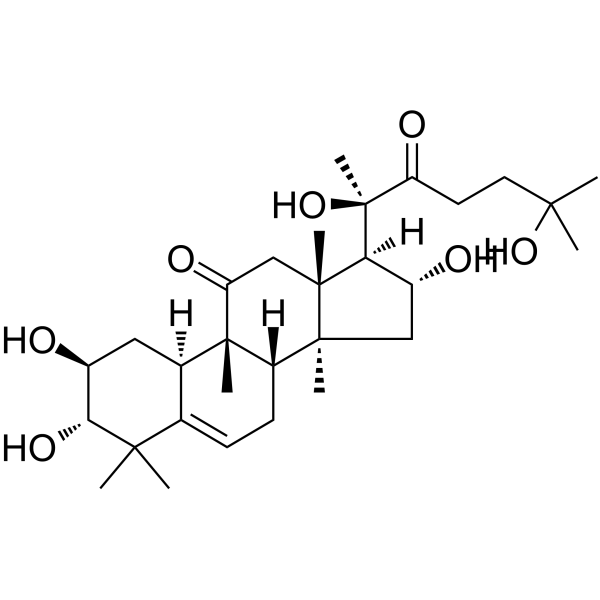
Physicochemical Properties
| Molecular Formula | C30H48O7 |
| Molecular Weight | 520.6979 |
| Exact Mass | 520.34 |
| CAS # | 50298-90-3 |
| PubChem CID | 10481797 |
| Appearance | White to off-white solid powder |
| Density | 1.22±0.1 g/cm3 |
| Boiling Point | 668.4±55.0 °C at 760 mmHg |
| Melting Point | 158-159ºC |
| Flash Point | 372.0±28.0 °C |
| Vapour Pressure | 0.0±4.6 mmHg at 25°C |
| Index of Refraction | 1.577 |
| LogP | 1.92 |
| Hydrogen Bond Donor Count | 5 |
| Hydrogen Bond Acceptor Count | 7 |
| Rotatable Bond Count | 5 |
| Heavy Atom Count | 37 |
| Complexity | 1020 |
| Defined Atom Stereocenter Count | 10 |
| SMILES | C[C@@]12C[C@H]([C@@H]([C@]1(CC(=O)[C@@]3([C@H]2CC=C4[C@H]3C[C@@H]([C@H](C4(C)C)O)O)C)C)[C@](C)(C(=O)CCC(C)(C)O)O)O |
| InChi Key | VVBWBGOEAVGFTN-LPQIEKFGSA-N |
| InChi Code | InChI=1S/C30H48O7/c1-25(2,36)12-11-21(33)30(8,37)23-19(32)14-27(5)20-10-9-16-17(13-18(31)24(35)26(16,3)4)29(20,7)22(34)15-28(23,27)6/h9,17-20,23-24,31-32,35-37H,10-15H2,1-8H3/t17-,18+,19-,20+,23+,24-,27+,28-,29+,30+/m1/s1 |
| Chemical Name | (2S,3S,8S,9R,10R,13R,14S,16R,17R)-17-[(2R)-2,6-dihydroxy-6-methyl-3-oxoheptan-2-yl]-2,3,16-trihydroxy-4,4,9,13,14-pentamethyl-1,2,3,7,8,10,12,15,16,17-decahydrocyclopenta[a]phenanthren-11-one |
| HS Tariff Code | 2934.99.9001 |
| Storage |
Powder-20°C 3 years 4°C 2 years In solvent -80°C 6 months -20°C 1 month Note: This product requires protection from light (avoid light exposure) during transportation and storage. |
| Shipping Condition | Room temperature (This product is stable at ambient temperature for a few days during ordinary shipping and time spent in Customs) |
Biological Activity
| Targets |
- The primary targets of Cucurbitacin IIb are associated with the JAK-STAT signaling pathway, specifically targeting phosphorylated STAT3 (p-STAT3) in mouse lymphocytes.[1] - Cucurbitacin IIb also modulates the activity of proteins involved in lymphocyte proliferation and cytokine secretion (e.g., NF-κB, ERK1/2).[1] |
| ln Vitro |
- Cucurbitacin IIb inhibits the proliferation of mouse lymphocytes in a dose-dependent manner. When mouse splenic lymphocytes (stimulated with concanavalin A, ConA) are treated with Cucurbitacin IIb (0.1–10 μM) for 48 hours, the MTT assay shows a 30–80% reduction in cell viability, with an IC₅₀ of 1.2 μM. It has minimal effect on unstimulated lymphocytes (viability reduction <10% at 5 μM) [1] - Cucurbitacin IIb reduces the secretion of pro-inflammatory cytokines by mouse lymphocytes. ELISA analysis reveals that treatment of ConA-stimulated lymphocytes with 0.5–5 μM Cucurbitacin IIb for 24 hours decreases the levels of IL-2 (by 40–70%) and IFN-γ (by 35–65%) in the culture supernatant, compared to untreated stimulated cells [1] - Cucurbitacin IIb downregulates the JAK-STAT signaling pathway in mouse lymphocytes. Western blot shows that 1–3 μM Cucurbitacin IIb treatment for 12 hours reduces the expression of p-STAT3 (by 50–80%) and p-JAK2 (by 40–60%) in ConA-stimulated lymphocytes, without significant changes in total STAT3 or JAK2 levels. It also decreases the nuclear translocation of p-STAT3 (detected by immunofluorescence) [1] - Cucurbitacin IIb suppresses the activation of NF-κB and ERK1/2 pathways. In ConA-stimulated lymphocytes, 0.5–2 μM Cucurbitacin IIb reduces the phosphorylation of IκBα (by 30–50%) and ERK1/2 (by 45–70%) at 6 hours post-treatment, as measured by western blot [1] |
| ln Vivo |
- Cucurbitacin IIb alleviates ConA-induced liver inflammation in mice. Mice treated with Cucurbitacin IIb (0.25 or 0.5 mg/kg body weight, intraperitoneal injection) 1 hour before ConA administration (20 mg/kg, intravenous injection) show reduced serum levels of ALT (by 35–60%) and AST (by 30–55%) at 24 hours post-ConA, compared to ConA-only controls. Histopathological analysis of liver tissue reveals less neutrophil infiltration and hepatocyte necrosis in Cucurbitacin IIb-treated groups [1] - Cucurbitacin IIb lowers systemic pro-inflammatory cytokine levels in ConA-induced mice. Serum ELISA shows that 0.5 mg/kg Cucurbitacin IIb reduces IL-2 (by 50%) and IFN-γ (by 45%) levels at 12 hours post-ConA, and decreases TNF-α (by 40%) at 24 hours post-ConA [1] - Cucurbitacin IIb inhibits lymphocyte infiltration in inflamed liver tissue. Immunohistochemistry of mouse liver sections (24 hours post-ConA) shows a 40–60% reduction in CD4⁺ and CD8⁺ T cell infiltration in mice treated with 0.25–0.5 mg/kg Cucurbitacin IIb, compared to ConA-only mice [1] |
| Enzyme Assay |
1. Isolate mouse splenic lymphocytes and culture them in RPMI 1640 medium supplemented with 10% fetal bovine serum. Stimulate the cells with 5 μg/mL ConA for 2 hours to activate the JAK-STAT pathway. 2. Add serial dilutions of Cucurbitacin IIb (0.1–5 μM) to the stimulated cells and incubate at 37°C with 5% CO₂ for 12 hours. The control group receives an equal volume of DMSO (final concentration <0.1%). 3. Harvest the cells by centrifugation (1000 × g for 5 minutes), wash twice with cold PBS, and lyse the cells with RIPA buffer containing protease and phosphatase inhibitors. 4. Centrifuge the cell lysate at 12,000 × g for 15 minutes at 4°C to collect the supernatant (total protein extract). Determine protein concentration using a BCA assay. 5. Separate 30 μg of total protein per sample by SDS-PAGE, transfer to PVDF membranes, and block with 5% non-fat milk for 1 hour at room temperature. 6. Incubate the membranes with primary antibodies against p-STAT3 (Tyr705), total STAT3, and GAPDH (loading control) overnight at 4°C. Wash the membranes three times with TBST, then incubate with HRP-conjugated secondary antibodies for 1 hour at room temperature. 7. Detect the protein bands using an enhanced chemiluminescence (ECL) kit, and quantify the intensity of p-STAT3 bands relative to GAPDH using densitometry software [1] |
| Cell Assay |
- Mouse Lymphocyte Proliferation Assay: 1. Isolate splenic lymphocytes from 6–8 week-old BALB/c mice using density gradient centrifugation (Ficoll-Paque). Resuspend the cells in RPMI 1640 medium containing 10% fetal bovine serum, 100 U/mL penicillin, and 100 μg/mL streptomycin. 2. Seed the cells in 96-well plates at a density of 2×10⁵ cells/well. Add 5 μg/mL ConA to stimulate proliferation, and treat with serial dilutions of Cucurbitacin IIb (0.1–10 μM). Set up unstimulated (no ConA) and untreated (no Cucurbitacin IIb) control groups. 3. Incubate the plates at 37°C with 5% CO₂ for 48 hours. Add 20 μL of MTT reagent (5 mg/mL) to each well and continue incubating for 4 hours. 4. Add 150 μL of DMSO to each well to dissolve the formazan crystals. Measure the absorbance at 570 nm using a microplate reader. Calculate cell proliferation inhibition rate as [1 - (absorbance of treated group / absorbance of untreated stimulated group)] × 100% [1] - Cytokine ELISA Assay: 1. Culture mouse splenic lymphocytes (1×10⁶ cells/mL) in 24-well plates, stimulate with 5 μg/mL ConA, and treat with 0.5–5 μM Cucurbitacin IIb for 24 hours. 2. Collect the culture supernatant by centrifugation (1500 × g for 10 minutes), and store at -80°C until analysis. 3. Thaw the supernatant, and measure the concentrations of IL-2 and IFN-γ using commercial ELISA kits according to the manufacturer’s protocol (excluding supplier information). 4. Plot the standard curve using recombinant cytokines, and calculate the cytokine concentrations in the samples by comparing their absorbance values to the standard curve [1] |
| Animal Protocol |
1. Use 6–8 week-old male BALB/c mice (n=6 per group). Acclimate the mice for 1 week before the experiment, with free access to food and water. 2. Prepare Cucurbitacin IIb by dissolving it in DMSO and diluting with normal saline to a final DMSO concentration of 5% (v/v). The doses used are 0.25 mg/kg and 0.5 mg/kg body weight. 3. Administer Cucurbitacin IIb to the treatment groups via intraperitoneal injection (10 mL/kg body weight) 1 hour before ConA challenge. The control group receives an equal volume of vehicle (5% DMSO in normal saline). 4. Induce liver inflammation by intravenous injection of ConA (20 mg/kg body weight, dissolved in normal saline) via the tail vein. 5. At 12 hours and 24 hours post-ConA injection, collect 0.5 mL of blood from the orbital sinus of each mouse. Centrifuge the blood at 3000 × g for 15 minutes to separate serum, and measure serum ALT and AST levels using a biochemical analyzer. 6. At 24 hours post-ConA, sacrifice the mice by cervical dislocation. Excise the liver, rinse with cold PBS, and fix a portion of the liver tissue in 10% neutral buffered formalin for histopathological analysis (HE staining). Collect the remaining liver tissue and spleen for immunohistochemistry (CD4⁺/CD8⁺ T cell detection) and western blot (p-STAT3 analysis) [1] |
| Toxicity/Toxicokinetics |
- In vitro, Cucurbitacin IIb shows low toxicity to normal mouse cells. At concentrations up to 5 μM, it does not significantly affect the viability of mouse hepatocytes (AML12 cells) or kidney cells (NRK-52E cells) (viability >85% in MTT assays) [1] - In vivo, Cucurbitacin IIb is well-tolerated at therapeutic doses. Mice treated with 0.25–0.5 mg/kg Cucurbitacin IIb (intraperitoneal, single dose) show no significant changes in body weight (no >5% reduction) over 7 days. Histopathological analysis of liver, kidney, heart, and lung tissues reveals no obvious damage or inflammation, compared to the vehicle control group [1] - No adverse effects (e.g., diarrhea, lethargy, organ dysfunction) are observed in mice treated with Cucurbitacin IIb at doses up to 1 mg/kg, but a 1 mg/kg dose causes a 10% reduction in body weight at 7 days post-administration [1] |
| References |
[1]. Cucurbitacin IIb exhibits anti-inflammatory activity through modulating multiple cellular behaviors of mouse lymphocytes. PLoS One. 2014 Feb 25;9(2):e89751. |
| Additional Infomation |
Dihydrocucurbitacin F is a cucurbitacin. Cucurbitacin IIb has been reported in Hemsleya pengxianensis, Hemsleya graciliflora, and other organisms with data available. - Cucurbitacin IIb is a triterpenoid compound isolated from plants of the Cucurbitaceae family (e.g., bitter melon, pumpkin), which are traditionally used in herbal medicine for anti-inflammatory purposes [1] - The anti-inflammatory mechanism of Cucurbitacin IIb involves multiple pathways: (1) inhibiting lymphocyte proliferation to reduce immune cell infiltration; (2) downregulating JAK-STAT, NF-κB, and ERK1/2 pathways to suppress pro-inflammatory cytokine secretion; (3) reducing T cell infiltration in inflamed tissues to alleviate local inflammation [1] - Cucurbitacin IIb shows potential as a therapeutic agent for immune-mediated inflammatory diseases (e.g., autoimmune hepatitis, rheumatoid arthritis) due to its selective inhibition of activated lymphocytes and low toxicity to normal cells [1] |
Solubility Data
| Solubility (In Vitro) | DMSO : ~100 mg/mL (~192.05 mM) |
| Solubility (In Vivo) |
Solubility in Formulation 1: ≥ 2.5 mg/mL (4.80 mM) (saturation unknown) in 10% DMSO + 40% PEG300 + 5% Tween80 + 45% Saline (add these co-solvents sequentially from left to right, and one by one), clear solution. For example, if 1 mL of working solution is to be prepared, you can add 100 μL of 25.0 mg/mL clear DMSO stock solution to 400 μL PEG300 and mix evenly; then add 50 μL Tween-80 to the above solution and mix evenly; then add 450 μL normal saline to adjust the volume to 1 mL. Preparation of saline: Dissolve 0.9 g of sodium chloride in 100 mL ddH₂ O to obtain a clear solution. Solubility in Formulation 2: ≥ 2.5 mg/mL (4.80 mM) (saturation unknown) in 10% DMSO + 90% (20% SBE-β-CD in Saline) (add these co-solvents sequentially from left to right, and one by one), clear solution. For example, if 1 mL of working solution is to be prepared, you can add 100 μL of 25.0 mg/mL clear DMSO stock solution to 900 μL of 20% SBE-β-CD physiological saline solution and mix evenly. Preparation of 20% SBE-β-CD in Saline (4°C,1 week): Dissolve 2 g SBE-β-CD in 10 mL saline to obtain a clear solution. Solubility in Formulation 3: ≥ 2.5 mg/mL (4.80 mM) (saturation unknown) in 10% DMSO + 90% Corn Oil (add these co-solvents sequentially from left to right, and one by one), clear solution. For example, if 1 mL of working solution is to be prepared, you can add 100 μL of 25.0 mg/mL clear DMSO stock solution to 900 μL of corn oil and mix evenly. (Please use freshly prepared in vivo formulations for optimal results.) |
| Preparing Stock Solutions | 1 mg | 5 mg | 10 mg | |
| 1 mM | 1.9205 mL | 9.6025 mL | 19.2049 mL | |
| 5 mM | 0.3841 mL | 1.9205 mL | 3.8410 mL | |
| 10 mM | 0.1920 mL | 0.9602 mL | 1.9205 mL |