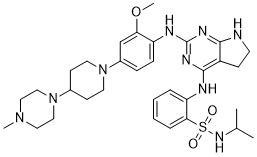
Conteltinib (CT-707) is a novel and potent tyrosine kinase inhibitor with antineoplastic activitiy. It acts a multi-kinase inhibitor targeting FAK, ALK, and Pyk2.
Physicochemical Properties
| Molecular Formula | C32H45N9O3S |
| Molecular Weight | 635.823204755783 |
| Exact Mass | 635.336 |
| CAS # | 1384860-29-0 |
| PubChem CID | 89860551 |
| Appearance | Light yellow to yellow solid powder |
| LogP | 5.1 |
| Hydrogen Bond Donor Count | 4 |
| Hydrogen Bond Acceptor Count | 12 |
| Rotatable Bond Count | 10 |
| Heavy Atom Count | 45 |
| Complexity | 1030 |
| Defined Atom Stereocenter Count | 0 |
| SMILES | S(C1C=CC=CC=1NC1=C2C(=NC(=N1)NC1C=CC(=CC=1OC)N1CCC(CC1)N1CCN(C)CC1)NCC2)(NC(C)C)(=O)=O |
| InChi Key | NPJCURIANJMFEO-UHFFFAOYSA-N |
| InChi Code | InChI=1S/C32H45N9O3S/c1-22(2)38-45(42,43)29-8-6-5-7-27(29)34-31-25-11-14-33-30(25)36-32(37-31)35-26-10-9-24(21-28(26)44-4)40-15-12-23(13-16-40)41-19-17-39(3)18-20-41/h5-10,21-23,38H,11-20H2,1-4H3,(H3,33,34,35,36,37) |
| Chemical Name | 2-[[2-[2-methoxy-4-[4-(4-methylpiperazin-1-yl)piperidin-1-yl]anilino]-6,7-dihydro-5H-pyrrolo[2,3-d]pyrimidin-4-yl]amino]-N-propan-2-ylbenzenesulfonamide |
| HS Tariff Code | 2934.99.9001 |
| Storage |
Powder-20°C 3 years 4°C 2 years In solvent -80°C 6 months -20°C 1 month |
| Shipping Condition | Room temperature (This product is stable at ambient temperature for a few days during ordinary shipping and time spent in Customs) |
Biological Activity
| ln Vitro | Conteltinib (CT-707) inhibits hepatocellular cancer by preventing FAK activation produced by XL184 in a synergistic manner [1]. In a human hepatocyte mitochondrial line, the combination of XL184 (5 μM) with Conteltinib (3 μM) led in heightened caspase-dependent cellular inflammation. This combination was much more efficacious than the solution medication alone [1]. Obesity rate is decreased and XL184 (5 μM) is induced by FAK phosphorylation [1]. |
| ln Vivo | HepG2 xenografts show good anti-tumor effects in nude mice when combined with CT-707 (ig 50 mg/kg twice daily for first 3 days, days 7, 8, 11, 12, and 14; once daily on days 4, 6, 9, 10, and 13; do not agree on day 5). XL184 (20 mg/kg once a day for the first 3 days; 10 mg/kg ig once a day on the 4th day; no dose on days 5 to 10; 10 mg/kg ig once a day on days 10 to 14). |
| Cell Assay |
Cell viability assay [1] Cell Types: Human hepatoma cell lines HepG2 and Bel-7402 Tested Concentrations: 1.0, 1.5, 2.0, 2.5 and 3.0 μM for HepG2 cells; 0.2, 0.4, 0.8, 1.5 and 3.0 μM for Bel-7402 cells Incubation Duration: 72 hrs (hours) Experimental Results: When cells were exposed to XL184 (5 μM), Conteltinib (3 μM), or their combination, survival rates were 57.3% and 39.3% and 11.2% respectively in HepG2; 57.8% in Bel-7402 %, 61.6% and 34.2%. Apoptosis analysis [1] Cell Types: HepG2 and Bel-7402 Cell Tested Concentrations: 3 μM Incubation Duration: 48 hrs (hours) Experimental Results: The apoptosis rates of the control group, XL184, Conteltinib and combination groups in HepG2 were 5.0%, 10.5%, respectively. 18.4%, and 41.1%, and Bel-7402 was 4.4%, 16.3%, 8.7%, and 36.4%, respectively. Western Blot Analysis[1] Cell Types: HepG2 and Bel-7402 Tested Concentrations: 3 μM Incubation Duration: 24 hrs (hours) Experimental Results: XL184-induced FAK phosphorylation was Dramatically diminished, which may be part of the reason for the synergistic effect. |
| Animal Protocol |
Animal/Disease Models: Nude mice transplanted with HepG2 xenografts [1] Doses: 50 mg/kg Route of Administration: intragastric (po) (po)(ig), twice a day for the first 3 days, days 7, 8, 11, Days 12 and 14; one time/day on days 4, 6, 9, 10, and 13; no administration on day 5. Experimental Results: Result in modest reduction in relative tumor volume (RTV). The inhibition rate of the combination group reached 77.4%, while the tumor weight of XL184 or CT-707 alone was suppressed by 30.7% and 19.4% respectively. |
| References |
[1]. CT-707, a Novel FAK Inhibitor, Synergizes with XL184 to Suppress Hepatocellular Carcinoma by Blocking XL184-Induced FAK Activation. Mol Cancer Ther. 2016 Dec;15(12):2916-2925. |
Solubility Data
| Solubility (In Vitro) | DMSO : ~31.25 mg/mL (~49.15 mM) |
| Solubility (In Vivo) |
Solubility in Formulation 1: ≥ 2.08 mg/mL (3.27 mM) (saturation unknown) in 10% DMSO + 40% PEG300 + 5% Tween80 + 45% Saline (add these co-solvents sequentially from left to right, and one by one), clear solution. For example, if 1 mL of working solution is to be prepared, you can add 100 μL of 20.8 mg/mL clear DMSO stock solution to 400 μL PEG300 and mix evenly; then add 50 μL Tween-80 to the above solution and mix evenly; then add 450 μL normal saline to adjust the volume to 1 mL. Preparation of saline: Dissolve 0.9 g of sodium chloride in 100 mL ddH₂ O to obtain a clear solution. Solubility in Formulation 2: ≥ 2.08 mg/mL (3.27 mM) (saturation unknown) in 10% DMSO + 90% (20% SBE-β-CD in Saline) (add these co-solvents sequentially from left to right, and one by one), clear solution. For example, if 1 mL of working solution is to be prepared, you can add 100 μL of 20.8 mg/mL clear DMSO stock solution to 900 μL of 20% SBE-β-CD physiological saline solution and mix evenly. Preparation of 20% SBE-β-CD in Saline (4°C,1 week): Dissolve 2 g SBE-β-CD in 10 mL saline to obtain a clear solution. Solubility in Formulation 3: ≥ 2.08 mg/mL (3.27 mM) (saturation unknown) in 10% DMSO + 90% Corn Oil (add these co-solvents sequentially from left to right, and one by one), clear solution. For example, if 1 mL of working solution is to be prepared, you can add 100 μL of 20.8 mg/mL clear DMSO stock solution to 900 μL of corn oil and mix evenly. (Please use freshly prepared in vivo formulations for optimal results.) |
| Preparing Stock Solutions | 1 mg | 5 mg | 10 mg | |
| 1 mM | 1.5728 mL | 7.8639 mL | 15.7277 mL | |
| 5 mM | 0.3146 mL | 1.5728 mL | 3.1455 mL | |
| 10 mM | 0.1573 mL | 0.7864 mL | 1.5728 mL |