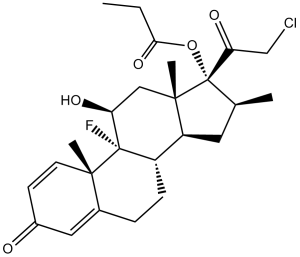
Clobetasol propionate (formerly CGP-9555, CCl-4725; CGP9555; CCl4725; Clobex Cosvate; Temovate; Olux Tenovate) is a topical corticosteroid used as an anti-inflammatory for treatment of various skin disorders including eczema and psoriasis.
Physicochemical Properties
| Molecular Formula | C25H32CLFO5 | |
| Molecular Weight | 466.97 | |
| Exact Mass | 466.192 | |
| CAS # | 25122-46-7 | |
| Related CAS # | 25122-46-7 (propionate);25122-41-2; | |
| PubChem CID | 32798 | |
| Appearance | White to off-white solid powder | |
| Density | 1.3±0.1 g/cm3 | |
| Boiling Point | 569.0±50.0 °C at 760 mmHg | |
| Melting Point | 195.5-197ºC | |
| Flash Point | 297.9±30.1 °C | |
| Vapour Pressure | 0.0±3.5 mmHg at 25°C | |
| Index of Refraction | 1.560 | |
| LogP | 3.98 | |
| Hydrogen Bond Donor Count | 1 | |
| Hydrogen Bond Acceptor Count | 6 | |
| Rotatable Bond Count | 5 | |
| Heavy Atom Count | 32 | |
| Complexity | 929 | |
| Defined Atom Stereocenter Count | 8 | |
| SMILES | CCC(=O)O[C@@]1([C@H](C[C@@H]2[C@@]1(C[C@@H]([C@]3([C@H]2CCC4=CC(=O)C=C[C@@]43C)F)O)C)C)C(=O)CCl |
|
| InChi Key | FKWXHUWJFNMNSE-NQNWYGNOSA-N | |
| InChi Code | InChI=1S/C25H32ClFO5/c1-5-21(31)32-23(4)14(2)10-18-17-7-6-15-11-16(28)8-9-22(15,3)25(17,27)19(29)12-24(18,23)20(30)13-26/h8-9,11,14,17-19,29H,5-7,10,12-13H2,1-4H3/t14-,17-,18-,19-,22-,23+,24-,25-/m0/s1 | |
| Chemical Name | (8S,9R,10S,11S,13R,14S,16S,17R)-13-(2-chloroacetyl)-9-fluoro-11-hydroxy-10,16,17-trimethyl-3-oxo-6,7,8,9,10,11,12,13,14,15,16,17-dodecahydro-3H-cyclopenta[a]phenanthren-17-yl propionate | |
| Synonyms |
|
|
| HS Tariff Code | 2934.99.9001 | |
| Storage |
Powder-20°C 3 years 4°C 2 years In solvent -80°C 6 months -20°C 1 month |
|
| Shipping Condition | Room temperature (This product is stable at ambient temperature for a few days during ordinary shipping and time spent in Customs) |
Biological Activity
| Targets |
Human Cytochrome P450 3A5 (CYP3A5): The Ki value of Clobetasol Propionate for inhibiting CYP3A5 was 0.02 μM (heme-mediated selective inhibition); it showed no significant inhibition on other CYP isoforms (e.g., CYP3A4, CYP1A2, CYP2C9, CYP2C19, CYP2D6) at concentrations up to 10 μM [1] |
| ln Vitro |
Clobetasol propionate has an IC50 of 15.6 μM against CYP3A4[1]. Clobetasol propionate (1 μM; 24 hours) did not raise the levels of CYP3A4 protein, but it preferentially inhibits CYP3A5. No cell lines (AsPC-1 wild type (WT), CYP3A5 overexpressing AsPC-1CYP3A5–/– cells ("3A5–/– + 3A5OE” cells), and AsPC-1CYP3A5–/– CYP3A4–overexpressing cells ("3A5–/– + 3A4OE” cells) were affected by clobetasol propionate [1]. Inhibition of CYP3A5 Activity: Clobetasol Propionate selectively inhibited recombinant human CYP3A5-mediated testosterone 6β-hydroxylation in a concentration-dependent manner, with an IC50 of 0.03 μM; this inhibition was reversed by increasing heme concentration, indicating heme-mediated interaction [1] - Anti-Psoriatic Activity on Keratinocytes: Clobetasol Propionate (0.05% formulation) suppressed the proliferation of psoriatic keratinocytes in vitro, reduced the expression of pro-inflammatory cytokines (e.g., TNF-α, IL-6) and chemokines (e.g., CXCL8) via inhibiting the NF-κB signaling pathway [2] - Efficacy in Psoriatic Skin Explants: In human psoriatic skin-SCID mouse transplant models, topical application of Clobetasol Propionate (0.05% cream) decreased epidermal thickness by 40–50% and reduced the number of CD3+ T cells in the dermis compared to untreated controls; it also downregulated the expression of psoriasis-related markers (e.g., keratin 17) [3] |
| ln Vivo |
In a transplant SCID mouse model of human psoriatic skin, clobetasol propionate (topically administered; applied daily for 14 days) decreased epidermal thickness in both normal and psoriatic skin [3]. Efficacy in Mouse Psoriasis Models: Topical administration of Clobetasol Propionate (0.05% cream) to imiquimod-induced psoriatic mice once daily for 7 days reduced ear thickness by 35% and decreased epidermal hyperplasia, as well as the infiltration of neutrophils and macrophages in the ear skin [2] - Efficacy in SCID Mouse Transplant Models: Clobetasol Propionate (0.05% cream, applied twice daily for 2 weeks) significantly ameliorated psoriatic lesions in human psoriatic skin grafted onto SCID mice, with a 30% reduction in the epidermal proliferation index (Ki-67+ cells) compared to Cyclosporin A (10 mg/kg, oral) [3] |
| Enzyme Assay |
CYP3A5 Inhibition Assay: The assay was conducted in a 100 μL reaction system containing recombinant human CYP3A5, NADPH-regenerating system (glucose-6-phosphate, glucose-6-phosphate dehydrogenase, NADP+), and testosterone (substrate). Clobetasol Propionate was added at different concentrations (0.001–10 μM), and the mixture was incubated at 37°C for 30 minutes. The reaction was stopped by adding acetonitrile, and the product (testosterone 6β-hydroxylate) was quantified using HPLC-MS/MS. The inhibition rate was calculated to determine Ki and IC50 values [1] |
| Cell Assay |
Keratinocyte Proliferation Assay: Primary psoriatic keratinocytes were cultured in DMEM medium with 10% FBS. Clobetasol Propionate was added at concentrations of 0.01, 0.1, 1, and 10 μM, and cells were incubated for 48 hours. Cell proliferation was measured using the MTT assay, and the IC50 for inhibiting keratinocyte proliferation was 0.2 μM. Western blot analysis was performed to detect the expression of NF-κB p65 (phosphorylated form), and PCR was used to quantify TNF-α and IL-6 mRNA levels [2] - Skin Explant Culture Assay: Human psoriatic skin tissues were cut into 4 mm biopsies and cultured in RPMI 1640 medium. Clobetasol Propionate (0.05% cream) was applied topically to the biopsies once daily for 5 days. Immunohistochemistry was used to stain for keratin 17 and CD3+ T cells, and epidermal thickness was measured using image analysis software [3] |
| Animal Protocol |
Imiquimod-Induced Psoriasis Mouse Model: Female BALB/c mice (6–8 weeks old) were used. Psoriasis was induced by topical application of 5% imiquimod cream on the right ear once daily for 6 days. From day 7, Clobetasol Propionate (0.05% cream) was applied topically to the right ear once daily for 7 days. Ear thickness was measured using a caliper every 2 days, and skin tissues were collected for histopathological analysis (H&E staining) [2] - SCID Mouse Human Skin Transplant Model: Male SCID mice (4–6 weeks old) were anesthetized, and human psoriatic skin biopsies (5 mm) were grafted onto the dorsal skin. After 2 weeks of graft stabilization, Clobetasol Propionate (0.05% cream) was applied topically to the grafted skin twice daily for 2 weeks. Mice were euthanized, and grafted skin was collected for immunohistochemistry (Ki-67, CD3 staining) and mRNA analysis [3] |
| ADME/Pharmacokinetics |
Absorption, Distribution and Excretion Twice daily application of clobetasol foam leads to a Cmax of 59±36pg/mL with a Tmax of 5 hours. Clobetasol cream showed an increase in clobetasol concentrations from 50.7±96.0pg/mL to 56.3±104.7pg/mL. Corticosteroids are eliminated predominantly in the urine. Data regarding the volume of distribution of clobetasole propionate are not readily available. Data regarding the clearance of clobetasol propionate are not readily available. Metabolism / Metabolites The metabolism of clobetasol propionate is not well studied but it does induce metabolic enzymes, even when delivered topically. The metabolism of clobetasol propionate is predicted to follow similar metabolic pathways to other corticosteroids including the addition of oxygen, hydrogen, glucuronides, and sulfates to form water soluble metabolites. Biological Half-Life Data regarding the half life of clobetasol propionate are not readily available. Topical Absorption: Clobetasol Propionate showed minimal systemic absorption after topical application in healthy human volunteers; the plasma concentration was below the detection limit (0.1 ng/mL) in 90% of subjects. In psoriatic patients, absorption was slightly increased (plasma concentration up to 0.3 ng/mL) due to impaired skin barrier, but no accumulation was observed after 4 weeks of daily application [2] |
| Toxicity/Toxicokinetics |
Protein Binding Data regarding the protein binding of clobetasol propionate are not readily available. Corticosteroids are generally bound to corticosteroid binding globulin and serum albumin in plasma. Local Skin Toxicity: Topical application of Clobetasol Propionate (0.05% cream) in humans was associated with mild local side effects, including skin atrophy (15% of patients), dryness (10%), and pruritus (5%); these effects were reversible after discontinuing treatment [2] |
| References |
[1]. Clobetasol Propionate Is a Heme-Mediated Selective Inhibitor of Human Cytochrome P450 3A5. J Med Chem. 2020 Feb 13;63(3):1415-1433. [2]. Topical clobetasol propionate in the treatment of psoriasis: a review of newer formulations. Am J Clin Dermatol. 2009;10(6):397-406. [3]. Anti-CD11a ameliorates disease in the human psoriatic skin-SCID mouse transplant model: comparison of antibody to CD11a with Cyclosporin A and clobetasol propionate. Lab Invest. 2001 Sep;81(9):1253-61. |
| Additional Infomation |
Clobetasol Propionate can cause developmental toxicity and female reproductive toxicity according to state or federal government labeling requirements. Clobetasol propionate is the 17-O-propionate ester of clobetasol. A potent corticosteroid, it is used to treat various skin disorders, including exzema and psoriasis. It has a role as an anti-inflammatory drug. It is an 11beta-hydroxy steroid, a 20-oxo steroid, a glucocorticoid, a fluorinated steroid, a 3-oxo-Delta(1),Delta(4)-steroid and a chlorinated steroid. It is functionally related to a clobetasol and a propionic acid. Clobetasol propionate is a prednisolone derivative with higher specificity for glucocorticoid receptors than mineralocorticoid receptors. It has demonstrated superior activity compared to [fluocinonide] and was first described in the literature in 1974. Clobetasol Propionate was granted FDA approval on 27 December 1985. Clobetasol Propionate is the propionate salt form of clobetasol, a topical synthetic corticosteroid with anti-inflammatory, anti-pruritic, and vasoconstrictive properties. Clobetasol propionate exerts its effect by binding to cytoplasmic glucocorticoid receptors and subsequently activates glucocorticoid receptor mediated gene expression. This results in synthesis of certain anti-inflammatory proteins, while inhibiting the synthesis of certain inflammatory mediators. Specifically, clobetasol propionate appears to induce phospholipase A2 inhibitory proteins, thereby controlling the release of the inflammatory precursor arachidonic acid from membrane phospholipids by phospholipase A2. A derivative of PREDNISOLONE with high glucocorticoid activity and low mineralocorticoid activity. Absorbed through the skin faster than FLUOCINONIDE, it is used topically in treatment of PSORIASIS but may cause marked adrenocortical suppression. See also: Clobetasol (has active moiety); Clobetasol propionate; niacinamide (component of); Clobetasol propionate; coal tar; salicylic acid (component of) ... View More ... Drug Indication Clobetasol propionate is indicated to treat moderate to severe plaque psoriasis as well as inflammatory and pruritic manifestations of corticosteroid responsive dermatoses. FDA Label Mechanism of Action The short term effects of corticosteroids are decreased vasodilation and permeability of capillaries, as well as decreased leukocyte migration to sites of inflammation. Corticosteroids binding to the glucocorticoid receptor mediates changes in gene expression that lead to multiple downstream effects over hours to days. Glucocorticoids inhibit neutrophil apoptosis and demargination; they inhibit phospholipase A2, which decreases the formation of arachidonic acid derivatives; they inhibit NF-Kappa B and other inflammatory transcription factors; they promote anti-inflammatory genes like interleukin-10. Lower doses of corticosteroids provide an anti-inflammatory effect, while higher doses are immunosuppressive. High doses of glucocorticoids for an extended period bind to the mineralocorticoid receptor, raising sodium levels and decreasing potassium levels. Pharmacodynamics Corticosteroids bind to the glucocorticoid receptor, inhibiting pro-inflammatory signals, and promoting anti-inflammatory signals. Clobetasol propionate is generally applied twice daily so the duration of action is long. Corticosteroids have a wide therapeutic window as patients may require doses that are multiples of what the body naturally produces. Patients taking corticosteroids should be counselled regarding the risk of hypothalamic-pituitary-adrenal axis suppression and increased susceptibility to infections. Indication: Clobetasol Propionate is a high-potency topical corticosteroid used for the treatment of moderate-to-severe psoriasis, especially plaque psoriasis [2] - Formulations: Newer formulations reported include foam, lotion, and spray, which show improved skin penetration and patient compliance compared to traditional creams; the foam formulation has a lower incidence of skin atrophy (8% vs. 15% for cream) [2] - Mechanism Comparison: In the SCID mouse model, Clobetasol Propionate showed similar efficacy to Cyclosporin A (immunosuppressant) in ameliorating psoriatic lesions but had a faster onset of action (7 days vs. 14 days for Cyclosporin A) [3] |
Solubility Data
| Solubility (In Vitro) |
|
|||
| Solubility (In Vivo) |
Solubility in Formulation 1: ≥ 2.5 mg/mL (5.35 mM) (saturation unknown) in 10% DMSO + 40% PEG300 + 5% Tween80 + 45% Saline (add these co-solvents sequentially from left to right, and one by one), clear solution. For example, if 1 mL of working solution is to be prepared, you can add 100 μL of 25.0 mg/mL clear DMSO stock solution to 400 μL PEG300 and mix evenly; then add 50 μL Tween-80 to the above solution and mix evenly; then add 450 μL normal saline to adjust the volume to 1 mL. Preparation of saline: Dissolve 0.9 g of sodium chloride in 100 mL ddH₂ O to obtain a clear solution. Solubility in Formulation 2: ≥ 2.5 mg/mL (5.35 mM) (saturation unknown) in 10% DMSO + 90% Corn Oil (add these co-solvents sequentially from left to right, and one by one), clear solution. For example, if 1 mL of working solution is to be prepared, you can add 100 μL of 25.0 mg/mL clear DMSO stock solution to 900 μL of corn oil and mix evenly. (Please use freshly prepared in vivo formulations for optimal results.) |
| Preparing Stock Solutions | 1 mg | 5 mg | 10 mg | |
| 1 mM | 2.1415 mL | 10.7073 mL | 21.4147 mL | |
| 5 mM | 0.4283 mL | 2.1415 mL | 4.2829 mL | |
| 10 mM | 0.2141 mL | 1.0707 mL | 2.1415 mL |