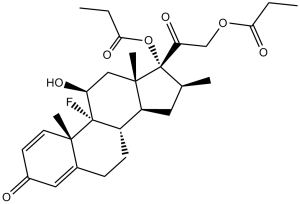
Betamethasone Dipropionate (Alphatrex; BetaVal; Diprolene; SCH-11460; SCH11460; Diprolene AF; Diprosone; Luxiq; Betamethasone 17,21-dipropionate) is a synthetic glucocorticoid steroid with anti-inflammatory and immunosuppressive activities. It is approved as a topical cream, ointment, lotion or gel (Diprolene) to treat itching and other minor skin conditions such as eczema.
Physicochemical Properties
| Molecular Formula | C28H37FO7 | |
| Molecular Weight | 504.59 | |
| Exact Mass | 504.252 | |
| CAS # | 5593-20-4 | |
| Related CAS # | Betamethasone;378-44-9;Beclometasone dipropionate;5534-09-8;Beclometasone dipropionate monohydrate;77011-63-3;Betamethasone dipropionate-d10;2280940-19-2 | |
| PubChem CID | 21800 | |
| Appearance | White to off-white solid powder | |
| Density | 1.2±0.1 g/cm3 | |
| Boiling Point | 603.2±55.0 °C at 760 mmHg | |
| Melting Point | 178 °C | |
| Flash Point | 318.6±31.5 °C | |
| Vapour Pressure | 0.0±3.9 mmHg at 25°C | |
| Index of Refraction | 1.550 | |
| LogP | 4.42 | |
| Hydrogen Bond Donor Count | 1 | |
| Hydrogen Bond Acceptor Count | 8 | |
| Rotatable Bond Count | 8 | |
| Heavy Atom Count | 36 | |
| Complexity | 1050 | |
| Defined Atom Stereocenter Count | 8 | |
| SMILES | CCC(=O)OCC(=O)[C@]1([C@H](C[C@@H]2[C@@]1(C[C@@H]([C@]3([C@H]2CCC4=CC(=O)C=C[C@@]43C)F)O)C)C)OC(=O)CC |
|
| InChi Key | CIWBQSYVNNPZIQ-XYWKZLDCSA-N | |
| InChi Code | InChI=1S/C28H37FO7/c1-6-23(33)35-15-22(32)28(36-24(34)7-2)16(3)12-20-19-9-8-17-13-18(30)10-11-25(17,4)27(19,29)21(31)14-26(20,28)5/h10-11,13,16,19-21,31H,6-9,12,14-15H2,1-5H3/t16-,19-,20-,21-,25-,26-,27-,28-/m0/s1 | |
| Chemical Name | (8S,9R,10S,11S,13S,14S,16S,17R)-9-fluoro-11-hydroxy-10,13,16-trimethyl-3-oxo-17-(2-(propionyloxy)acetyl)-6,7,8,9,10,11,12,13,14,15,16,17-dodecahydro-3H-cyclopenta[a]phenanthren-17-yl propionate | |
| Synonyms |
|
|
| HS Tariff Code | 2934.99.9001 | |
| Storage |
Powder-20°C 3 years 4°C 2 years In solvent -80°C 6 months -20°C 1 month |
|
| Shipping Condition | Room temperature (This product is stable at ambient temperature for a few days during ordinary shipping and time spent in Customs) |
Biological Activity
| ln Vivo |
Psoriasis, dermatitis, and eczema are inflammatory skin disorders that are treated with betomethona dipropionate, an extremely strong corticosteroid. This is an artificial counterpart of adrenocortical steroids. Efficacy in seborrhoeic dermatitis: Topical Betamethasone Dipropionate significantly improved clinical symptoms of seborrhoeic dermatitis (including erythema, scaling, pruritus, and inflammation) compared to placebo. After 2-4 weeks of treatment, the proportion of patients achieving "clear" or "markedly improved" status ranged from 65% to 82% [1] - Superiority to milder corticosteroids: Betamethasone Dipropionate showed greater efficacy than low-potency topical corticosteroids (e.g., hydrocortisone) in reducing severe scaling and pruritus, with a mean symptom score reduction of 40-55% versus 20-30% in the low-potency group [1] - Relapse prevention: Continuous low-dose maintenance therapy with Betamethasone Dipropionate (2-3 times weekly) reduced the relapse rate of seborrhoeic dermatitis by 38% compared to no maintenance therapy over a 12-week follow-up [1] |
| Toxicity/Toxicokinetics |
Local skin adverse effects: The most common adverse events associated with topical Betamethasone Dipropionate were mild to moderate local irritation (12-18% of patients), including burning, stinging, and dryness. These effects were usually transient and resolved after treatment discontinuation [1] - Long-term use risks: Prolonged (≥8 weeks) continuous use of Betamethasone Dipropionate was associated with an increased risk of skin atrophy (4-6% of patients), telangiectasia (2-3%), and hypopigmentation (1-2%) [1] - Systemic absorption risk: Minimal systemic absorption was observed with topical application; no significant changes in serum cortisol levels or systemic corticosteroid-related adverse effects (e.g., hypertension, hyperglycemia) were reported in clinical trials [1] |
| References | Cochrane Database Syst Rev. 2013 Jan 31;1:CD007633.doi: 10.1002/14651858.CD007633.pub2. |
| Additional Infomation |
Betamethasone dipropionate is a steroid ester that is betamethasone in which the hydroxy hydrogens at positions 17 and 21 are replaced by propanoyl groups. It is used in combination with calcipotriene hydrate, a synthetic vitamin D analogue, for the topical treatment of plaque psoriasis in adult patients. It has a role as an antipsoriatic. It is a steroid ester, an 11beta-hydroxy steroid, a 20-oxo steroid, a fluorinated steroid, a propanoate ester and a 3-oxo-Delta(1),Delta(4)-steroid. It is functionally related to a betamethasone. Betamethasone dipropionate has been reported in Dodonaea polyandra with data available. Betamethasone Dipropionate is the 17,21-dipropionate ester of betamethasone, a synthetic glucocorticoid with metabolic, immunosuppressive and anti-inflammatory actions. Betamethasone dipropionate binds to specific intracellular glucocorticoid receptors and subsequently binds to DNA to modify gene expression. The synthesis of certain anti-inflammatory proteins is induced while the synthesis of certain inflammatory mediators is inhibited. As a result, there is an overall reduction in chronic inflammation and autoimmune reactions. See also: Betamethasone (has active moiety); Betamethasone Dipropionate; Calcipotriene (component of); Betamethasone Dipropionate; Clotrimazole (component of) ... View More ... Betamethasone Dipropionate is a medium-to-high potency topical corticosteroid used for the treatment of inflammatory dermatoses, including seborrhoeic dermatitis [1] - Its therapeutic effect in seborrhoeic dermatitis is mediated by anti-inflammatory, antipruritic, and antikeratinizing properties [1] - The Cochrane review concluded that topical Betamethasone Dipropionate is effective for short-term (2-4 weeks) treatment of moderate-to-severe seborrhoeic dermatitis, but long-term continuous use should be avoided to minimize local skin adverse effects [1] |
Solubility Data
| Solubility (In Vitro) |
|
|||
| Solubility (In Vivo) |
Solubility in Formulation 1: 2.75 mg/mL (5.45 mM) in 10% DMSO + 40% PEG300 + 5% Tween80 + 45% Saline (add these co-solvents sequentially from left to right, and one by one), suspension solution; with sonication. For example, if 1 mL of working solution is to be prepared, you can add 100 μL of 27.5 mg/mL clear DMSO stock solution to 400 μL PEG300 and mix evenly; then add 50 μL Tween-80 to the above solution and mix evenly; then add 450 μL normal saline to adjust the volume to 1 mL. Preparation of saline: Dissolve 0.9 g of sodium chloride in 100 mL ddH₂ O to obtain a clear solution. Solubility in Formulation 2: ≥ 2.75 mg/mL (5.45 mM) (saturation unknown) in 10% DMSO + 90% Corn Oil (add these co-solvents sequentially from left to right, and one by one), clear solution. For example, if 1 mL of working solution is to be prepared, you can add 100 μL of 27.5 mg/mL clear DMSO stock solution to 900 μL of corn oil and mix evenly. (Please use freshly prepared in vivo formulations for optimal results.) |
| Preparing Stock Solutions | 1 mg | 5 mg | 10 mg | |
| 1 mM | 1.9818 mL | 9.9090 mL | 19.8181 mL | |
| 5 mM | 0.3964 mL | 1.9818 mL | 3.9636 mL | |
| 10 mM | 0.1982 mL | 0.9909 mL | 1.9818 mL |