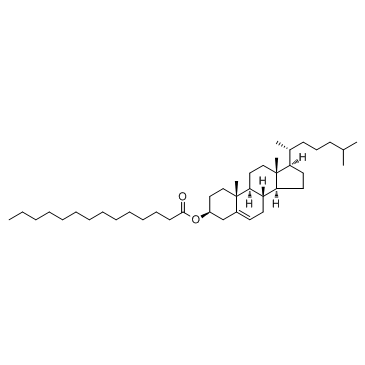
Cholesterol myristate is a naturally occurring steroid found in traditional Chinese medicine. It acts by binding to ion channels such as the nicotinic acetylcholine receptor, GABAA receptor, and the inward-rectifier potassium ion channel.
Physicochemical Properties
| Molecular Formula | C41H72O2 |
| Molecular Weight | 597.0092 |
| Exact Mass | 596.553 |
| CAS # | 1989-52-2 |
| Related CAS # | Cholesterol;57-88-5;Cholesteryl behenate;61510-09-6 |
| PubChem CID | 99486 |
| Appearance | White to off-white solid powder |
| Density | 0.95 g/cm3 |
| Boiling Point | 630.7ºC at 760 mmHg |
| Melting Point | 84 °C |
| Flash Point | 334.8ºC |
| Vapour Pressure | 8.15E-16mmHg at 25°C |
| Index of Refraction | 1.506 |
| LogP | 12.64 |
| Hydrogen Bond Donor Count | 0 |
| Hydrogen Bond Acceptor Count | 2 |
| Rotatable Bond Count | 19 |
| Heavy Atom Count | 43 |
| Complexity | 873 |
| Defined Atom Stereocenter Count | 8 |
| SMILES | CCCCCCCCCCCCCC(=O)O[C@H]1CC[C@@]2([C@H]3CC[C@]4([C@H]([C@@H]3CC=C2C1)CC[C@@H]4[C@H](C)CCCC(C)C)C)C |
| InChi Key | SJDMTGSQPOFVLR-ZPQCIJQQSA-N |
| InChi Code | InChI=1S/C41H72O2/c1-7-8-9-10-11-12-13-14-15-16-17-21-39(42)43-34-26-28-40(5)33(30-34)22-23-35-37-25-24-36(32(4)20-18-19-31(2)3)41(37,6)29-27-38(35)40/h22,31-32,34-38H,7-21,23-30H2,1-6H3/t32-,34+,35+,36-,37+,38+,40+,41-/m1/s1 |
| Chemical Name | [(3S,8S,9S,10R,13R,14S,17R)-10,13-dimethyl-17-[(2R)-6-methylheptan-2-yl]-2,3,4,7,8,9,11,12,14,15,16,17-dodecahydro-1H-cyclopenta[a]phenanthren-3-yl] tetradecanoate |
| HS Tariff Code | 2934.99.9001 |
| Storage |
Powder-20°C 3 years 4°C 2 years In solvent -80°C 6 months -20°C 1 month |
| Shipping Condition | Room temperature (This product is stable at ambient temperature for a few days during ordinary shipping and time spent in Customs) |
Biological Activity
| Targets |
Inhibitor of Differentiation (Id) proteins (Id1, Id2, Id3) [1][2] BMP-Id signaling pathway (inhibitor of BMP-induced apoptosis) [2] |
| ln Vitro |
In mesenchymal stem cells (MSCs) treated with an Id1 promoter reporter design, cholesterol myristate boosts Id1 promoter activity. MSC apoptosis induced by serum-free is inhibited by cholesterol myristate. In serum-free treated MSCs, cholesterol myristate upregulates the expression of Id1 and its target gene bcl-x/l. Furthermore, cholesterol myristate's anti-apoptotic activity is lessened by noggin, a BMP antagonist [1]. The induction of PC12 cell death in serum-free circumstances can be inhibited by cholesterol myristate. In PC12 cells treated without serum, cholesterol myristate markedly upregulates the expression of BMP4, BMPRIA, p-Smad1/5/8, Id1, and its anti-apoptotic target gene Bcl-xL [1]. In mesenchymal stem cells (MSCs), Cholesterol myristate (1, 5, 10 μM) dose-dependently suppressed apoptosis induced by serum deprivation: Annexin V-FITC/PI staining showed that the apoptotic rate decreased from 28.6% (control) to 18.2% (1 μM), 10.5% (5 μM), and 6.8% (10 μM). It upregulated the mRNA and protein expression of Id1, Id2, and Id3 (Id1 mRNA increased by 1.8-fold, 3.2-fold, 4.5-fold; Id2 by 1.5-fold, 2.9-fold, 4.1-fold; Id3 by 1.6-fold, 3.0-fold, 4.3-fold at 1, 5, 10 μM, respectively) and reduced the activation of caspase-3 (cleaved caspase-3 protein levels decreased by 35%-78%) and cleavage of PARP. [1] In PC12 cells, Cholesterol myristate (1, 5, 10 μM) concentration-dependently inhibited BMP2-induced apoptosis: The apoptotic rate (Annexin V staining) was reduced from 32.4% (BMP2 alone) to 22.1% (1 μM), 13.8% (5 μM), and 8.3% (10 μM) after 48 hours of treatment. It upregulated Id1-3 mRNA and protein expression (similar to MSC results) and attenuated BMP2-induced activation of the BMP signaling pathway (reduced phosphorylation of Smad1/5/8). Caspase-3 activity (colorimetric assay) was decreased by 30%-75% in a dose-dependent manner. [2] |
| Enzyme Assay |
Id protein expression detection (Western blot): Cells (MSCs/PC12) were lysed after treatment with Cholesterol myristate, and total proteins were separated by SDS-PAGE, transferred to membranes, and probed with antibodies against Id1, Id2, Id3, cleaved caspase-3, cleaved PARP, and GAPDH (internal reference). Protein band intensity was quantified to assess expression levels. [1][2] Id mRNA quantification (qPCR): Total RNA was extracted from treated cells, reverse-transcribed into cDNA, and qPCR was performed using specific primers for Id1, Id2, Id3, and GAPDH. Relative mRNA expression was calculated by the 2^(-ΔΔCt) method. [1][2] Caspase-3 activity assay: Cell lysates were prepared and incubated with a caspase-3-specific colorimetric substrate at 37°C for 2 hours. The absorbance was measured at 405 nm, and caspase-3 activity was calculated relative to the control group. [2] Smad phosphorylation detection (Western blot): PC12 cells treated with Cholesterol myristate and BMP2 were lysed, and proteins were probed with antibodies against phosphorylated Smad1/5/8 and total Smad1 to evaluate BMP signaling activation. [2] |
| Cell Assay |
MSC apoptosis suppression assay: Mesenchymal stem cells were seeded in 6-well plates (5×10⁴ cells/well) and cultured to 70% confluence. Cells were serum-deprived to induce apoptosis and simultaneously treated with Cholesterol myristate (1, 5, 10 μM) for 48 hours. Cells were collected for Annexin V-FITC/PI staining and flow cytometry to detect apoptotic rate; total RNA and proteins were extracted for qPCR and Western blot analysis of Id1-3, cleaved caspase-3, and cleaved PARP. [1] PC12 cell apoptosis suppression assay: PC12 cells were seeded in 6-well plates (1×10⁵ cells/well) and cultured overnight. Cells were pre-treated with Cholesterol myristate (1, 5, 10 μM) for 1 hour, then stimulated with BMP2 (50 ng/mL) to induce apoptosis. After 48 hours of incubation, apoptotic rate was detected by Annexin V-FITC/PI staining; caspase-3 activity was measured by colorimetric assay; qPCR and Western blot were used to quantify Id1-3 expression and Smad1/5/8 phosphorylation. [2] |
| References |
[1]. Cholesterol myristate suppresses the apoptosis of mesenchymal stem cells via upregulation of inhibitor of differentiation. Steroids. 2010 Dec 12;75(13-14):1119-26. [2]. BMP-Id pathway targeted by cholesterol myristate suppresses the apoptosis of PC12 cells. Brain Res. 2011 Jan 7;1367:33-42. [3]. Cholesterol binding to ion channels. Front Physiol. 2014 Feb 26;5:65. |
| Additional Infomation |
Cholesteryl myristate is a cholesterol ester obtained by the formal condensation of the hydroxy group of cholesterol with the carboxy group of myristic acid. It has a role as a mouse metabolite. Cholesteryl myristate has been reported in Trachyrhamphus serratus with data available. Cholesterol myristate is a cholesterol ester compound formed by the esterification of cholesterol and myristic acid. [1][2] Its core biological activity is the dose-dependent suppression of apoptosis in mesenchymal stem cells (MSCs) and PC12 cells (neuron-like cells) via upregulating the expression of Id proteins (Id1, Id2, Id3) and inhibiting the BMP-Id signaling pathway. [1][2] In PC12 cells, Cholesterol myristate reverses BMP2-induced apoptotic signaling by blocking Smad1/5/8 phosphorylation, thereby protecting cells from apoptotic death. [2] In MSCs, it exerts anti-apoptotic effects under serum deprivation conditions by reducing the activation of the caspase-dependent apoptotic pathway (inhibiting caspase-3 activation and PARP cleavage). [1] |
Solubility Data
| Solubility (In Vitro) |
Ethanol : ~3.33 mg/mL (~5.58 mM) H2O : < 0.1 mg/mL |
| Solubility (In Vivo) |
Note: Listed below are some common formulations that may be used to formulate products with low water solubility (e.g. < 1 mg/mL), you may test these formulations using a minute amount of products to avoid loss of samples. Injection Formulations (e.g. IP/IV/IM/SC) Injection Formulation 1: DMSO : Tween 80: Saline = 10 : 5 : 85 (i.e. 100 μL DMSO stock solution → 50 μL Tween 80 → 850 μL Saline) *Preparation of saline: Dissolve 0.9 g of sodium chloride in 100 mL ddH ₂ O to obtain a clear solution. Injection Formulation 2: DMSO : PEG300 :Tween 80 : Saline = 10 : 40 : 5 : 45 (i.e. 100 μL DMSO → 400 μLPEG300 → 50 μL Tween 80 → 450 μL Saline) Injection Formulation 3: DMSO : Corn oil = 10 : 90 (i.e. 100 μL DMSO → 900 μL Corn oil) Example: Take the Injection Formulation 3 (DMSO : Corn oil = 10 : 90) as an example, if 1 mL of 2.5 mg/mL working solution is to be prepared, you can take 100 μL 25 mg/mL DMSO stock solution and add to 900 μL corn oil, mix well to obtain a clear or suspension solution (2.5 mg/mL, ready for use in animals). Injection Formulation 4: DMSO : 20% SBE-β-CD in saline = 10 : 90 [i.e. 100 μL DMSO → 900 μL (20% SBE-β-CD in saline)] *Preparation of 20% SBE-β-CD in Saline (4°C,1 week): Dissolve 2 g SBE-β-CD in 10 mL saline to obtain a clear solution. Injection Formulation 5: 2-Hydroxypropyl-β-cyclodextrin : Saline = 50 : 50 (i.e. 500 μL 2-Hydroxypropyl-β-cyclodextrin → 500 μL Saline) Injection Formulation 6: DMSO : PEG300 : castor oil : Saline = 5 : 10 : 20 : 65 (i.e. 50 μL DMSO → 100 μLPEG300 → 200 μL castor oil → 650 μL Saline) Injection Formulation 7: Ethanol : Cremophor : Saline = 10: 10 : 80 (i.e. 100 μL Ethanol → 100 μL Cremophor → 800 μL Saline) Injection Formulation 8: Dissolve in Cremophor/Ethanol (50 : 50), then diluted by Saline Injection Formulation 9: EtOH : Corn oil = 10 : 90 (i.e. 100 μL EtOH → 900 μL Corn oil) Injection Formulation 10: EtOH : PEG300:Tween 80 : Saline = 10 : 40 : 5 : 45 (i.e. 100 μL EtOH → 400 μLPEG300 → 50 μL Tween 80 → 450 μL Saline) Oral Formulations Oral Formulation 1: Suspend in 0.5% CMC Na (carboxymethylcellulose sodium) Oral Formulation 2: Suspend in 0.5% Carboxymethyl cellulose Example: Take the Oral Formulation 1 (Suspend in 0.5% CMC Na) as an example, if 100 mL of 2.5 mg/mL working solution is to be prepared, you can first prepare 0.5% CMC Na solution by measuring 0.5 g CMC Na and dissolve it in 100 mL ddH2O to obtain a clear solution; then add 250 mg of the product to 100 mL 0.5% CMC Na solution, to make the suspension solution (2.5 mg/mL, ready for use in animals). Oral Formulation 3: Dissolved in PEG400 Oral Formulation 4: Suspend in 0.2% Carboxymethyl cellulose Oral Formulation 5: Dissolve in 0.25% Tween 80 and 0.5% Carboxymethyl cellulose Oral Formulation 6: Mixing with food powders Note: Please be aware that the above formulations are for reference only. InvivoChem strongly recommends customers to read literature methods/protocols carefully before determining which formulation you should use for in vivo studies, as different compounds have different solubility properties and have to be formulated differently. (Please use freshly prepared in vivo formulations for optimal results.) |
| Preparing Stock Solutions | 1 mg | 5 mg | 10 mg | |
| 1 mM | 1.6750 mL | 8.3751 mL | 16.7501 mL | |
| 5 mM | 0.3350 mL | 1.6750 mL | 3.3500 mL | |
| 10 mM | 0.1675 mL | 0.8375 mL | 1.6750 mL |