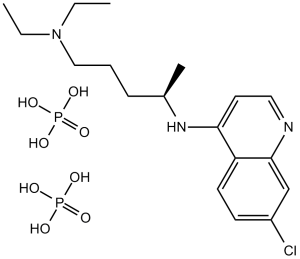
Chloroquine phosphate is reported to be highly effective in combating SARS-CoV-2 (COVID-19, CoronaVirus, or the COVID-19 pandemic) infection in vitro. It functions as a strong inhibitor of autophagy and toll-like receptors (TLRs) and a 4-aminoquinoline antimalarial drug that is used to treat and prevent malaria in regions where the disease is known to be susceptible to its effects. In addition to being an ATM activator, it also has anti-rheumatoid properties. Chloroquine diphosphate has been documented as an adjuvant for chemotherapy and radiation therapy to induce autophagy in cells and prevent the proliferation or metastasis of anti-cancer cells. The process by which chloroquine diphosphate induces autophagy in cells involves arresting them in the G1 phase, which up-regulates the expression of p53 and p27 and down-regulates the expression of CDK2 and cyclin D1.
Physicochemical Properties
| Molecular Formula | C18H32CLN3O8P2 | |
| Molecular Weight | 515.8625 | |
| Exact Mass | 515.14 | |
| Elemental Analysis | C, 41.91; H, 6.25; Cl, 6.87; N, 8.15; O, 24.81; P, 12.01 | |
| CAS # | 50-63-5 | |
| Related CAS # | Chloroquine phosphate;50-63-5;Chloroquine-d5;1854126-41-2;Chloroquine dihydrochloride;3545-67-3;Chloroquine-d5 diphosphate; 132-73-0 (sulfate); 1854126-42-3; 54-05-7 ;151-69-9 (acetate) ; 1446-17-9 (phosphate); 3545-67-3 (HCl) ; 50-63-5 (diphosphate) ; | |
| PubChem CID | 64927 | |
| Appearance | White to light yellow crystalline powder | |
| Boiling Point | 460.6ºC at 760 mmHg | |
| Melting Point | 200 °C | |
| Flash Point | 232.3ºC | |
| LogP | 3.03 | |
| Hydrogen Bond Donor Count | 7 | |
| Hydrogen Bond Acceptor Count | 11 | |
| Rotatable Bond Count | 8 | |
| Heavy Atom Count | 32 | |
| Complexity | 359 | |
| Defined Atom Stereocenter Count | 0 | |
| InChi Key | QKICWELGRMTQCR-UHFFFAOYSA-N | |
| InChi Code | InChI=1S/C18H26ClN3.2H3O4P/c1-4-22(5-2)12-6-7-14(3)21-17-10-11-20-18-13-15(19)8-9-16(17)18;2*1-5(2,3)4/h8-11,13-14H,4-7,12H2,1-3H3,(H,20,21);2*(H3,1,2,3,4) | |
| Chemical Name | 4-N-(7-chloroquinolin-4-yl)-1-N,1-N-diethylpentane-1,4-diamine;phosphoric acid | |
| Synonyms |
|
|
| HS Tariff Code | 2934.99.9001 | |
| Storage |
Powder-20°C 3 years 4°C 2 years In solvent -80°C 6 months -20°C 1 month Note: Please store this product in a sealed and protected environment (e.g. under nitrogen), avoid exposure to moisture and light. |
|
| Shipping Condition | Room temperature (This product is stable at ambient temperature for a few days during ordinary shipping and time spent in Customs) |
Biological Activity
| Targets | Plasmodium; Malaria; TLRs; SARS-COV-2; HIV-1 | |
| ln Vitro |
|
|
| ln Vivo |
|
|
| Enzyme Assay | Chloroquine suppressed matrix metalloproteinase (MMP)-2 and MMP-9 mRNA expression and protein activity, whereas MMP-13 mRNA expression and proteolytic activity were increased. Despite enhancing TLR9 mRNA expression, chloroquine suppressed TLR9 protein expression in vitro.[2] | |
| Cell Assay | The cells are cultivated in 6-well plates using normal culture medium with either vehicle or 25 or 50 μM chloroquine until they are almost confluent. Afterward, they are rinsed with sterile phosphate-buffered saline (PBS) and continue to culture in serum-free culture medium for the specified durations. Centrifugation is used to quickly harvest the cells in lysis buffer and clarify them after the culture medium is discarded at the predetermined time points. Once the supernatants have been boiled in reducing sodium dodecyl sulphate (SDS) sample buffer, 100 μg of protein is loaded into each lane. The samples are then electrophoresed into 10 or 4–20% gradient polyacrylamide SDS gels before being placed onto a nitrocellulose membrane. TLR9 is detected by incubating the blots with anti-TLR9 antibodies diluted 1:500 in Tris-buffered saline containing 0.1% (v/v) Tween-20 (TBST) for an overnight period at 4°C. Polyclonal rabbit anti-actin is used to confirm equal loading. Horseradish peroxidase-linked secondary antibodies are used in secondary detection. Using an ECL kit, the protein bands can be seen through chemiluminescence. | |
| Animal Protocol |
|
|
| Toxicity/Toxicokinetics |
Effects During Pregnancy and Lactation ◉ Summary of Use during Lactation Very small amounts of chloroquine are excreted in breast milk; when given once weekly, the amount of drug is not sufficient to harm the infant nor is the quantity sufficient to protect the child from malaria. United Kingdom malaria treatment guidelines recommend that weekly chloroquine 500 mg be given until breastfeeding is completed and primaquine can be given. Breastfeeding infants should receive the recommended dosages of chloroquine for malaria prophylaxis.In HIV-infected women, elevated viral HIV loads in milk were decreased after treatment with chloroquine to a greater extent than other women who were treated with the combination of sulfadoxine and pyrimethamine. Because no information is available on the daily use of chloroquine during breastfeeding, hydroxychloroquine or another agent may be preferred in this situation, especially while nursing a newborn or preterm infant. ◉ Effects in Breastfed Infants Several authors have pointed out that malaria prophylaxis in nursing mothers with chloroquine is common in endemic areas. As of the revision date, no reports of adverse reactions in breastfed infants have been published. ◉ Effects on Lactation and Breastmilk Relevant published information was not found as of the revision date. |
|
| References |
[1]. Chloroquine promotes IL-17 production by CD4+ T cells via p38-dependent IL-23 release by monocyte-derived Langerhans-like cells. J Immunol. 2014 Dec 15;193(12):6135-43. [2]. Chloroquine has tumor-inhibitory and tumor-promoting effects in triple-negative breast cancer. Oncol Lett. 2013 Dec;6(6):1665-1672. [3]. Effect of toll-like receptor 7 and 9 targeted therapy to prevent the development of hepatocellular carcinoma. Liver Int. 2014 Jul 2. doi: 10.1111/liv.12626. [4]. Chloroquine and hydroxychloroquine as available weapons to fight COVID-19. Int J Antimicrob Agents. 2020;55(4):105932. [5]. Remdesivir and chloroquine effectively inhibit the recently emerged novel coronavirus (2019-nCoV) in vitro. Cell Res. 2020 Mar;30(3):269-271. [6]. The anti-HIV-1 activity of chloroquine. J Clin Virol. 2001;20(3):131-135. |
|
| Additional Infomation |
Chloroquine Phosphate is the phosphate salt of chloroquine, a quinoline compound with antimalarial and anti-inflammatory properties. Chloroquine is the most widely used drug against malaria, except for those cases caused by chloroquine resistant Plasmodium falciparum. Although the mechanism of action is not fully understood, chloroquine is shown to inhibit the parasitic enzyme heme polymerase that converts the toxic heme into non-toxic hemazoin, thereby resulting in the accumulation of toxic heme within the parasite. Chloroquine may also interfere with the biosynthesis of nucleic acids. See also: Chloroquine (has active moiety); Chloroquine phosphate; primaquine phosphate (component of); Chloroquine Phosphate; Embutramide; Lidocaine (component of). |
Solubility Data
| Solubility (In Vitro) |
|
|||
| Solubility (In Vivo) |
Solubility in Formulation 1: 100 mg/mL (193.85 mM) in PBS (add these co-solvents sequentially from left to right, and one by one), clear solution; with sonication (<60°C). (Please use freshly prepared in vivo formulations for optimal results.) |
| Preparing Stock Solutions | 1 mg | 5 mg | 10 mg | |
| 1 mM | 1.9385 mL | 9.6926 mL | 19.3851 mL | |
| 5 mM | 0.3877 mL | 1.9385 mL | 3.8770 mL | |
| 10 mM | 0.1939 mL | 0.9693 mL | 1.9385 mL |