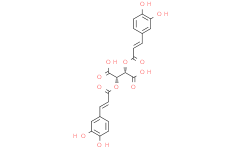
Physicochemical Properties
| Molecular Formula | C22H18O12 |
| Molecular Weight | 474.3711 |
| Exact Mass | 474.079 |
| CAS # | 70831-56-0 |
| Related CAS # | Chicoric acid;6537-80-0 |
| PubChem CID | 5281764 |
| Appearance | White to off-white solid powder |
| Density | 1.6±0.1 g/cm3 |
| Boiling Point | 785.0±60.0 °C at 760 mmHg |
| Melting Point | 206 °C |
| Flash Point | 272.9±26.4 °C |
| Vapour Pressure | 0.0±2.9 mmHg at 25°C |
| Index of Refraction | 1.726 |
| LogP | 3.81 |
| Hydrogen Bond Donor Count | 6 |
| Hydrogen Bond Acceptor Count | 12 |
| Rotatable Bond Count | 11 |
| Heavy Atom Count | 34 |
| Complexity | 740 |
| Defined Atom Stereocenter Count | 2 |
| SMILES | C1=CC(=C(C=C1/C=C/C(=O)O[C@@H](C(=O)O)[C@@H](OC(=O)/C=C/C2=CC(=C(C=C2)O)O)C(=O)O)O)O |
| InChi Key | YDDGKXBLOXEEMN-IABMMNSOSA-N |
| InChi Code | InChI=1S/C22H18O12/c23-13-5-1-11(9-15(13)25)3-7-17(27)33-19(21(29)30)20(22(31)32)34-18(28)8-4-12-2-6-14(24)16(26)10-12/h1-10,19-20,23-26H,(H,29,30)(H,31,32)/b7-3+,8-4+/t19-,20-/m1/s1 |
| Chemical Name | (2R,3R)-2,3-bis[[(E)-3-(3,4-dihydroxyphenyl)prop-2-enoyl]oxy]butanedioic acid |
| HS Tariff Code | 2934.99.9001 |
| Storage |
Powder-20°C 3 years 4°C 2 years In solvent -80°C 6 months -20°C 1 month Note: Please store this product in a sealed and protected environment (e.g. under nitrogen), avoid exposure to moisture. |
| Shipping Condition | Room temperature (This product is stable at ambient temperature for a few days during ordinary shipping and time spent in Customs) |
Biological Activity
| ln Vitro | At concentrations between 500 nM and 10 μM, L-chocoric acid inhibits integration; however, at values more than 1 μM, it also inhibits entrance. Viral entrance is considerably impacted by L-chichoric acid at doses of 5 μM or above. A decrease in integrated provirus and a rise in the DNA to cDNA ratio of the two LTR circles indicated that L-chichoric acid also impeded integration. About 500 nM is the EC50 of L-chichoric acid against HIV, and this quantity does not prevent HIV from infecting H9 cells [1]. L-chichoric acid had an ED50 of 400 nM against the HIVNL4-3 control virus, but it was completely ineffective against HIVNL4-3 passaged in the presence of 8 μM of this molecule [2]. |
| References |
[1]. L-chicoric acid inhibits human immunodeficiency virus type 1 integration in vivo and is a noncompetitive but reversible inhibitor of HIV-1 integrase in vitro. Virology. 2004 Sep 1;326(2):203-19. [2]. Resistance to the anti-human immunodeficiency virus type 1 compound L-chicoric acid results from a single mutation at amino acid 140 of integrase. J Virol. 1998 Oct;72(10):8420-4. [3]. Robinson WE Jr. L-chicoric acid, an inhibitor of human immunodeficiency virus type 1 (HIV-1) integrase, improves on the in vitro anti-HIV-1 effect of a protease inhibitor (AG1350). Antiviral Res. 1998 Aug;39(2):101-11. |
| Additional Infomation |
Chicoric acid is an organooxygen compound. It has a role as a HIV-1 integrase inhibitor and a geroprotector. It is functionally related to a tetracarboxylic acid. Chicoric acid has been reported in Camellia sinensis, Hydrastis canadensis, and other organisms with data available. |
Solubility Data
| Solubility (In Vitro) | DMSO : ~100 mg/mL (~210.81 mM) |
| Solubility (In Vivo) |
Solubility in Formulation 1: ≥ 2.5 mg/mL (5.27 mM) (saturation unknown) in 10% DMSO + 40% PEG300 + 5% Tween80 + 45% Saline (add these co-solvents sequentially from left to right, and one by one), clear solution. For example, if 1 mL of working solution is to be prepared, you can add 100 μL of 25.0 mg/mL clear DMSO stock solution to 400 μL PEG300 and mix evenly; then add 50 μL Tween-80 to the above solution and mix evenly; then add 450 μL normal saline to adjust the volume to 1 mL. Preparation of saline: Dissolve 0.9 g of sodium chloride in 100 mL ddH₂ O to obtain a clear solution. Solubility in Formulation 2: ≥ 2.5 mg/mL (5.27 mM) (saturation unknown) in 10% DMSO + 90% (20% SBE-β-CD in Saline) (add these co-solvents sequentially from left to right, and one by one), clear solution. For example, if 1 mL of working solution is to be prepared, you can add 100 μL of 25.0 mg/mL clear DMSO stock solution to 900 μL of 20% SBE-β-CD physiological saline solution and mix evenly. Preparation of 20% SBE-β-CD in Saline (4°C,1 week): Dissolve 2 g SBE-β-CD in 10 mL saline to obtain a clear solution. Solubility in Formulation 3: ≥ 2.5 mg/mL (5.27 mM) (saturation unknown) in 10% DMSO + 90% Corn Oil (add these co-solvents sequentially from left to right, and one by one), clear solution. For example, if 1 mL of working solution is to be prepared, you can add 100 μL of 25.0 mg/mL clear DMSO stock solution to 900 μL of corn oil and mix evenly. (Please use freshly prepared in vivo formulations for optimal results.) |
| Preparing Stock Solutions | 1 mg | 5 mg | 10 mg | |
| 1 mM | 2.1081 mL | 10.5403 mL | 21.0806 mL | |
| 5 mM | 0.4216 mL | 2.1081 mL | 4.2161 mL | |
| 10 mM | 0.2108 mL | 1.0540 mL | 2.1081 mL |