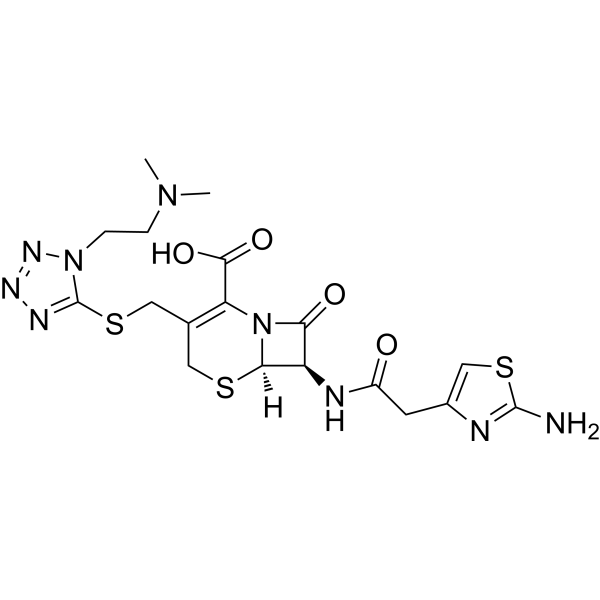
Physicochemical Properties
| Molecular Formula | C18H23N9O4S3 |
| Molecular Weight | 525.63 |
| Exact Mass | 525.103 |
| CAS # | 61622-34-2 |
| Related CAS # | Cefotiam hydrochloride;66309-69-1;Cefotiam dihydrochloride hydrate |
| PubChem CID | 43708 |
| Appearance | Typically exists as solid at room temperature |
| Density | 1.8±0.1 g/cm3 |
| Index of Refraction | 1.855 |
| LogP | 0.24 |
| Hydrogen Bond Donor Count | 3 |
| Hydrogen Bond Acceptor Count | 13 |
| Rotatable Bond Count | 10 |
| Heavy Atom Count | 34 |
| Complexity | 848 |
| Defined Atom Stereocenter Count | 2 |
| SMILES | O=C(C(N12)=C(CSC3=NN=NN3CCN(C)C)CS[C@]2([H])[C@H](NC(CC4=CSC(N)=N4)=O)C1=O)O |
| InChi Key | QYQDKDWGWDOFFU-IUODEOHRSA-N |
| InChi Code | InChI=1S/C18H23N9O4S3/c1-25(2)3-4-26-18(22-23-24-26)34-7-9-6-32-15-12(14(29)27(15)13(9)16(30)31)21-11(28)5-10-8-33-17(19)20-10/h8,12,15H,3-7H2,1-2H3,(H2,19,20)(H,21,28)(H,30,31)/t12-,15-/m1/s1 |
| Chemical Name | (6R,7R)-7-[[2-(2-amino-1,3-thiazol-4-yl)acetyl]amino]-3-[[1-[2-(dimethylamino)ethyl]tetrazol-5-yl]sulfanylmethyl]-8-oxo-5-thia-1-azabicyclo[4.2.0]oct-2-ene-2-carboxylic acid |
| HS Tariff Code | 2934.99.9001 |
| Storage |
Powder-20°C 3 years 4°C 2 years In solvent -80°C 6 months -20°C 1 month |
| Shipping Condition | Room temperature (This product is stable at ambient temperature for a few days during ordinary shipping and time spent in Customs) |
Biological Activity
| ln Vitro | Cefotiam (SCE-963; 0-6.25 μg/mL; 8 h) shows MIC value of 1.56 μg/mL antibacterial activity against P. mirabilis IFO 3849 [1]. Cefotiam exhibits excellent activity against Staphylococcus aureus and Staphylococcus aureus (0–6.25μg/mL; 8 hours). MIC values for Staphylococcus aureus (27 strains) and Staphylococcus aureus. albus (8 strains) range from 0.25 to 0.5 μg/mL. The minimum inhibitory concentration (MIC) ranged from 0.06-4 μg/mL for all 29 strains of hemolytic streptococcus, 9 strains of pneumococci, and 6 strains of viridans streptococci [2]. |
| ln Vivo | Mice with urinary tract infections caused by Proteus mirabilis can be cured of these infections by administering cefotiam (SCE-963; 12.5-800 mg/kg; intravenously; twice daily for five days) which also reduces or eliminates bacteria in the kidneys and bladder wall [1]. |
| Animal Protocol |
Animal/Disease Models: Kiwi fruit xenograft in female CF1/b mice [1] Doses: 12.5, 25, 50, 100, 200, 400 and 800 mg/kg twice (two times) daily for 5 days Experimental Results: The day after the end of treatment The mice that were sacrificed had diminished or complete eradication of bacteria in their bladder walls and kidneys. |
| ADME/Pharmacokinetics |
Absorption, Distribution and Excretion Rapidly absorbed following intramuscular injection. Bioavailability is 60% following intramuscular injection. Biological Half-Life Approximately 1 hour. |
| Toxicity/Toxicokinetics |
Protein Binding 40% |
| References |
[1]. Iwahi T, et, al. Comparative activities of cefotiam and cefazolin against urinary tract infections with Proteus mirabilis in mice. Antimicrob Agents Chemother. 1980 Aug;18(2):257-63. [2]. Watt B, et, al. In-vitro activity of cefotiam against bacteria of clinical interest. J Antimicrob Chemother. 1982 Nov;10(5):391-5. |
| Additional Infomation |
Cefotiam is a cephalosporin with ({1-[2-(dimethylamino)ethyl]-1H-tetrazol-5-yl}sulfanyl)methyl and (2-amino-1,3-thiazol-4-yl)acetamido substituents at positions 3 and 7, respectively, of the cephem skeleton. A third generation beta-lactam cephalosporin antibiotic, it is active against a broad spectrum of both Gram positive and Gram negative bacteria. It has a role as an antibacterial drug. It is a cephalosporin, a semisynthetic derivative and a beta-lactam antibiotic allergen. One of the cephalosporins that has a broad spectrum of activity against both gram-positive and gram-negative microorganisms. Cefotiam has been reported in Bos taurus with data available. Cefotiam is a third-generation, semi-synthetic, beta-lactam cephalosporin antibiotic with antibacterial activity. Cefotiam binds to penicillin-binding proteins (PBPs), transpeptidases that are responsible for crosslinking of peptidoglycan. By preventing crosslinking of peptidoglycan, cell wall integrity is lost and cell wall synthesis is halted. One of the CEPHALOSPORINS that has a broad spectrum of activity against both gram-positive and gram-negative microorganisms. Drug Indication For treatment of severe infections caused by susceptible bacteria. Mechanism of Action The bactericidal activity of cefotiam results from the inhibition of cell wall synthesis via affinity for penicillin-binding proteins (PBPs). Pharmacodynamics Cefotiam is a third generation beta-lactam cephalosporin antibiotic that works by inhibiting bacterial cell wall biosynthesis. It is a broad spectrum antibiotic that is effective against Gram positive and Gram negative bacteria. |
Solubility Data
| Solubility (In Vitro) | May dissolve in DMSO (in most cases), if not, try other solvents such as H2O, Ethanol, or DMF with a minute amount of products to avoid loss of samples |
| Solubility (In Vivo) |
Note: Listed below are some common formulations that may be used to formulate products with low water solubility (e.g. < 1 mg/mL), you may test these formulations using a minute amount of products to avoid loss of samples. Injection Formulations (e.g. IP/IV/IM/SC) Injection Formulation 1: DMSO : Tween 80: Saline = 10 : 5 : 85 (i.e. 100 μL DMSO stock solution → 50 μL Tween 80 → 850 μL Saline) *Preparation of saline: Dissolve 0.9 g of sodium chloride in 100 mL ddH ₂ O to obtain a clear solution. Injection Formulation 2: DMSO : PEG300 :Tween 80 : Saline = 10 : 40 : 5 : 45 (i.e. 100 μL DMSO → 400 μLPEG300 → 50 μL Tween 80 → 450 μL Saline) Injection Formulation 3: DMSO : Corn oil = 10 : 90 (i.e. 100 μL DMSO → 900 μL Corn oil) Example: Take the Injection Formulation 3 (DMSO : Corn oil = 10 : 90) as an example, if 1 mL of 2.5 mg/mL working solution is to be prepared, you can take 100 μL 25 mg/mL DMSO stock solution and add to 900 μL corn oil, mix well to obtain a clear or suspension solution (2.5 mg/mL, ready for use in animals). Injection Formulation 4: DMSO : 20% SBE-β-CD in saline = 10 : 90 [i.e. 100 μL DMSO → 900 μL (20% SBE-β-CD in saline)] *Preparation of 20% SBE-β-CD in Saline (4°C,1 week): Dissolve 2 g SBE-β-CD in 10 mL saline to obtain a clear solution. Injection Formulation 5: 2-Hydroxypropyl-β-cyclodextrin : Saline = 50 : 50 (i.e. 500 μL 2-Hydroxypropyl-β-cyclodextrin → 500 μL Saline) Injection Formulation 6: DMSO : PEG300 : castor oil : Saline = 5 : 10 : 20 : 65 (i.e. 50 μL DMSO → 100 μLPEG300 → 200 μL castor oil → 650 μL Saline) Injection Formulation 7: Ethanol : Cremophor : Saline = 10: 10 : 80 (i.e. 100 μL Ethanol → 100 μL Cremophor → 800 μL Saline) Injection Formulation 8: Dissolve in Cremophor/Ethanol (50 : 50), then diluted by Saline Injection Formulation 9: EtOH : Corn oil = 10 : 90 (i.e. 100 μL EtOH → 900 μL Corn oil) Injection Formulation 10: EtOH : PEG300:Tween 80 : Saline = 10 : 40 : 5 : 45 (i.e. 100 μL EtOH → 400 μLPEG300 → 50 μL Tween 80 → 450 μL Saline) Oral Formulations Oral Formulation 1: Suspend in 0.5% CMC Na (carboxymethylcellulose sodium) Oral Formulation 2: Suspend in 0.5% Carboxymethyl cellulose Example: Take the Oral Formulation 1 (Suspend in 0.5% CMC Na) as an example, if 100 mL of 2.5 mg/mL working solution is to be prepared, you can first prepare 0.5% CMC Na solution by measuring 0.5 g CMC Na and dissolve it in 100 mL ddH2O to obtain a clear solution; then add 250 mg of the product to 100 mL 0.5% CMC Na solution, to make the suspension solution (2.5 mg/mL, ready for use in animals). Oral Formulation 3: Dissolved in PEG400 Oral Formulation 4: Suspend in 0.2% Carboxymethyl cellulose Oral Formulation 5: Dissolve in 0.25% Tween 80 and 0.5% Carboxymethyl cellulose Oral Formulation 6: Mixing with food powders Note: Please be aware that the above formulations are for reference only. InvivoChem strongly recommends customers to read literature methods/protocols carefully before determining which formulation you should use for in vivo studies, as different compounds have different solubility properties and have to be formulated differently. (Please use freshly prepared in vivo formulations for optimal results.) |
| Preparing Stock Solutions | 1 mg | 5 mg | 10 mg | |
| 1 mM | 1.9025 mL | 9.5124 mL | 19.0248 mL | |
| 5 mM | 0.3805 mL | 1.9025 mL | 3.8050 mL | |
| 10 mM | 0.1902 mL | 0.9512 mL | 1.9025 mL |