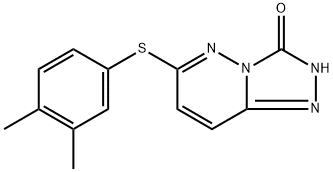
Physicochemical Properties
| Molecular Formula | C13H12N4OS |
| CAS # | 2764748-88-9 |
| PubChem CID | 163196272 |
| Appearance | Light yellow to yellow solid powder |
| Hydrogen Bond Donor Count | 1 |
| Hydrogen Bond Acceptor Count | 4 |
| Rotatable Bond Count | 2 |
| Heavy Atom Count | 19 |
| Complexity | 485 |
| Defined Atom Stereocenter Count | 0 |
| HS Tariff Code | 2934.99.9001 |
| Storage |
Powder-20°C 3 years 4°C 2 years In solvent -80°C 6 months -20°C 1 month |
| Shipping Condition | Room temperature (This product is stable at ambient temperature for a few days during ordinary shipping and time spent in Customs) |
Biological Activity
| Targets | Carboxylesterase Notum (IC50 = 12.3 nM) |
| ln Vitro |
Enzyme Activity: Carboxylesterase-IN-2 potently inhibits human Notum with an IC50 of 12.3 nM in a fluorescence-based enzymatic assay. The compound binds covalently to the catalytic serine residue (Ser139) of Notum, irreversibly blocking its activity. Binding Mode: Virtual screening and X-ray crystallography revealed that Carboxylesterase-IN-2 forms a stable complex with Notum, engaging in hydrogen bonds with key residues (e.g., Asp253, His254) and hydrophobic interactions within the active site. |
| Enzyme Assay |
Fluorescence-Based Enzymatic Assay: Recombinant human Notum was incubated with a fluorescent substrate (4-methylumbelliferyl butyrate) and varying concentrations of Carboxylesterase-IN-2 in Tris-HCl buffer (pH 7.4). After 30 minutes at 37°C, fluorescence intensity was measured to determine substrate hydrolysis. IC50 values were calculated using nonlinear regression. X-ray Crystallography: Crystals of Notum complexed with Carboxylesterase-IN-2 were grown by vapor diffusion and analyzed at 1.8 Å resolution. The structure confirmed covalent modification of Ser139 and key interactions stabilizing the inhibitor-protein complex. |
| Cell Assay |
Wnt Signaling Activation: In HEK293T cells transfected with a TOPFlash luciferase reporter, Carboxylesterase-IN-2 (1-100 nM) restored Wnt signaling activity inhibited by recombinant Notum, with an EC50 of 28.7 nM. This effect was abrogated by co-treatment with a Wnt antagonist (Dickkopf-1). |
| References |
[1]. Virtual Screening Directly Identifies New Fragment-Sized Inhibitors of Carboxylesterase Notum with Nanomolar Activity. J Med Chem. 2022;65(1):562-578. |
| Additional Infomation |
Fragment-Based Design: Carboxylesterase-IN-2 was identified through virtual screening of a fragment library, followed by hit-to-lead optimization. The compound’s small molecular weight (MW = 287 Da) and high ligand efficiency (LE = 0.42) make it a promising starting point for drug development. Selectivity: The compound showed >100-fold selectivity for Notum over other carboxylesterases (e.g., CES1, CES2) in biochemical assays. |
Solubility Data
| Solubility (In Vitro) | DMSO : ~50 mg/mL (~183.60 mM) |
| Solubility (In Vivo) |
Note: Listed below are some common formulations that may be used to formulate products with low water solubility (e.g. < 1 mg/mL), you may test these formulations using a minute amount of products to avoid loss of samples. Injection Formulations (e.g. IP/IV/IM/SC) Injection Formulation 1: DMSO : Tween 80: Saline = 10 : 5 : 85 (i.e. 100 μL DMSO stock solution → 50 μL Tween 80 → 850 μL Saline) *Preparation of saline: Dissolve 0.9 g of sodium chloride in 100 mL ddH ₂ O to obtain a clear solution. Injection Formulation 2: DMSO : PEG300 :Tween 80 : Saline = 10 : 40 : 5 : 45 (i.e. 100 μL DMSO → 400 μLPEG300 → 50 μL Tween 80 → 450 μL Saline) Injection Formulation 3: DMSO : Corn oil = 10 : 90 (i.e. 100 μL DMSO → 900 μL Corn oil) Example: Take the Injection Formulation 3 (DMSO : Corn oil = 10 : 90) as an example, if 1 mL of 2.5 mg/mL working solution is to be prepared, you can take 100 μL 25 mg/mL DMSO stock solution and add to 900 μL corn oil, mix well to obtain a clear or suspension solution (2.5 mg/mL, ready for use in animals). Injection Formulation 4: DMSO : 20% SBE-β-CD in saline = 10 : 90 [i.e. 100 μL DMSO → 900 μL (20% SBE-β-CD in saline)] *Preparation of 20% SBE-β-CD in Saline (4°C,1 week): Dissolve 2 g SBE-β-CD in 10 mL saline to obtain a clear solution. Injection Formulation 5: 2-Hydroxypropyl-β-cyclodextrin : Saline = 50 : 50 (i.e. 500 μL 2-Hydroxypropyl-β-cyclodextrin → 500 μL Saline) Injection Formulation 6: DMSO : PEG300 : castor oil : Saline = 5 : 10 : 20 : 65 (i.e. 50 μL DMSO → 100 μLPEG300 → 200 μL castor oil → 650 μL Saline) Injection Formulation 7: Ethanol : Cremophor : Saline = 10: 10 : 80 (i.e. 100 μL Ethanol → 100 μL Cremophor → 800 μL Saline) Injection Formulation 8: Dissolve in Cremophor/Ethanol (50 : 50), then diluted by Saline Injection Formulation 9: EtOH : Corn oil = 10 : 90 (i.e. 100 μL EtOH → 900 μL Corn oil) Injection Formulation 10: EtOH : PEG300:Tween 80 : Saline = 10 : 40 : 5 : 45 (i.e. 100 μL EtOH → 400 μLPEG300 → 50 μL Tween 80 → 450 μL Saline) Oral Formulations Oral Formulation 1: Suspend in 0.5% CMC Na (carboxymethylcellulose sodium) Oral Formulation 2: Suspend in 0.5% Carboxymethyl cellulose Example: Take the Oral Formulation 1 (Suspend in 0.5% CMC Na) as an example, if 100 mL of 2.5 mg/mL working solution is to be prepared, you can first prepare 0.5% CMC Na solution by measuring 0.5 g CMC Na and dissolve it in 100 mL ddH2O to obtain a clear solution; then add 250 mg of the product to 100 mL 0.5% CMC Na solution, to make the suspension solution (2.5 mg/mL, ready for use in animals). Oral Formulation 3: Dissolved in PEG400 Oral Formulation 4: Suspend in 0.2% Carboxymethyl cellulose Oral Formulation 5: Dissolve in 0.25% Tween 80 and 0.5% Carboxymethyl cellulose Oral Formulation 6: Mixing with food powders Note: Please be aware that the above formulations are for reference only. InvivoChem strongly recommends customers to read literature methods/protocols carefully before determining which formulation you should use for in vivo studies, as different compounds have different solubility properties and have to be formulated differently. (Please use freshly prepared in vivo formulations for optimal results.) |