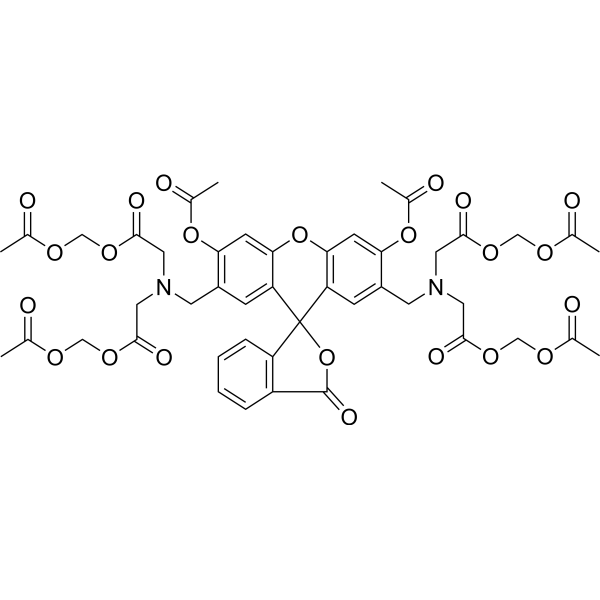
Physicochemical Properties
| Molecular Formula | C46H46N2O23 |
| Molecular Weight | 994.8571 |
| Exact Mass | 994.249 |
| CAS # | 148504-34-1 |
| PubChem CID | 390986 |
| Appearance | White to off-white solid powder |
| Density | 1.5±0.1 g/cm3 |
| Boiling Point | 982.7±65.0 °C at 760 mmHg |
| Flash Point | 548.1±34.3 °C |
| Vapour Pressure | 0.0±0.3 mmHg at 25°C |
| Index of Refraction | 1.611 |
| LogP | 3.49 |
| Hydrogen Bond Donor Count | 0 |
| Hydrogen Bond Acceptor Count | 25 |
| Rotatable Bond Count | 32 |
| Heavy Atom Count | 71 |
| Complexity | 1810 |
| Defined Atom Stereocenter Count | 0 |
| SMILES | CC(=O)OCOC(=O)CN(CC1=CC2=C(C=C1OC(=O)C)OC3=C(C24C5=CC=CC=C5C(=O)O4)C=C(C(=C3)OC(=O)C)CN(CC(=O)OCOC(=O)C)CC(=O)OCOC(=O)C)CC(=O)OCOC(=O)C |
| InChi Key | BQRGNLJZBFXNCZ-UHFFFAOYSA-N |
| InChi Code | InChI=1S/C46H46N2O23/c1-25(49)60-21-64-41(55)17-47(18-42(56)65-22-61-26(2)50)15-31-11-35-39(13-37(31)68-29(5)53)70-40-14-38(69-30(6)54)32(12-36(40)46(35)34-10-8-7-9-33(34)45(59)71-46)16-48(19-43(57)66-23-62-27(3)51)20-44(58)67-24-63-28(4)52/h7-14H,15-24H2,1-6H3 |
| Chemical Name | acetyloxymethyl 2-[[2-(acetyloxymethoxy)-2-oxoethyl]-[[3',6'-diacetyloxy-7'-[[bis[2-(acetyloxymethoxy)-2-oxoethyl]amino]methyl]-3-oxospiro[2-benzofuran-1,9'-xanthene]-2'-yl]methyl]amino]acetate |
| Synonyms | Calcein AM; 148504-34-1; Calcein-AM; Glycine, N,N'-[[3',6'-bis(acetyloxy)-3-oxospiro[isobenzofuran-1(3H),9'-[9H]xanthene]-2',7'-diyl]bis(methylene)]bis[N-[2-[(acetyloxy)methoxy]-2-oxoethyl]-, 1,1'-bis[(acetyloxy)methyl] ester; acetyloxymethyl 2-[[2-(acetyloxymethoxy)-2-oxoethyl]-[[3',6'-diacetyloxy-7'-[[bis[2-(acetyloxymethoxy)-2-oxoethyl]amino]methyl]-3-oxospiro[2-benzofuran-1,9'-xanthene]-2'-yl]methyl]amino]acetate; Tetrakis(acetoxymethyl) 2,2',2'',2'''-(((3',6'-diacetoxy-3-oxo-3H-spiro[isobenzofuran-1,9'-xanthene]-2',7'-diyl)bis(methylene))bis(azanetriyl))tetraacetate; acetoxymethyl 2-[[2-(acetoxymethoxy)-2-oxo-ethyl]-[[3',6'-diacetoxy-7'-[[bis[2-(acetoxymethoxy)-2-oxo-ethyl]amino]methyl]-3-oxo-spiro[isobenzofuran-1,9'-xanthene]-2'-yl]methyl]amino]acetate; calcein-acetoxymethyl ester; |
| HS Tariff Code | 2934.99.9001 |
| Storage |
Powder-20°C 3 years 4°C 2 years In solvent -80°C 6 months -20°C 1 month Note: This product requires protection from light (avoid light exposure) during transportation and storage. |
| Shipping Condition | Room temperature (This product is stable at ambient temperature for a few days during ordinary shipping and time spent in Customs) |
Biological Activity
| Targets | Fluorescent Dye; Emission (Em) = 515; Excitation (Ex) = 485 |
| ln Vitro |
Instruction for use 1. Preparation of Calcein AM working solution Prepare 5 mM stock solution with DMSO, then dilute the stock solution with preheated serum-free cell culture medium or PBS to prepare 1-10 μ M Calcein AM working solution. Note: Please adjust the concentration of Calcein AM working solution based on you specific needs, and use and prepare it freshly. 2. Cell staining (suspended cells) 2.1 Centrifuge and collect cells, wash twice with PBS for 5 minutes each time. The cell density is 1 × 10~6/mL. 2.2 Add 1 mL Calcein AM working solution and incubate at 37 ℃ for 30-45 minutes. 2.3 400 g, centrifuge for 3-4 minutes, discard the supernatant. 2.4 Wash the cells twice with PBS, each time for 5 minutes. After resuspending cells in 1 mL serum-free medium or PBS, observe them using a fluorescence microscope or flow cytometer. 3. Cell staining (adherent cells) 3.1 Culture adherent cells on sterile coverslips. 3.2 Remove the cover glass from the culture medium and aspirate excess culture medium. 3.3 Add 100 μ L of dye working solution, gently shake to completely cover the cells, and incubate at 37 ℃ for 30-45 minutes. 3.4 Remove the dye working solution, wash 2-3 times with culture medium for 5 minutes each time, and observe using a fluorescence microscope or fluorescence enzyme-linked immunosorbent assay (ELISA) detector. |
| ln Vivo | Since calcein-AM is a marker of cell viability and does not impair cell function, it has been determined to be appropriate for use in domestic research [2]. |
| Cell Assay |
- Multidrug transporter function assay: In cells expressing multidrug transporters, Calcein-AM enters cells and is hydrolyzed by esterases to calcein, a fluorescent product. Calcein is actively effluxed by multidrug transporters, and changes in intracellular fluorescence intensity reflect transporter activity. Lower fluorescence intensity indicates higher transporter activity. [1] - Cytotoxicity assessment: Calcein-AM penetrates viable cells and is hydrolyzed to fluorescent calcein. Cytotoxic agents that impair esterase activity or membrane integrity reduce intracellular fluorescence. Decreased fluorescence intensity correlates with increased cytotoxicity. [2] - Cell-cell adhesion assay: Lymphocytes labeled with Calcein-AM are co-cultured with target cells. Adhesion is quantified by measuring retained fluorescence after washing unbound cells; higher fluorescence indicates stronger cell-cell adhesion. [3] - Erythrocyte viability and aging detection: Calcein-AM enters erythrocytes and is hydrolyzed to fluorescent calcein. Reduced fluorescence intensity correlates with decreased viability or increased aging, as esterase activity declines in senescent or damaged cells. [4] - Multidrug transporter assay: 1. Seed transporter-expressing cells in 96-well plates and incubate until confluent. 2. Add Calcein-AM (final concentration 0.1-1 μM) and incubate at 37°C for 30-60 minutes. 3. Measure intracellular fluorescence (Ex/Em = 485/535 nm) using a microplate reader. Compare with control cells lacking transporters to quantify efflux activity. [1] - Cytotoxicity test: 1. Seed target cells in 96-well plates and treat with test compounds for 24-48 hours. 2. Add Calcein-AM (0.5 μM) and incubate for 30 minutes. 3. Measure fluorescence; calculate cytotoxicity as the percentage reduction compared to untreated controls. [2] - Cell-cell adhesion assay: 1. Label lymphocytes with Calcein-AM (5 μM) for 30 minutes, then wash to remove excess dye. 2. Co-culture labeled lymphocytes with target cells in 96-well plates at a 10:1 ratio for 1 hour. 3. Wash gently to remove non-adherent cells and measure retained fluorescence. [3] - Erythrocyte viability assay: 1. Incubate erythrocyte suspensions with Calcein-AM (1 μM) at 37°C for 45 minutes. 2. Analyze fluorescence intensity using flow cytometry or a microplate reader. Correlate fluorescence with viability (higher fluorescence = greater viability). [4] |
| References |
[1]. Calcein accumulation as a fluorometric functional assay of the multidrug transporter. Biochim Biophys Acta. 1994 May 11;1191(2):384-8. [2]. A new microcellular cytotoxicity test based on calcein-AM release. Hum Immunol. 1993 Aug;37(4):264-70. [3]. A non-isotopic, highly sensitive, fluorimetric, cell-cell adhesion microplate assay using calceinAM-labeled lymphocytes. J Immunol Methods. 1995 Jan 13;178(1):41-51. [4]. Novel fluorescence assay using calcein-AM for the determination of human erythrocyte viabilityand aging. Cytometry A. 2005 Jul;66(1):78-84. |
| Additional Infomation |
Calcein am is an organic heteropentacyclic compound that is calcein in which all four carboxy group hydrogens have been substituted by (acetyloxy)methoxy groups and the hyrodgens of the two hydroxy groups have been substituted by acetyl groups. It is a a non-fluorescent probe cleaved to a fluorescent probe by non-specific intracellular esterases. It has a role as a fluorochrome. It is an acetate ester, an organic heteropentacyclic compound, a gamma-lactone, an oxaspiro compound, a member of 2-benzofurans and a xanthene dye. It is functionally related to a calcein.
- Mechanism of action: Calcein-AM is a non-fluorescent, hydrophobic ester that penetrates viable cell membranes. Intracellular esterases hydrolyze it to calcein, a hydrophilic fluorescent compound trapped inside cells, emitting green fluorescence (Ex/Em = 494/517 nm). [1][2][3][4] - Applications: Used as a viability probe for assessing multidrug resistance, cytotoxicity, cell adhesion, and erythrocyte aging in vitro. Its membrane permeability and esterase dependence make it a specific marker for intact, metabolically active cells. [1][2][3][4] |
Solubility Data
| Solubility (In Vitro) | DMSO : ~100 mg/mL (~100.52 mM) |
| Solubility (In Vivo) |
Note: Listed below are some common formulations that may be used to formulate products with low water solubility (e.g. < 1 mg/mL), you may test these formulations using a minute amount of products to avoid loss of samples. Injection Formulations (e.g. IP/IV/IM/SC) Injection Formulation 1: DMSO : Tween 80: Saline = 10 : 5 : 85 (i.e. 100 μL DMSO stock solution → 50 μL Tween 80 → 850 μL Saline) *Preparation of saline: Dissolve 0.9 g of sodium chloride in 100 mL ddH ₂ O to obtain a clear solution. Injection Formulation 2: DMSO : PEG300 :Tween 80 : Saline = 10 : 40 : 5 : 45 (i.e. 100 μL DMSO → 400 μLPEG300 → 50 μL Tween 80 → 450 μL Saline) Injection Formulation 3: DMSO : Corn oil = 10 : 90 (i.e. 100 μL DMSO → 900 μL Corn oil) Example: Take the Injection Formulation 3 (DMSO : Corn oil = 10 : 90) as an example, if 1 mL of 2.5 mg/mL working solution is to be prepared, you can take 100 μL 25 mg/mL DMSO stock solution and add to 900 μL corn oil, mix well to obtain a clear or suspension solution (2.5 mg/mL, ready for use in animals). Injection Formulation 4: DMSO : 20% SBE-β-CD in saline = 10 : 90 [i.e. 100 μL DMSO → 900 μL (20% SBE-β-CD in saline)] *Preparation of 20% SBE-β-CD in Saline (4°C,1 week): Dissolve 2 g SBE-β-CD in 10 mL saline to obtain a clear solution. Injection Formulation 5: 2-Hydroxypropyl-β-cyclodextrin : Saline = 50 : 50 (i.e. 500 μL 2-Hydroxypropyl-β-cyclodextrin → 500 μL Saline) Injection Formulation 6: DMSO : PEG300 : castor oil : Saline = 5 : 10 : 20 : 65 (i.e. 50 μL DMSO → 100 μLPEG300 → 200 μL castor oil → 650 μL Saline) Injection Formulation 7: Ethanol : Cremophor : Saline = 10: 10 : 80 (i.e. 100 μL Ethanol → 100 μL Cremophor → 800 μL Saline) Injection Formulation 8: Dissolve in Cremophor/Ethanol (50 : 50), then diluted by Saline Injection Formulation 9: EtOH : Corn oil = 10 : 90 (i.e. 100 μL EtOH → 900 μL Corn oil) Injection Formulation 10: EtOH : PEG300:Tween 80 : Saline = 10 : 40 : 5 : 45 (i.e. 100 μL EtOH → 400 μLPEG300 → 50 μL Tween 80 → 450 μL Saline) Oral Formulations Oral Formulation 1: Suspend in 0.5% CMC Na (carboxymethylcellulose sodium) Oral Formulation 2: Suspend in 0.5% Carboxymethyl cellulose Example: Take the Oral Formulation 1 (Suspend in 0.5% CMC Na) as an example, if 100 mL of 2.5 mg/mL working solution is to be prepared, you can first prepare 0.5% CMC Na solution by measuring 0.5 g CMC Na and dissolve it in 100 mL ddH2O to obtain a clear solution; then add 250 mg of the product to 100 mL 0.5% CMC Na solution, to make the suspension solution (2.5 mg/mL, ready for use in animals). Oral Formulation 3: Dissolved in PEG400 Oral Formulation 4: Suspend in 0.2% Carboxymethyl cellulose Oral Formulation 5: Dissolve in 0.25% Tween 80 and 0.5% Carboxymethyl cellulose Oral Formulation 6: Mixing with food powders Note: Please be aware that the above formulations are for reference only. InvivoChem strongly recommends customers to read literature methods/protocols carefully before determining which formulation you should use for in vivo studies, as different compounds have different solubility properties and have to be formulated differently. (Please use freshly prepared in vivo formulations for optimal results.) |
| Preparing Stock Solutions | 1 mg | 5 mg | 10 mg | |
| 1 mM | 1.0052 mL | 5.0258 mL | 10.0517 mL | |
| 5 mM | 0.2010 mL | 1.0052 mL | 2.0103 mL | |
| 10 mM | 0.1005 mL | 0.5026 mL | 1.0052 mL |