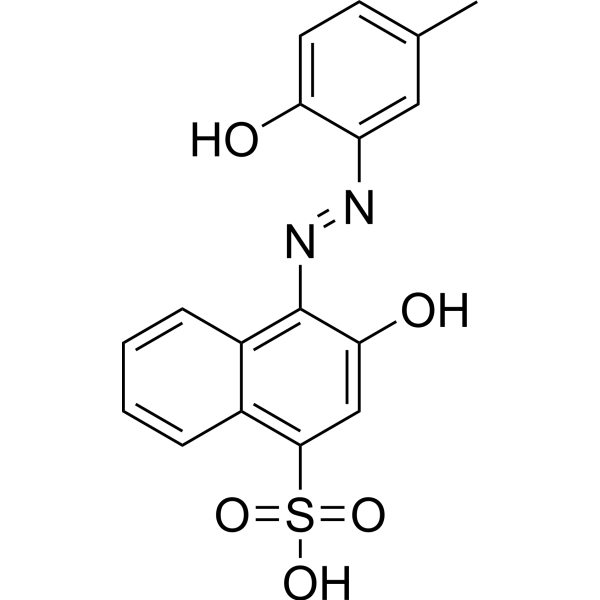
Physicochemical Properties
| Molecular Formula | C17H14N2O5S |
| Molecular Weight | 358.36 |
| Exact Mass | 358.062 |
| CAS # | 3147-14-6 |
| PubChem CID | 2530 |
| Appearance | Light brown to black solid powder |
| Density | 1.5±0.1 g/cm3 |
| Melting Point | 300ºC |
| Index of Refraction | 1.682 |
| LogP | 1.45 |
| Hydrogen Bond Donor Count | 3 |
| Hydrogen Bond Acceptor Count | 7 |
| Rotatable Bond Count | 3 |
| Heavy Atom Count | 25 |
| Complexity | 590 |
| Defined Atom Stereocenter Count | 0 |
| InChi Key | VBRNLOQCBCPPHL-UHFFFAOYSA-N |
| InChi Code | InChI=1S/C17H14N2O5S/c1-10-6-7-14(20)13(8-10)18-19-17-12-5-3-2-4-11(12)16(9-15(17)21)25(22,23)24/h2-9,20-21H,1H3,(H,22,23,24) |
| Chemical Name | 3-hydroxy-4-[(2-hydroxy-5-methylphenyl)diazenyl]naphthalene-1-sulfonic acid |
| HS Tariff Code | 2934.99.9001 |
| Storage |
Powder-20°C 3 years 4°C 2 years In solvent -80°C 6 months -20°C 1 month Note: This product requires protection from light (avoid light exposure) during transportation and storage. |
| Shipping Condition | Room temperature (This product is stable at ambient temperature for a few days during ordinary shipping and time spent in Customs) |
Biological Activity
| References |
[1]. Simultaneously detection of calcium and magnesium in various samples by calmagite and chemometrics data processing. Spectrochim Acta A Mol Biomol Spectrosc. 2016 Dec 5;169:72-81. |
| Additional Infomation |
- Calmagite is a chromogenic reagent used for the simultaneous quantitative determination of calcium (Ca²⁺) and magnesium (Mg²⁺) ions in various samples[1] - Calmagite forms stable colored complexes with Ca²⁺ and Mg²⁺ ions under specific pH conditions, and the complexes exhibit characteristic absorption spectra that can be detected by molecular absorption spectrometry[1] - The samples applicable for detection using Calmagite include water samples (tap water, mineral water), biological samples (serum, urine), and pharmaceutical formulations[1] - The detection principle involves mixing Calmagite solution with the sample in a buffered system, incubating to form Ca²⁺-Calmagite and Mg²⁺-Calmagite complexes, measuring the absorbance of the mixture over a specific wavelength range (400-800 nm), and applying chemometric methods (partial least squares regression) to process the absorbance data for simultaneous quantification of Ca²⁺ and Mg²⁺ without prior separation[1] |
Solubility Data
| Solubility (In Vitro) |
DMSO : ~33.33 mg/mL (~93.00 mM) H2O : ~7.14 mg/mL (~19.92 mM) |
| Solubility (In Vivo) |
Solubility in Formulation 1: ≥ 2.5 mg/mL (6.98 mM) (saturation unknown) in 10% DMSO + 40% PEG300 + 5% Tween80 + 45% Saline (add these co-solvents sequentially from left to right, and one by one), clear solution. For example, if 1 mL of working solution is to be prepared, you can add 100 μL of 25.0 mg/mL clear DMSO stock solution to 400 μL PEG300 and mix evenly; then add 50 μL Tween-80 to the above solution and mix evenly; then add 450 μL normal saline to adjust the volume to 1 mL. Preparation of saline: Dissolve 0.9 g of sodium chloride in 100 mL ddH₂ O to obtain a clear solution. Solubility in Formulation 2: ≥ 2.5 mg/mL (6.98 mM) (saturation unknown) in 10% DMSO + 90% (20% SBE-β-CD in Saline) (add these co-solvents sequentially from left to right, and one by one), clear solution. For example, if 1 mL of working solution is to be prepared, you can add 100 μL of 25.0 mg/mL clear DMSO stock solution to 900 μL of 20% SBE-β-CD physiological saline solution and mix evenly. Preparation of 20% SBE-β-CD in Saline (4°C,1 week): Dissolve 2 g SBE-β-CD in 10 mL saline to obtain a clear solution. (Please use freshly prepared in vivo formulations for optimal results.) |
| Preparing Stock Solutions | 1 mg | 5 mg | 10 mg | |
| 1 mM | 2.7905 mL | 13.9525 mL | 27.9049 mL | |
| 5 mM | 0.5581 mL | 2.7905 mL | 5.5810 mL | |
| 10 mM | 0.2790 mL | 1.3952 mL | 2.7905 mL |