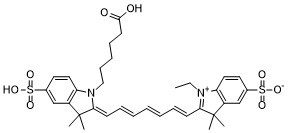
CY7 is a novel and potent fluorescence labeling agent and a dye that is widely used for labeling peptides, proteins and oligos etc. Cy7 dye conjugates are one type of the most common near infrared red fluorophores used in in vivo imaging applications. Excitation (nm): 749, Emission (nm): 767. It displays excitation/emission maxima of 745/800 nm, respectively. Cy7 has commonly been conjugated to secondary antibodies for use in fluorescence microscopy and flow cytometry.
Physicochemical Properties
| Molecular Formula | C₃₅H₄₂N₂O₈S₂ |
| Molecular Weight | 682.85 |
| Exact Mass | 682.238 |
| CAS # | 943298-08-6 |
| PubChem CID | 73554281 |
| Appearance | Light yellow to green yellow solid powder |
| LogP | 8.414 |
| Hydrogen Bond Donor Count | 2 |
| Hydrogen Bond Acceptor Count | 9 |
| Rotatable Bond Count | 12 |
| Heavy Atom Count | 47 |
| Complexity | 1510 |
| Defined Atom Stereocenter Count | 0 |
| SMILES | CCN\1C2=C(C=C(C=C2)S(=O)(=O)[O-])C(/C1=C/C=C/C=C/C=C/C3=[N+](C4=C(C3(C)C)C=C(C=C4)S(=O)(=O)O)CCCCCC(=O)O)(C)C |
| InChi Key | CZWUESRDTYLNDE-UHFFFAOYSA-N |
| InChi Code | InChI=1S/C35H42N2O8S2/c1-6-36-29-20-18-25(46(40,41)42)23-27(29)34(2,3)31(36)15-11-8-7-9-12-16-32-35(4,5)28-24-26(47(43,44)45)19-21-30(28)37(32)22-14-10-13-17-33(38)39/h7-9,11-12,15-16,18-21,23-24H,6,10,13-14,17,22H2,1-5H3,(H2-,38,39,40,41,42,43,44,45) |
| Chemical Name | (2Z)-2-[(2E,4E,6E)-7-[1-(5-carboxypentyl)-3,3-dimethyl-5-sulfoindol-1-ium-2-yl]hepta-2,4,6-trienylidene]-1-ethyl-3,3-dimethylindole-5-sulfonate |
| Synonyms | Cy-7Sulfo-Cyanine7Cy7 Cy 7 |
| HS Tariff Code | 2934.99.9001 |
| Storage |
Powder-20°C 3 years 4°C 2 years In solvent -80°C 6 months -20°C 1 month Note: This product requires protection from light (avoid light exposure) during transportation and storage. |
| Shipping Condition | Room temperature (This product is stable at ambient temperature for a few days during ordinary shipping and time spent in Customs) |
Biological Activity
| ln Vitro | Scheme 1: The ideal way to prepare proteins 1) Please prepare the protein (antibody) concentration to 2 mg/mL in order to acquire the labeling effect. 2) The protein solution has a pH of 8.5±0.In the event that the pH is less than 8.0, use 1 M. 3) The labeling efficiency will be significantly decreased if the protein content is less than 2 mg/mL. The range of suggested final protein concentration is 2–10 mg/mL for best labeling efficiency. 4) To ensure optimal labeling efficacy, the protein needs to be in a buffer free of ammonium ions and primary amines, like Tris or glycine. 2. Dye preparation (using, for instance, CY3-NHS ester) To make a 10 mM stock solution, fill the CY3-NHS ester vial with anhydrous DMSO. Use a pipette or vortex to thoroughly mix. 3. The quantity of pigment to be labeled determines how much reacted CY3-NHS ester is needed to prepare the dye dosage, and the ideal molar ratio of CY3-NHS is: As an illustration: Assuming that 500 μL of 2 mg/mL IgG (MW=150,000) is the necessary labeled protein, dissolve 1 mg of CY3-NHS ester in 100 μL DMSO to get the 5.05 μL of CY3-NHS ester that is needed. 10. The following is the calculation procedure: 1) mg/mL (IgG) × mL (IgG)/MW (IgG) = 2 mg/mL × 0.5 mL/150,000 mg/mmol = 6.7×10⁻⁶ mmol 2 mmol (CY3-NHS ester) = mmol (IgG) × 10=6.7 × 10⁻⁶ mmol×10=6.7 × 10⁻⁵ mmol 3) uL (CY3-NHS ester) = mmol (CY3-NHS ester) ×MW (CY3-NHS ester)/mg/μL (CY3-NHS ester) = 6.7 ×10⁻⁵ mmol ×753.88 mg/mmol/0.01 mg/μL=5.05 μL (CY3-NHS ester) 4. Execute the coupling reaction 1) Gently mix the 0.5 mL protein sample in the solution with 10 mg/mL freshly synthesized CY3-NHS ester in a centrifuge tube. Centrifuge for a little while to collect the sample at the bottom of the reaction tube. To prevent the creation of protein, do not thoroughly mix. 2) In the following step, wait 60 minutes after placing the reaction tube in a dark location. After 10 to 15 minutes, gently invert several times to fully combine. 5. Keeping Conjugates Apart An example of a dye-conjugate blocking procedure employing a SepHadex G-25 column is provided below. First, prepare the SepHadex G-25 column as directed by the manufacturer. 2) Fill the SepHadex G-25 column to the brim with the reaction mixture (from "Run conjugation reaction"). 3) Add PBS (pH 7.2–7.4) as soon as the sample is running below the top resin surface. 4) To finish column closure, add extra PBS (pH 7.2–7.4) to the intended sample. Mix the fractions that have the target dye-protein combination. |
| References |
[1]. Ptaszek M. Rational design of fluorophores for in vivo applications. Prog Mol Biol Transl Sci. 2013;113:59-108. [2]. A Unique Recombinant Fluoroprobe Targeting Activated Platelets Allows In Vivo Detection of Arterial Thrombosis and Pulmonary Embolism Using a Novel Three-Dimensional Fluorescence Emission Computed Tomography (FLECT) Technology. Theranostics. 2017 Feb 26;7(5):1047-1061. [3]. Shindy, H. A. (2017). Fundamentals in the chemistry of cyanine dyes: A review. Dyes and Pigments, 145, 505–513. doi:10.1016/j.dyepig.2017.06.029. |
Solubility Data
| Solubility (In Vitro) | DMSO : ≥ 33 mg/mL (~48.33 mM) |
| Solubility (In Vivo) |
Note: Listed below are some common formulations that may be used to formulate products with low water solubility (e.g. < 1 mg/mL), you may test these formulations using a minute amount of products to avoid loss of samples. Injection Formulations (e.g. IP/IV/IM/SC) Injection Formulation 1: DMSO : Tween 80: Saline = 10 : 5 : 85 (i.e. 100 μL DMSO stock solution → 50 μL Tween 80 → 850 μL Saline) *Preparation of saline: Dissolve 0.9 g of sodium chloride in 100 mL ddH ₂ O to obtain a clear solution. Injection Formulation 2: DMSO : PEG300 :Tween 80 : Saline = 10 : 40 : 5 : 45 (i.e. 100 μL DMSO → 400 μLPEG300 → 50 μL Tween 80 → 450 μL Saline) Injection Formulation 3: DMSO : Corn oil = 10 : 90 (i.e. 100 μL DMSO → 900 μL Corn oil) Example: Take the Injection Formulation 3 (DMSO : Corn oil = 10 : 90) as an example, if 1 mL of 2.5 mg/mL working solution is to be prepared, you can take 100 μL 25 mg/mL DMSO stock solution and add to 900 μL corn oil, mix well to obtain a clear or suspension solution (2.5 mg/mL, ready for use in animals). Injection Formulation 4: DMSO : 20% SBE-β-CD in saline = 10 : 90 [i.e. 100 μL DMSO → 900 μL (20% SBE-β-CD in saline)] *Preparation of 20% SBE-β-CD in Saline (4°C,1 week): Dissolve 2 g SBE-β-CD in 10 mL saline to obtain a clear solution. Injection Formulation 5: 2-Hydroxypropyl-β-cyclodextrin : Saline = 50 : 50 (i.e. 500 μL 2-Hydroxypropyl-β-cyclodextrin → 500 μL Saline) Injection Formulation 6: DMSO : PEG300 : castor oil : Saline = 5 : 10 : 20 : 65 (i.e. 50 μL DMSO → 100 μLPEG300 → 200 μL castor oil → 650 μL Saline) Injection Formulation 7: Ethanol : Cremophor : Saline = 10: 10 : 80 (i.e. 100 μL Ethanol → 100 μL Cremophor → 800 μL Saline) Injection Formulation 8: Dissolve in Cremophor/Ethanol (50 : 50), then diluted by Saline Injection Formulation 9: EtOH : Corn oil = 10 : 90 (i.e. 100 μL EtOH → 900 μL Corn oil) Injection Formulation 10: EtOH : PEG300:Tween 80 : Saline = 10 : 40 : 5 : 45 (i.e. 100 μL EtOH → 400 μLPEG300 → 50 μL Tween 80 → 450 μL Saline) Oral Formulations Oral Formulation 1: Suspend in 0.5% CMC Na (carboxymethylcellulose sodium) Oral Formulation 2: Suspend in 0.5% Carboxymethyl cellulose Example: Take the Oral Formulation 1 (Suspend in 0.5% CMC Na) as an example, if 100 mL of 2.5 mg/mL working solution is to be prepared, you can first prepare 0.5% CMC Na solution by measuring 0.5 g CMC Na and dissolve it in 100 mL ddH2O to obtain a clear solution; then add 250 mg of the product to 100 mL 0.5% CMC Na solution, to make the suspension solution (2.5 mg/mL, ready for use in animals). Oral Formulation 3: Dissolved in PEG400 Oral Formulation 4: Suspend in 0.2% Carboxymethyl cellulose Oral Formulation 5: Dissolve in 0.25% Tween 80 and 0.5% Carboxymethyl cellulose Oral Formulation 6: Mixing with food powders Note: Please be aware that the above formulations are for reference only. InvivoChem strongly recommends customers to read literature methods/protocols carefully before determining which formulation you should use for in vivo studies, as different compounds have different solubility properties and have to be formulated differently. (Please use freshly prepared in vivo formulations for optimal results.) |
| Preparing Stock Solutions | 1 mg | 5 mg | 10 mg | |
| 1 mM | 1.4645 mL | 7.3223 mL | 14.6445 mL | |
| 5 mM | 0.2929 mL | 1.4645 mL | 2.9289 mL | |
| 10 mM | 0.1464 mL | 0.7322 mL | 1.4645 mL |