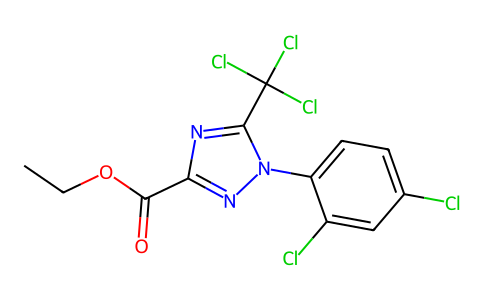
Physicochemical Properties
| Molecular Formula | C12H8CL5N3O2 |
| Molecular Weight | 403.47582 |
| Exact Mass | 400.906 |
| CAS # | 103112-35-2 |
| PubChem CID | 3033865 |
| Appearance | Typically exists as solid at room temperature |
| Density | 1.65 g/cm3 |
| Boiling Point | 469.8ºC at 760 mmHg |
| Flash Point | 237.9ºC |
| Vapour Pressure | 5.35E-09mmHg at 25°C |
| Index of Refraction | 1.645 |
| LogP | 4.577 |
| Hydrogen Bond Donor Count | 0 |
| Hydrogen Bond Acceptor Count | 4 |
| Rotatable Bond Count | 4 |
| Heavy Atom Count | 22 |
| Complexity | 409 |
| Defined Atom Stereocenter Count | 0 |
| SMILES | CCOC(C1=NN(C2C=CC(Cl)=CC=2Cl)C(C(Cl)(Cl)Cl)=N1)=O |
| InChi Key | GMBRUAIJEFRHFQ-UHFFFAOYSA-N |
| InChi Code | InChI=1S/C12H8Cl5N3O2/c1-2-22-10(21)9-18-11(12(15,16)17)20(19-9)8-4-3-6(13)5-7(8)14/h3-5H,2H2,1H3 |
| Chemical Name | ethyl 1-(2,4-dichlorophenyl)-5-(trichloromethyl)-1,2,4-triazole-3-carboxylate |
| Synonyms | Fenchlorazole-ethyl; 103112-35-2; Fenchlorazole-Et; Fenchlorazole-ethyl [ISO]; Fenchlorazole ethyl; HOE 070542; DTXSID6041268; 1H-1,2,4-Triazole-3-carboxylic acid, 1-(2,4-dichlorophenyl)-5-(trichloromethyl)-, ethyl ester; |
| HS Tariff Code | 2934.99.9001 |
| Storage |
Powder-20°C 3 years 4°C 2 years In solvent -80°C 6 months -20°C 1 month |
| Shipping Condition | Room temperature (This product is stable at ambient temperature for a few days during ordinary shipping and time spent in Customs) |
Biological Activity
| Targets | Herbicide |
| ln Vitro | The dominance of safener can unite with herbicides acquiring the efficient protection of crop and qualifying control of weeds in agricultural fields. In order to solve the crop toxicity problem and exploit the novel potential safener for fenoxaprop-P-ethyl herbicide, a series of trichloromethyl dichlorobenzene triazole derivatives were designed and synthesized by the principle of active subunit combination. A total of 21 novel substituted trichloromethyl dichlorobenzene triazole compounds were synthesized by substituted aminophenol and amino alcohol derivatives as the starting materials, using cyclization and acylation. All the compounds were unambiguously characterized by IR, 1H-NMR, 13C-NMR, and HRMS. A greenhouse bioassay indicated that most of the title compounds could protect wheat from injury caused by fenoxaprop-P-ethyl at varying degrees, in which compound 5o exhibited excellent safener activity at a concentration of 10 μmol/L and was superior to the commercialized compound fenchlorazole. A structure–activity relationship for the novel compounds was determined, which demonstrated that those compounds containing benzoxazine groups showed better activity than that of oxazole-substituted compounds. Introducing a benzoxazine fragment and electron-donating group to specific positions could improve or maintain the safener activity for wheat against attack by the herbicide fenoxaprop-P-ethyl. A molecular docking model suggested that a potential mechanism between 5o and fenoxaprop-P-ethyl is associated with the detoxication of the herbicide. Results from the present work revealed that compound 5o exhibited good crop safener activities toward wheat and could be a promising candidate structure for further research on wheat protection. [1] |
| Toxicity/Toxicokinetics |
3033865 rat LD50 oral >5 gm/kg GASTROINTESTINAL: OTHER CHANGES; LIVER: OTHER CHANGES; BLOOD: HEMORRHAGE National Technical Information Service., OTS0524063-1 3033865 rat LD50 skin >2 gm/kg GASTROINTESTINAL: OTHER CHANGES; LIVER: OTHER CHANGES; BLOOD: HEMORRHAGE National Technical Information Service., OTS0524063-1 3033865 rat LD50 intraperitoneal 910 mg/kg BEHAVIORAL: ALTERED SLEEP TIME (INCLUDING CHANGE IN RIGHTING REFLEX); BEHAVIORAL: CHANGES IN MOTOR ACTIVITY (SPECIFIC ASSAY); LUNGS, THORAX, OR RESPIRATION: RESPIRATORY DEPRESSION National Technical Information Service., OTS0524063-1 3033865 mouse LD50 oral 2 gm/kg BEHAVIORAL: ALTERED SLEEP TIME (INCLUDING CHANGE IN RIGHTING REFLEX); BEHAVIORAL: CHANGES IN MOTOR ACTIVITY (SPECIFIC ASSAY); LUNGS, THORAX, OR RESPIRATION: RESPIRATORY DEPRESSION National Technical Information Service., OTS0524063-1 3033865 rabbit LD50 skin >2 gm/kg GASTROINTESTINAL: OTHER CHANGES; LIVER: OTHER CHANGES; BLOOD: HEMORRHAGE National Technical Information Service., OTS0524063-1 |
| References | [1]. Design, Synthesis and Evaluation of Novel Trichloromethyl Dichlorophenyl Triazole Derivatives as Potential Safener. Biomolecules. 2019 Sep 1;9(9):438. |
| Additional Infomation | Fenchlorazole-ethyl is a dichlorobenzene. |
Solubility Data
| Solubility (In Vitro) | May dissolve in DMSO (in most cases), if not, try other solvents such as H2O, Ethanol, or DMF with a minute amount of products to avoid loss of samples |
| Solubility (In Vivo) |
Note: Listed below are some common formulations that may be used to formulate products with low water solubility (e.g. < 1 mg/mL), you may test these formulations using a minute amount of products to avoid loss of samples. Injection Formulations (e.g. IP/IV/IM/SC) Injection Formulation 1: DMSO : Tween 80: Saline = 10 : 5 : 85 (i.e. 100 μL DMSO stock solution → 50 μL Tween 80 → 850 μL Saline) *Preparation of saline: Dissolve 0.9 g of sodium chloride in 100 mL ddH ₂ O to obtain a clear solution. Injection Formulation 2: DMSO : PEG300 :Tween 80 : Saline = 10 : 40 : 5 : 45 (i.e. 100 μL DMSO → 400 μLPEG300 → 50 μL Tween 80 → 450 μL Saline) Injection Formulation 3: DMSO : Corn oil = 10 : 90 (i.e. 100 μL DMSO → 900 μL Corn oil) Example: Take the Injection Formulation 3 (DMSO : Corn oil = 10 : 90) as an example, if 1 mL of 2.5 mg/mL working solution is to be prepared, you can take 100 μL 25 mg/mL DMSO stock solution and add to 900 μL corn oil, mix well to obtain a clear or suspension solution (2.5 mg/mL, ready for use in animals). Injection Formulation 4: DMSO : 20% SBE-β-CD in saline = 10 : 90 [i.e. 100 μL DMSO → 900 μL (20% SBE-β-CD in saline)] *Preparation of 20% SBE-β-CD in Saline (4°C,1 week): Dissolve 2 g SBE-β-CD in 10 mL saline to obtain a clear solution. Injection Formulation 5: 2-Hydroxypropyl-β-cyclodextrin : Saline = 50 : 50 (i.e. 500 μL 2-Hydroxypropyl-β-cyclodextrin → 500 μL Saline) Injection Formulation 6: DMSO : PEG300 : castor oil : Saline = 5 : 10 : 20 : 65 (i.e. 50 μL DMSO → 100 μLPEG300 → 200 μL castor oil → 650 μL Saline) Injection Formulation 7: Ethanol : Cremophor : Saline = 10: 10 : 80 (i.e. 100 μL Ethanol → 100 μL Cremophor → 800 μL Saline) Injection Formulation 8: Dissolve in Cremophor/Ethanol (50 : 50), then diluted by Saline Injection Formulation 9: EtOH : Corn oil = 10 : 90 (i.e. 100 μL EtOH → 900 μL Corn oil) Injection Formulation 10: EtOH : PEG300:Tween 80 : Saline = 10 : 40 : 5 : 45 (i.e. 100 μL EtOH → 400 μLPEG300 → 50 μL Tween 80 → 450 μL Saline) Oral Formulations Oral Formulation 1: Suspend in 0.5% CMC Na (carboxymethylcellulose sodium) Oral Formulation 2: Suspend in 0.5% Carboxymethyl cellulose Example: Take the Oral Formulation 1 (Suspend in 0.5% CMC Na) as an example, if 100 mL of 2.5 mg/mL working solution is to be prepared, you can first prepare 0.5% CMC Na solution by measuring 0.5 g CMC Na and dissolve it in 100 mL ddH2O to obtain a clear solution; then add 250 mg of the product to 100 mL 0.5% CMC Na solution, to make the suspension solution (2.5 mg/mL, ready for use in animals). Oral Formulation 3: Dissolved in PEG400 Oral Formulation 4: Suspend in 0.2% Carboxymethyl cellulose Oral Formulation 5: Dissolve in 0.25% Tween 80 and 0.5% Carboxymethyl cellulose Oral Formulation 6: Mixing with food powders Note: Please be aware that the above formulations are for reference only. InvivoChem strongly recommends customers to read literature methods/protocols carefully before determining which formulation you should use for in vivo studies, as different compounds have different solubility properties and have to be formulated differently. (Please use freshly prepared in vivo formulations for optimal results.) |
| Preparing Stock Solutions | 1 mg | 5 mg | 10 mg | |
| 1 mM | 2.4784 mL | 12.3922 mL | 24.7844 mL | |
| 5 mM | 0.4957 mL | 2.4784 mL | 4.9569 mL | |
| 10 mM | 0.2478 mL | 1.2392 mL | 2.4784 mL |