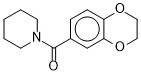
CX546 is an AMPA receptor potentiator. It binds specifically to the agonist bound non-desensitized receptor, and most likely destabilizing the desensitized receptor conformation. CX546 enhances cognitive function in rats. It has also been proposed as a treatment for schizophrenia.
Physicochemical Properties
| Molecular Formula | C14H17NO3MOLECULARWEIGHT |
| Molecular Weight | 247.2897 |
| Exact Mass | 247.121 |
| CAS # | 215923-54-9 |
| Related CAS # | 215923-54-9 |
| PubChem CID | 2890 |
| Appearance | White to off-white solid powder |
| Density | 1.215g/cm3 |
| Boiling Point | 422.8ºC at 760 mmHg |
| Flash Point | 209.5ºC |
| Vapour Pressure | 2.34E-07mmHg at 25°C |
| Index of Refraction | 1.573 |
| LogP | 2.021 |
| Hydrogen Bond Donor Count | 0 |
| Hydrogen Bond Acceptor Count | 3 |
| Rotatable Bond Count | 1 |
| Heavy Atom Count | 18 |
| Complexity | 301 |
| Defined Atom Stereocenter Count | 0 |
| InChi Key | LJUNPHMOGNFFOS-UHFFFAOYSA-N |
| InChi Code | InChI=1S/C14H17NO3/c16-14(15-6-2-1-3-7-15)11-4-5-12-13(10-11)18-9-8-17-12/h4-5,10H,1-3,6-9H2 |
| Chemical Name | 2,3-dihydro-1,4-benzodioxin-6-yl(piperidin-1-yl)methanone |
| HS Tariff Code | 2934.99.9001 |
| Storage |
Powder-20°C 3 years 4°C 2 years In solvent -80°C 6 months -20°C 1 month |
| Shipping Condition | Room temperature (This product is stable at ambient temperature for a few days during ordinary shipping and time spent in Customs) |
Biological Activity
| ln Vivo | In cultured rat entorhinal/hippocampal slices, treatment with ampakine CX614 (intraperitoneal injection) raises brain-derived neurotrophic factor (BDNF) mRNA and protein levels considerably and reversibly [1]. |
| References |
[1]. Positive modulation of AMPA receptors increases neurotrophin expression by hippocampal and cortical neurons. J Neurosci. 2000 Jan 1;20(1):8-21. [2]. The ampakine CX546 restores the prepulse inhibition and latent inhibition deficits in mGluR5-deficient mice. Neuropsychopharmacology. 2007 Apr;32(4):745-56. |
Solubility Data
| Solubility (In Vitro) |
DMSO : ~100 mg/mL (~404.38 mM) Ethanol : ~100 mg/mL (~404.38 mM) H2O : ~2 mg/mL (~8.09 mM) |
| Solubility (In Vivo) |
Solubility in Formulation 1: ≥ 2.5 mg/mL (10.11 mM) (saturation unknown) in 10% DMSO + 40% PEG300 + 5% Tween80 + 45% Saline (add these co-solvents sequentially from left to right, and one by one), clear solution. For example, if 1 mL of working solution is to be prepared, you can add 100 μL of 25.0 mg/mL clear DMSO stock solution to 400 μL PEG300 and mix evenly; then add 50 μL Tween-80 to the above solution and mix evenly; then add 450 μL normal saline to adjust the volume to 1 mL. Preparation of saline: Dissolve 0.9 g of sodium chloride in 100 mL ddH₂ O to obtain a clear solution. Solubility in Formulation 2: ≥ 2.5 mg/mL (10.11 mM) (saturation unknown) in 10% DMSO + 90% (20% SBE-β-CD in Saline) (add these co-solvents sequentially from left to right, and one by one), clear solution. For example, if 1 mL of working solution is to be prepared, you can add 100 μL of 25.0 mg/mL clear DMSO stock solution to 900 μL of 20% SBE-β-CD physiological saline solution and mix evenly. Preparation of 20% SBE-β-CD in Saline (4°C,1 week): Dissolve 2 g SBE-β-CD in 10 mL saline to obtain a clear solution. Solubility in Formulation 3: ≥ 2.5 mg/mL (10.11 mM) (saturation unknown) in 10% DMSO + 90% Corn Oil (add these co-solvents sequentially from left to right, and one by one), clear solution. For example, if 1 mL of working solution is to be prepared, you can add 100 μL of 25.0 mg/mL clear DMSO stock solution to 900 μL of corn oil and mix evenly. Solubility in Formulation 4: ≥ 2.5 mg/mL (10.11 mM) (saturation unknown) in 10% EtOH + 40% PEG300 + 5% Tween80 + 45% Saline (add these co-solvents sequentially from left to right, and one by one), clear solution. For example, if 1 mL of working solution is to be prepared, you can add 100 μL of 25.0 mg/mL clear EtOH stock solution to 400 μL of PEG300 and mix evenly; then add 50 μL of Tween-80 to the above solution and mix evenly; then add 450 μL of normal saline to adjust the volume to 1 mL. Preparation of saline: Dissolve 0.9 g of sodium chloride in 100 mL ddH₂ O to obtain a clear solution. Solubility in Formulation 5: ≥ 2.5 mg/mL (10.11 mM) (saturation unknown) in 10% EtOH + 90% (20% SBE-β-CD in Saline) (add these co-solvents sequentially from left to right, and one by one), clear solution. For example, if 1 mL of working solution is to be prepared, you can add 100 μL of 25.0 mg/mL clear EtOH stock solution to 900 μL of 20% SBE-β-CD physiological saline solution and mix evenly. Preparation of 20% SBE-β-CD in Saline (4°C,1 week): Dissolve 2 g SBE-β-CD in 10 mL saline to obtain a clear solution. Solubility in Formulation 6: ≥ 2.5 mg/mL (10.11 mM) (saturation unknown) in 10% EtOH + 90% Corn Oil (add these co-solvents sequentially from left to right, and one by one), clear solution. For example, if 1 mL of working solution is to be prepared, you can add 100 μL of 25.0 mg/mL clear EtOH stock solution to 900 μL of corn oil and mix evenly. Solubility in Formulation 7: 2 mg/mL (8.09 mM) in PBS (add these co-solvents sequentially from left to right, and one by one), clear solution; with ultrasonication. Solubility in Formulation 8: 4 mg/mL (16.18 mM) in 20% HP-β-CD in Saline (add these co-solvents sequentially from left to right, and one by one), clear solution; with ultrasonication. Preparation of saline: Dissolve 0.9 g of sodium chloride in 100 mL ddH₂ O to obtain a clear solution. (Please use freshly prepared in vivo formulations for optimal results.) |
| Preparing Stock Solutions | 1 mg | 5 mg | 10 mg | |
| 1 mM | 4.0438 mL | 20.2192 mL | 40.4384 mL | |
| 5 mM | 0.8088 mL | 4.0438 mL | 8.0877 mL | |
| 10 mM | 0.4044 mL | 2.0219 mL | 4.0438 mL |