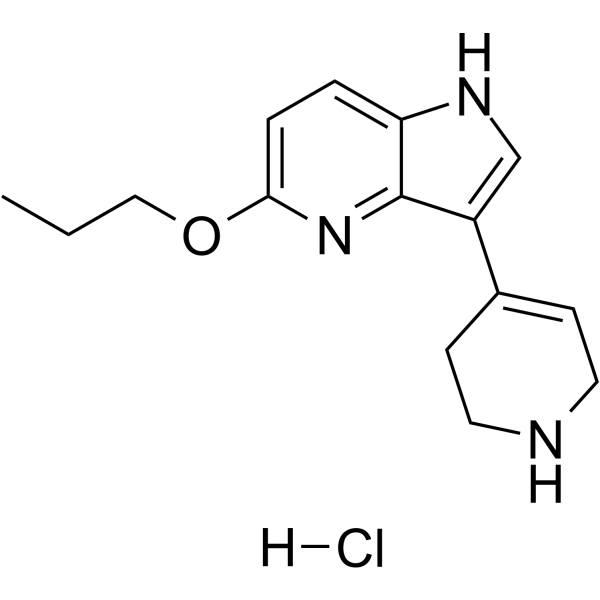
Physicochemical Properties
| Molecular Formula | C15H20CLN3O |
| Molecular Weight | 293.791802406311 |
| Exact Mass | 293.129 |
| Elemental Analysis | C, 70.01; H, 7.44; N, 16.33; O, 6.22 |
| CAS # | 845861-39-4 |
| Related CAS # | 845861-39-4 (HCl); 131084-35-0; |
| PubChem CID | 11652258 |
| Appearance | Light yellow to yellow solid powder |
| LogP | 3.859 |
| Hydrogen Bond Donor Count | 3 |
| Hydrogen Bond Acceptor Count | 3 |
| Rotatable Bond Count | 4 |
| Heavy Atom Count | 20 |
| Complexity | 331 |
| Defined Atom Stereocenter Count | 0 |
| InChi Key | PIIOXKQIZCVXMD-UHFFFAOYSA-N |
| InChi Code | InChI=1S/C15H19N3O.ClH/c1-2-9-19-14-4-3-13-15(18-14)12(10-17-13)11-5-7-16-8-6-11;/h3-5,10,16-17H,2,6-9H2,1H3;1H |
| Chemical Name | 5-propoxy-3-(1,2,3,6-tetrahydropyridin-4-yl)-1H-pyrrolo[3,2-b]pyridine;hydrochloride |
| Synonyms | CP 94253 hydrochloride; 845861-39-4; CP94253 hydrochloride; CP94253 (hydrochloride); 5-PROPOXY-3-(1,2,3,6-TETRAHYDRO-4-PYRIDINYL)-1H-PYRROLO[3,2-B]PYRIDINE hydrochloride; 5-propoxy-3-(1,2,3,6-tetrahydropyridin-4-yl)-1H-pyrrolo[3,2-b]pyridine hydrochloride; 1H-Pyrrolo[3,2-b]pyridine, 5-propoxy-3-(1,2,3,6-tetrahydro-4-pyridinyl)-,monohydrochloride; 5-propoxy-3-(1,2,3,6-tetrahydropyridin-4-yl)-1H-pyrrolo[3,2-b]pyridine;hydrochloride; |
| HS Tariff Code | 2934.99.9001 |
| Storage |
Powder-20°C 3 years 4°C 2 years In solvent -80°C 6 months -20°C 1 month Note: Please store this product in a sealed and protected environment, avoid exposure to moisture. |
| Shipping Condition | Room temperature (This product is stable at ambient temperature for a few days during ordinary shipping and time spent in Customs) |
Biological Activity
| Targets | 5-HT1B receptor |
| ln Vitro | CP-94,253, 3-(1,2,5,6-tetrahydro-4-pyridyl)-5-propoxypyrrolo[3,2-b]pyridine, a new serotonergic ligand, was found to exhibit significantly greater binding affinity at 5-HT1B receptors than at 5-HT1A or 5-HT1C receptors. Saturation studies showed CP-94,253 to be a competitive inhibitor of [125l]iodocyanopindolol binding to 5-HT1B sites. Its competition curve with this radioligand was shifted to the right (decreased affinity) in the presence of Gpp(NH)p, indicating an agonist function for CP-94,253[1]. |
| ln Vivo |
Oral administration of CP-94,253 to rats caused inhibition of food intake, decrease in body weight gain, and hyperlocomotion, effects apparently elicited via activation of 5-HT1B receptors[1]. The ability of selective serotonin (5-HT) receptor agonists to reduce the extracellular concentration of 5-HT was examined in the striatum of awake, unrestrained mice by in vivo microdialysis. Systemic administration of either 8-OH-PIPAT (R-(+)-trans-8-hydroxy-2-[N-n-propyl-N-(3'-iodo-2'-propenyl)] aminotetralin), a novel 5-HT(1A) receptor agonist, or CP 94,253, a selective 5-HT(1B) receptor agonist, resulted in significant dose-related reductions of striatal 5-HT. The effect of 8-OH-PIPAT (1.0 mg/kg) was blocked by pretreatment with WAY 100635 (0.1 mg/kg), a selective 5-HT(1A) receptor antagonist, but it was not blocked by pretreatment with GR 127935 (0.056 mg/kg), a selective 5-HT(1B/1D) receptor antagonist. The effect of CP 94,253 (1.0 mg/kg) was blocked by pretreatment with GR 127935 (0.056 mg/kg) but was not blocked by pretreatment with WAY 100635 (0.1 mg/kg). Neither WAY 100635 nor GR 127935 altered extracellular 5-HT levels at the doses that were able to completely block the effects of either 8-OH-PIPAT or CP 94,253. The present findings suggest that, on systemic administration, both 8-OH-PIPAT and CP 94,253 are potent and selective agonists at the somatodendritic 5-HT(1A) autoreceptor and terminal 5-HT(1B/1D) autoreceptor, respectively, and are each able to cause decreases in extracellular levels of 5-HT in the mouse striatum by activating a distinct set of receptors[2]. |
| Cell Assay |
Neuro2A (N2A) cells were maintained with growth media consisting of Dulbecco’s Modified Eagle’s Medium (DMEM), 10% fetal bovine serum (FBS), and 1x Antibiotic-Antimycotic at 37°C in 5% CO2. N2A cells were transfected with a plasmid expressing HA-tagged rat 5-HT1B receptor in a pcDNA3 backbone (N2A-1B) using Lipofectamine LTX, and selection for the stably transfected cell lines was achieved with 500 μg/mL geneticin (G418). Cells were plated in 60 mm plates 48 hours before treatment with growth media consisting of DMEM, 10% dialyzed serum, and 1x Antibiotic-Antimycotic, and fed with fresh dialyzed growth media 24 hours before treatment. One hour before agonist treatment, cells were switched to serum-free Opti-MEM to wash out any residual 5-HT, with or without the presence of antagonists as described. Following agonist treatment, cells were lysed with modified RIPA buffer (10 mM Tris-HCl pH 7.4, 150 mM NaCl, 1 mM EDTA, 1% Triton X-100, 0.25% sodium deoxycholate, 1% CHAPS, and 1x protease and phosphatase inhibitors) and briefly vortexed. Cell debris was pelleted by centrifugation at 15,000 x g for five minutes. The protein concentration of the lysate was measured using the 660 nm protein assay. Treatment drugs used were: CP-94253, SB-224289 gallein, pertussis toxin, and U0126. These drugs were applied one hour prior to the addition of agonists. For β-arrestin experiments, N2A-1B β-arrestin knockout (KO) cells were grown in media additionally supplemented with 2 μg/ml puromycin. Cells were plated in 60 mm plates 24 hours prior to treatment. One hour before agonist treatment, cells were switched to serum-free Opti-MEM, with or without the presence of the selective 5-HT1B antagonist SB-224289 (1 μM), then treated with the selective 5-HT1B agonist CP-94253 (100 nM) for ten minutes. Cell lysates were prepared as described above. For mouse embryonic fibroblast (MEF) experiments, wild-type, β-arrestin 1 knockout, β-arrestin 2 knockout, and β-arrestin 1 and 2 double knockout MEF cells57 were maintained with growth media consisting of DMEM, 10% FBS, and 1% penicillin/streptomycin at 37°C in 7% CO2. Cells were plated in 60 mm plates 72 hours prior to drug treatment. Using Lipofectamine 2000, cells were transiently transfected 48 hours prior to drug treatment with 16.525 μg DNA of a plasmid mix containing 30% HA-tagged rat 5-HT1B receptor, 30% Clover, a bright green-yellow fluorescent protein derived from GFP, and 40% pCAGGS, an empty vector control plasmid.58 Plates were fed with fresh growth media 24 hours prior to drug treatment. Immediately before drug treatment, presence of Clover fluorescence was confirmed; Clover expression was used as a marker of successful plasmid transfection in each experiment. One hour before agonist treatment, cells were switched to serum-free Opti-MEM, with or without the presence of the selective 5-HT1B antagonist SB-224289 (1 μM), then treated with the selective 5-HT1B agonist CP-94253 (100 nM) for ten minutes. Cell lysates were prepared as described above. ACS Chem Neurosci. 2019 Jul 17;10(7):3143-3153. |
| Animal Protocol |
Effects of the serotonin 5-HT1B receptor agonist CP-94253 on the locomotor activity and body temperature of preweanling and adult male and female rats. Eur J Pharmacol. 2022 Jul 5:926:175019. Serotonin 5-HT1A receptor agonists increase locomotor activity of both preweanling and adult rodents. The part played by the 5-HT1B receptor in locomotion is less certain, with preliminary evidence suggesting that the actions of 5-HT1B receptor agonists are not uniform across ontogeny. To more fully examine the role of 5-HT1B receptors, locomotor activity and axillary temperatures of preweanling and adult male and female rats was assessed. In the first experiment, adult (PD 70) and preweanling (PD 10 and PD 15) male and female rats were injected with the 5-HT1B agonist CP-94253 (2.5-10 mg/kg) immediately before locomotor activity testing and 60 min before axillary temperatures were recorded. In the second experiment, specificity of drug action was determined in PD 10 rats by administering saline, WAY 100635 (a 5-HT1A antagonist), or GR 127935 (a 5-HT1B antagonist) 30 min before CP-94253 (10 mg/kg) treatment. CP-94253 significantly increased the locomotor activity of preweanling rats on PD 10, an effect that was fully attenuated by GR 127935. Conversely, CP-94253 significantly decreased the locomotor activity of male and female adult rats, whileCP-94253 did not affect the locomotor activity of PD 15 rats. Regardless of age, CP-94253 (2.5-10 mg/kg) significantly reduced the axillary temperatures of preweanling and adult rats. When considered together, these results show that 5-HT1B receptor stimulation activates motor circuits in PD 10 rats; whereas, 5-HT1B receptor agonism reduces the overall locomotor activity of adult rats, perhaps by blunting exploratory tendencies. |
| References |
[1]. (1992) Biochemical and behavioral studies of the 5-HT1B receptor agonist, CP-94,253. Drug Dev.Res. 26 241. [2]. Knobelman DA, Kung HF, Lucki I. Regulation of extracellular concentrations of 5-hydroxytryptamine (5-HT) in mouse striatum by 5-HT(1A) and 5-HT(1B) receptors. J Pharmacol Exp Ther. 2000 Mar;292(3):1111-7. |
| Additional Infomation |
The ability of selective serotonin (5-HT) receptor agonists to reduce the extracellular concentration of 5-HT was examined in the striatum of awake, unrestrained mice by in vivo microdialysis. Systemic administration of either 8-OH-PIPAT (R-(+)-trans-8-hydroxy-2-[N-n-propyl-N-(3'-iodo-2'-propenyl)] aminotetralin), a novel 5-HT(1A) receptor agonist, or CP 94,253, a selective 5-HT(1B) receptor agonist, resulted in significant dose-related reductions of striatal 5-HT. The effect of 8-OH-PIPAT (1.0 mg/kg) was blocked by pretreatment with WAY 100635 (0.1 mg/kg), a selective 5-HT(1A) receptor antagonist, but it was not blocked by pretreatment with GR 127935 (0.056 mg/kg), a selective 5-HT(1B/1D) receptor antagonist. The effect of CP 94,253 (1.0 mg/kg) was blocked by pretreatment with GR 127935 (0.056 mg/kg) but was not blocked by pretreatment with WAY 100635 (0.1 mg/kg). Neither WAY 100635 nor GR 127935 altered extracellular 5-HT levels at the doses that were able to completely block the effects of either 8-OH-PIPAT or CP 94,253. The present findings suggest that, on systemic administration, both 8-OH-PIPAT and CP 94,253 are potent and selective agonists at the somatodendritic 5-HT(1A) autoreceptor and terminal 5-HT(1B/1D) autoreceptor, respectively, and are each able to cause decreases in extracellular levels of 5-HT in the mouse striatum by activating a distinct set of receptors.[2] 5-HT1B receptors modulate synaptic serotonin (5-HT) levels and play a significant role in the regulation of emotional behaviors. These receptors are Gαi/o-coupled and inhibit adenylyl cyclase but have also been reported to activate MAP kinases; however, the details of signaling cascades downstream of 5-HT1B receptor activation remain unclear, particularly in neuronal cells. We generated a stable 5-HT1B receptor-expressing Neuro2A (N2A-1B) neuronal cell line and demonstrate that activation of these receptors by the selective 5-HT1B agonist CP-94253 results in activation of ERK1/2 but not of other closely related MAP kinases. Phosphoproteomics revealed four novel phosphorylation sites on the third intracellular loop of the 5-HT1B receptor, and mutations of serine-256 and serine-291 to alanine led to reduced levels of ERK1/2 phosphorylation following receptor activation. Inhibition of Gαi/o signaling with pertussis toxin, as well as MEK1/2 inhibition with U0126, also reduced 5-HT1B-mediated ERK1/2 phosphorylation. Finally, we found that knockout of either β-arrestin 1 or β-arrestin 2 prevented 5-HT1B-mediated phosphorylation of ERK1/2. Taken together, these results show that 5-HT1B receptor activation selectively induces ERK1/2 activation through both the Gαi subunit and β-arrestin proteins. This work elucidates the signal transduction pathway of 5-HT1B receptors, as well as key phosphorylation sites within the receptor that modulate ERK1/2 activation, and further characterizes the intracellular mechanisms that underlie 5-HT1B receptor function. ACS Chem Neurosci. 2019 Jul 17;10(7):3143-3153. |
Solubility Data
| Solubility (In Vitro) | DMSO : ~125 mg/mL (~425.47 mM) |
| Solubility (In Vivo) |
Solubility in Formulation 1: ≥ 2.08 mg/mL (7.08 mM) (saturation unknown) in 10% DMSO + 40% PEG300 + 5% Tween80 + 45% Saline (add these co-solvents sequentially from left to right, and one by one), clear solution. For example, if 1 mL of working solution is to be prepared, you can add 100 μL of 20.8 mg/mL clear DMSO stock solution to 400 μL PEG300 and mix evenly; then add 50 μL Tween-80 to the above solution and mix evenly; then add 450 μL normal saline to adjust the volume to 1 mL. Preparation of saline: Dissolve 0.9 g of sodium chloride in 100 mL ddH₂ O to obtain a clear solution. Solubility in Formulation 2: ≥ 2.08 mg/mL (7.08 mM) (saturation unknown) in 10% DMSO + 90% (20% SBE-β-CD in Saline) (add these co-solvents sequentially from left to right, and one by one), clear solution. For example, if 1 mL of working solution is to be prepared, you can add 100 μL of 20.8 mg/mL clear DMSO stock solution to 900 μL of 20% SBE-β-CD physiological saline solution and mix evenly. Preparation of 20% SBE-β-CD in Saline (4°C,1 week): Dissolve 2 g SBE-β-CD in 10 mL saline to obtain a clear solution. (Please use freshly prepared in vivo formulations for optimal results.) |
| Preparing Stock Solutions | 1 mg | 5 mg | 10 mg | |
| 1 mM | 3.4038 mL | 17.0190 mL | 34.0379 mL | |
| 5 mM | 0.6808 mL | 3.4038 mL | 6.8076 mL | |
| 10 mM | 0.3404 mL | 1.7019 mL | 3.4038 mL |