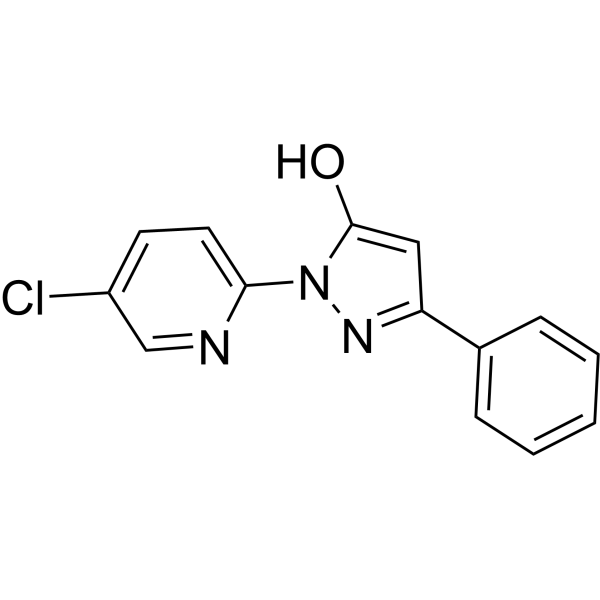
Physicochemical Properties
| Molecular Formula | C14H10CLN3O |
| Molecular Weight | 271.70 |
| Exact Mass | 271.051 |
| CAS # | 2579696-72-1 |
| PubChem CID | 155981996 |
| Appearance | Off-white to light yellow solid powder |
| LogP | 3 |
| Hydrogen Bond Donor Count | 1 |
| Hydrogen Bond Acceptor Count | 3 |
| Rotatable Bond Count | 2 |
| Heavy Atom Count | 19 |
| Complexity | 379 |
| Defined Atom Stereocenter Count | 0 |
| InChi Key | IRQULQWSSURBFT-UHFFFAOYSA-N |
| InChi Code | InChI=1S/C14H10ClN3O/c15-11-6-7-13(16-9-11)18-14(19)8-12(17-18)10-4-2-1-3-5-10/h1-9,17H |
| Chemical Name | 2-(5-chloropyridin-2-yl)-5-phenyl-1H-pyrazol-3-one |
| HS Tariff Code | 2934.99.9001 |
| Storage |
Powder-20°C 3 years 4°C 2 years In solvent -80°C 6 months -20°C 1 month |
| Shipping Condition | Room temperature (This product is stable at ambient temperature for a few days during ordinary shipping and time spent in Customs) |
Biological Activity
| ln Vitro | With a GI50 of 19.0 μM, COQ7-IN-1 (Compound 8; 0-30 μM; for 4 days) inhibits the growth of WI-38 cells. With a GI50 of 9.0±1.1 μM, COQ7-IN-1 weakly inhibits the growth of C3A cells. By reducing oxidative stress or blocking aerobic respiration, COQ7-IN-1 does not reduce the survival of C3A cells[1]. Demethoxy-UQ (DMQ) is changed to demethyl-UQ (DMeQ) by COQ7, which is subsequently changed to UQ by COQ3. Lack of COQ7 prevents cells from producing UQ, which leads to the accumulation of DMQ. For COQ7-IN-1 (10 μM; for 2 days) cultured with HeLa cells, the DMQ10 and UQ10 contents in each culture well are 13.2 and 12.2 ng/well, respectively. In HeLa cells, the DMQ10 content of COQ7-IN-1 is 52.0%[1]. |
| Cell Assay |
Cell Viability Assay[1] Cell Types: WI-38 cells Tested Concentrations: 0-30 μM Incubation Duration: 4 days Experimental Results: The concentration that caused 50% cell growth inhibition (GI50 ) was 19.0 μM. |
| References | [1]. Keiko Tsuganezawa, et al. Identification of small molecule inhibitors of human COQ7. Bioorg Med Chem. 2020 Jan 1;28(1):115182. |
Solubility Data
| Solubility (In Vitro) | DMSO: 100 mg/mL (368.05 mM) |
| Solubility (In Vivo) |
Solubility in Formulation 1: ≥ 2.08 mg/mL (7.66 mM) (saturation unknown) in 10% DMSO + 90% Corn Oil (add these co-solvents sequentially from left to right, and one by one), clear solution. For example, if 1 mL of working solution is to be prepared, you can add 100 μL of 20.8 mg/mL clear DMSO stock solution to 900 μL of corn oil and mix evenly. (Please use freshly prepared in vivo formulations for optimal results.) |
| Preparing Stock Solutions | 1 mg | 5 mg | 10 mg | |
| 1 mM | 3.6805 mL | 18.4026 mL | 36.8053 mL | |
| 5 mM | 0.7361 mL | 3.6805 mL | 7.3611 mL | |
| 10 mM | 0.3681 mL | 1.8403 mL | 3.6805 mL |