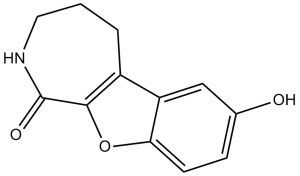
CID755673 (also known as benzoxoloazepinolone) is a novel, potent and selective cell-active pan-PKD1/2/3 (Protein kinase D) inhibitor with IC50 of 180 nM, 280nM, and 227 nM, respectively, it shows about 200-fold selectivity over other CAMKs. The first known small molecule PKD antagonist that is cell-active is CID755673. When compared to AKT, PLK1, CAK, CAMKII, PKD2 and PKD3, it has the highest selectivity for PKD1 and inhibits its activity with an IC50 of 182 nM. Additionally, it did not compete with ATP to inhibit enzymes. CID755673 significantly inhibits both PKD-mediated protein transport and PMA-induced nuclear export of HDAC5 in HeLa cells.
Physicochemical Properties
| Molecular Formula | C12H11NO3 | |
| Molecular Weight | 219.24 | |
| Exact Mass | 217.073 | |
| Elemental Analysis | C, 66.35; H, 5.10; N, 6.45; O, 22.10 | |
| CAS # | 521937-07-5 | |
| Related CAS # |
|
|
| PubChem CID | 755673 | |
| Appearance | brown solid powder | |
| Density | 1.3±0.1 g/cm3 | |
| Boiling Point | 531.8±38.0 °C at 760 mmHg | |
| Flash Point | 275.4±26.8 °C | |
| Vapour Pressure | 0.0±1.5 mmHg at 25°C | |
| Index of Refraction | 1.643 | |
| LogP | 1.41 | |
| Hydrogen Bond Donor Count | 2 | |
| Hydrogen Bond Acceptor Count | 3 | |
| Rotatable Bond Count | 0 | |
| Heavy Atom Count | 16 | |
| Complexity | 294 | |
| Defined Atom Stereocenter Count | 0 | |
| SMILES | O=C1NCCCC2=C1OC3=CC=C(O)C=C32 |
|
| InChi Key | ACFPJSJOWQNBN-UHFFFAOYSA-N | |
| InChi Code | InChI=1S/C12H11NO3/c14-7-3-4-10-9(6-7)8-2-1-5-13-12(15)11(8)16-10/h3-4,6,14H,1-2,5H2,(H,13,15) | |
| Chemical Name | 7-hydroxy-2,3,4,5-tetrahydro-[1]benzofuro[2,3-c]azepin-1-one | |
| Synonyms |
|
|
| HS Tariff Code | 2934.99.9001 | |
| Storage |
Powder-20°C 3 years 4°C 2 years In solvent -80°C 6 months -20°C 1 month |
|
| Shipping Condition | Room temperature (This product is stable at ambient temperature for a few days during ordinary shipping and time spent in Customs) |
Biological Activity
| Targets | PKD1 (IC50 = 182 nM); PKD3 (IC50 = 227 nM); PKD2 (IC50 = 280 nM) | ||
| ln Vitro | The class IIa histone deacetylase 5 nuclear exclusion caused by phorbol ester, the transport of vesicular stomatitis virus glycoprotein from the Golgi to the plasma membrane, and the fragmentation of the Golgi caused by ilimaquinone are all known biological actions of PKD1 that CID755673 inhibits. CID755673 inhibits prostate cancer cell proliferation, cell migration, and invasion[1]. | ||
| ln Vivo | The PKD inhibitor CID755673 reduces PKD1 and 2 phosphorylation in normal mice in a time- and dose-dependent manner after acute administration. For two weeks, chronic CID755673 administration to T2D db/db mice reduced the expression of the gene expression signature of PKD activation, improved measures of left ventricular diastolic and systolic function, and was linked to decreased heart weight[2]. | ||
| Enzyme Assay | The radiometric kinase assay is carried out by coincubating 0.5 μCi of [γ-32P]ATP, 20 μM ATP, 50 ng of purified recombinant human PKD (PKD1, PKD2, and PKD3) or CAMKIIα proteins, and 2.5 μg of Syntide-2 in 50 μL of kinase buffer that contains 50 mM Tris-HCl, pH 7.5, 4 mM MgCl2, 10 mM β-mercaptoethanol. When the initial rate of the reaction is within the linear kinetic range, the reaction can proceed[1]. | ||
| Cell Assay | By scraping the cells with a plastic pipette tip, the cells migrate toward the wound, which causes an immediate image of the wound to be captured. The DU145 cells are subsequently treated with or without CID755673 at various concentrations. With an inverted phase-contrast microscope and a 10 objective, the wound is imaged immediately (0 h) and at various intervals. Cells are fixed with methanol at the conclusion of the test and stained with crystal violet to produce the final image[1]. | ||
| Animal Protocol |
|
||
| References | [1]. Potent and selective disruption of protein kinase D functionality by a benzoxoloazepinolone. J Biol Chem. 2008 Nov 28;283(48):33516-26. [2]. The PKD inhibitor CID755673 enhances cardiac function in diabetic db/db mice. PLoS One. 2015 Mar 23;10(3):e0120934. | ||
| Additional Infomation | 7-hydroxy-2,3,4,5-tetrahydrobenzofuro[2,3-c]azepin-1-one is a member of benzofurans. |
Solubility Data
| Solubility (In Vitro) |
|
|||
| Solubility (In Vivo) |
Solubility in Formulation 1: ≥ 2.5 mg/mL (11.51 mM) (saturation unknown) in 10% DMSO + 40% PEG300 + 5% Tween80 + 45% Saline (add these co-solvents sequentially from left to right, and one by one), clear solution. For example, if 1 mL of working solution is to be prepared, you can add 100 μL of 25.0 mg/mL clear DMSO stock solution to 400 μL PEG300 and mix evenly; then add 50 μL Tween-80 to the above solution and mix evenly; then add 450 μL normal saline to adjust the volume to 1 mL. Preparation of saline: Dissolve 0.9 g of sodium chloride in 100 mL ddH₂ O to obtain a clear solution. Solubility in Formulation 2: ≥ 2.5 mg/mL (11.51 mM) (saturation unknown) in 10% DMSO + 90% (20% SBE-β-CD in Saline) (add these co-solvents sequentially from left to right, and one by one), clear solution. For example, if 1 mL of working solution is to be prepared, you can add 100 μL of 25.0 mg/mL clear DMSO stock solution to 900 μL of 20% SBE-β-CD physiological saline solution and mix evenly. Preparation of 20% SBE-β-CD in Saline (4°C,1 week): Dissolve 2 g SBE-β-CD in 10 mL saline to obtain a clear solution. Solubility in Formulation 3: ≥ 2.5 mg/mL (11.51 mM) (saturation unknown) in 10% DMSO + 90% Corn Oil (add these co-solvents sequentially from left to right, and one by one), clear solution. For example, if 1 mL of working solution is to be prepared, you can add 100 μL of 25.0 mg/mL clear DMSO stock solution to 900 μL of corn oil and mix evenly. Solubility in Formulation 4: 2%DMSO+30%peg300+2%t-80+ddaH2O: 6mg/mL (Please use freshly prepared in vivo formulations for optimal results.) |
| Preparing Stock Solutions | 1 mg | 5 mg | 10 mg | |
| 1 mM | 4.5612 mL | 22.8061 mL | 45.6121 mL | |
| 5 mM | 0.9122 mL | 4.5612 mL | 9.1224 mL | |
| 10 mM | 0.4561 mL | 2.2806 mL | 4.5612 mL |