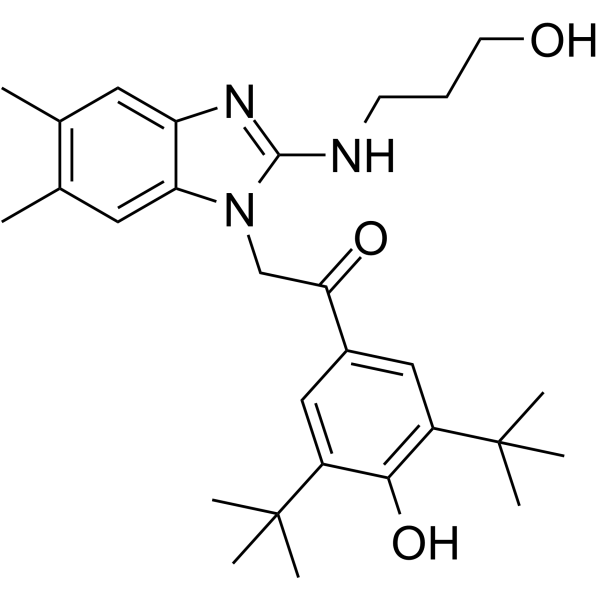
Physicochemical Properties
| Molecular Formula | C28H39N3O3 |
| Molecular Weight | 465.638 |
| Exact Mass | 465.299 |
| CAS # | 758679-97-9 |
| PubChem CID | 2858523 |
| Appearance | Off-white to light yellow solid powder |
| Density | 1.1±0.1 g/cm3 |
| Boiling Point | 618.9±65.0 °C at 760 mmHg |
| Flash Point | 328.1±34.3 °C |
| Vapour Pressure | 0.0±1.9 mmHg at 25°C |
| Index of Refraction | 1.573 |
| LogP | 6.64 |
| Hydrogen Bond Donor Count | 3 |
| Hydrogen Bond Acceptor Count | 5 |
| Rotatable Bond Count | 9 |
| Heavy Atom Count | 34 |
| Complexity | 661 |
| Defined Atom Stereocenter Count | 0 |
| InChi Key | CYCGGKILBWERDJ-UHFFFAOYSA-N |
| InChi Code | InChI=1S/C28H39N3O3/c1-17-12-22-23(13-18(17)2)31(26(30-22)29-10-9-11-32)16-24(33)19-14-20(27(3,4)5)25(34)21(15-19)28(6,7)8/h12-15,32,34H,9-11,16H2,1-8H3,(H,29,30) |
| Chemical Name | 1-(3,5-ditert-butyl-4-hydroxyphenyl)-2-[2-(3-hydroxypropylamino)-5,6-dimethylbenzimidazol-1-yl]ethanone |
| Synonyms | CID 2858522; CID-2858522; CID2858522 |
| HS Tariff Code | 2934.99.9001 |
| Storage |
Powder-20°C 3 years 4°C 2 years In solvent -80°C 6 months -20°C 1 month |
| Shipping Condition | Room temperature (This product is stable at ambient temperature for a few days during ordinary shipping and time spent in Customs) |
Biological Activity
| ln Vitro | Compound 1, CID-2858522, has an IC50 of 70 nM, which inhibits NF-κB mediated by antigen receptors. With an IC50 of 85 μM, CID-2858522 also inhibits testosterone hydroxylase when human liver microsomes (HLM) and a NADPH-generating apparatus are present [1]. CID-2858522 inhibits NF-κB reporter gene activity in the HEK293 cell line utilized for primary screening in a concentration-dependent manner with an IC50 of approximately 70 nM and a maximal inhibition of 0.25–0.5 μM. On the other hand, CID-2858522 exhibits selectivity for the NF-κB pathway activated by PMA/Ionomycin because it does not suppress TNF-induced NF-κB-reporter gene activity at concentrations as high as 4 μM. At doses ≤8 μM, CID-2858522 is not hazardous to HEK293 cells, according to cell viability tests. In transient transfection studies, CID-2858522 also effectively suppresses NF-κB reporter gene activity caused by PMA/Ionomycin[2]. |
| ln Vivo | Using a small cohort of three male mice, in vivo dose-exposure profiling of CID-2858522 (Compound 1a) is carried out. When evaluated at t=3 h, CID-2858522 displays usual dose-dependent behavior, but at 0.5 h, serum levels for the 30 mg/kg dose are higher than for the 50 mg/kg dose. This indicates nonlinear pharmacokinetics. One possible explanation for the increased accumulation observed at a dose of 50 mg/kg is a depot effect brought on by CYP3A4 inhibition. At t=3 h, the cohort shows definite symptoms of morbidity at the 50 mg/kg dose[2]. |
| References |
[1]. Selective benzimidazole inhibitors of the antigen receptor-mediated NF-kappaB activationpathway. Bioorg Med Chem. 2010 Mar 1;18(5):1918-24. [2]. Inhibition of protein kinase C-driven nuclear factor-kappaB activation: synthesis, structure-activity relationship, and pharmacological profiling of pathway specific benzimidazole probe molecules. J Med Chem. 2010 Jun 24;53(12):4793-. [3]. Chemical biology strategy reveals pathway-selective inhibitor of NF-kappaB activation induced by protein kinase C. ACS Chem Biol. 2010 Mar 19;5(3):287-99. |
| Additional Infomation | 1-(3,5-ditert-butyl-4-hydroxyphenyl)-2-[2-(3-hydroxypropylamino)-5,6-dimethyl-1-benzimidazolyl]ethanone is an aromatic ketone. |
Solubility Data
| Solubility (In Vitro) | DMSO : ~25 mg/mL (~53.69 mM) |
| Solubility (In Vivo) |
Solubility in Formulation 1: ≥ 2.5 mg/mL (5.37 mM) (saturation unknown) in 10% DMSO + 40% PEG300 + 5% Tween80 + 45% Saline (add these co-solvents sequentially from left to right, and one by one), clear solution. For example, if 1 mL of working solution is to be prepared, you can add 100 μL of 25.0 mg/mL clear DMSO stock solution to 400 μL PEG300 and mix evenly; then add 50 μL Tween-80 to the above solution and mix evenly; then add 450 μL normal saline to adjust the volume to 1 mL. Preparation of saline: Dissolve 0.9 g of sodium chloride in 100 mL ddH₂ O to obtain a clear solution. Solubility in Formulation 2: 2.5 mg/mL (5.37 mM) in 10% DMSO + 90% (20% SBE-β-CD in Saline) (add these co-solvents sequentially from left to right, and one by one), suspension solution; with ultrasonication. For example, if 1 mL of working solution is to be prepared, you can add 100 μL of 25.0 mg/mL clear DMSO stock solution to 900 μL of 20% SBE-β-CD physiological saline solution and mix evenly. Preparation of 20% SBE-β-CD in Saline (4°C,1 week): Dissolve 2 g SBE-β-CD in 10 mL saline to obtain a clear solution. (Please use freshly prepared in vivo formulations for optimal results.) |
| Preparing Stock Solutions | 1 mg | 5 mg | 10 mg | |
| 1 mM | 2.1476 mL | 10.7379 mL | 21.4758 mL | |
| 5 mM | 0.4295 mL | 2.1476 mL | 4.2952 mL | |
| 10 mM | 0.2148 mL | 1.0738 mL | 2.1476 mL |