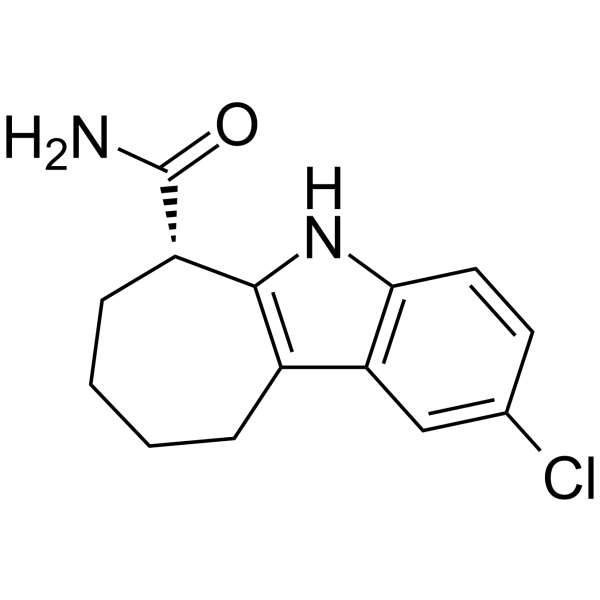
Physicochemical Properties
| Molecular Formula | C14H15CLN2O |
| Molecular Weight | 262.74 |
| Exact Mass | 262.087 |
| CAS # | 848193-72-6 |
| PubChem CID | 914268 |
| Appearance | Typically exists as solid at room temperature |
| LogP | 4.266 |
| Hydrogen Bond Donor Count | 2 |
| Hydrogen Bond Acceptor Count | 1 |
| Rotatable Bond Count | 1 |
| Heavy Atom Count | 18 |
| Complexity | 336 |
| Defined Atom Stereocenter Count | 1 |
| SMILES | NC([C@H]1CCCCC2C3C=C(Cl)C=CC=3NC1=2)=O |
| InChi Key | ABIVOOWWGYJNLV-JTQLQIEISA-N |
| InChi Code | InChI=1S/C14H15ClN2O/c15-8-5-6-12-11(7-8)9-3-1-2-4-10(14(16)18)13(9)17-12/h5-7,10,17H,1-4H2,(H2,16,18)/t10-/m0/s1 |
| Chemical Name | (6S)-2-chloro-5,6,7,8,9,10-hexahydrocyclohepta[b]indole-6-carboxamide |
| Synonyms | CHIC 35; CHIC35; CHIC-35 |
| HS Tariff Code | 2934.99.9001 |
| Storage |
Powder-20°C 3 years 4°C 2 years In solvent -80°C 6 months -20°C 1 month |
| Shipping Condition | Room temperature (This product is stable at ambient temperature for a few days during ordinary shipping and time spent in Customs) |
Biological Activity
| ln Vitro | Similar to Cambinol (200 μM), CHIC-35 (0.5 μM; 16 hours) also promotes histone H4 acetylation in BMDM [1]. There was no significant difference in early embryo survival observed in CHIC-35 (5 μM; 72 hours) [2]. To advance to different embryonic stages, 2.4 ng of chd7 MO was microinjected into zebrafish embryos. CHIC-35 was administered to chd7 mutant embryos between the ages of 8 and 24 hpf. After removing CHIC-35 (5 μM) at 24 hpf, the embryos were cultured in new egg water until they reached 4 dpf. Comparing chd7 amorphous larvae to controls, the pattern of cartilage elements is significantly decreased and disordered; however, CHIC-35 exhibits a partial repair of craniofacial cartilage elements [2]. At 4 dpf, the mandibles of control zebrafish embryos were well-formed, while the mandibles of chd7 mutants were smaller. Treatment with CHIC-35 (5 μM) restores the expression of the sox9ainchd7 morphant [2]. Compared to 10% of wild-type controls, over 30% of chd7 mutant embryos (24hpf to 72hpf) displayed an almost total loss of isl2a expression in the cranial region. This amount was considerably decreased to 7.5% by CHIC-35. Tg-labeled enteric neurons, however, did not exhibit any discernible effects from CHIC-35 [2]. |
| References |
[1]. The sirtuin inhibitor cambinol impairs MAPK signaling, inhibits inflammatory and innate immune responses and protects from septic shock. Biochim Biophys Acta. 2013 Jun;1833(6):1498-510. [2]. Chemical screens in a zebrafish model of CHARGE syndrome identifies small molecules that ameliorate disease-like phenotypes in embryo. Eur J Med Genet. 2020 Feb;63(2):103661. |
| Additional Infomation | CHIC-35 is an organic heterotricyclic compound resulting from the formal fusion of the 2-3 bond of 5-chloroindole with the 2-3 bond of cycloheptanecarboxamide (the S enantiomer). It is a potent, cell-permeable, metabolically stable and selective inhibitor of the deacetylase SIRT1. It has a role as an EC 3.5.1.98 (histone deacetylase) inhibitor. It is an aromatic compound, an organic heterotricyclic compound, an organochlorine compound and a primary carboxamide. |
Solubility Data
| Solubility (In Vitro) | May dissolve in DMSO (in most cases), if not, try other solvents such as H2O, Ethanol, or DMF with a minute amount of products to avoid loss of samples |
| Solubility (In Vivo) |
Note: Listed below are some common formulations that may be used to formulate products with low water solubility (e.g. < 1 mg/mL), you may test these formulations using a minute amount of products to avoid loss of samples. Injection Formulations (e.g. IP/IV/IM/SC) Injection Formulation 1: DMSO : Tween 80: Saline = 10 : 5 : 85 (i.e. 100 μL DMSO stock solution → 50 μL Tween 80 → 850 μL Saline) *Preparation of saline: Dissolve 0.9 g of sodium chloride in 100 mL ddH ₂ O to obtain a clear solution. Injection Formulation 2: DMSO : PEG300 :Tween 80 : Saline = 10 : 40 : 5 : 45 (i.e. 100 μL DMSO → 400 μLPEG300 → 50 μL Tween 80 → 450 μL Saline) Injection Formulation 3: DMSO : Corn oil = 10 : 90 (i.e. 100 μL DMSO → 900 μL Corn oil) Example: Take the Injection Formulation 3 (DMSO : Corn oil = 10 : 90) as an example, if 1 mL of 2.5 mg/mL working solution is to be prepared, you can take 100 μL 25 mg/mL DMSO stock solution and add to 900 μL corn oil, mix well to obtain a clear or suspension solution (2.5 mg/mL, ready for use in animals). Injection Formulation 4: DMSO : 20% SBE-β-CD in saline = 10 : 90 [i.e. 100 μL DMSO → 900 μL (20% SBE-β-CD in saline)] *Preparation of 20% SBE-β-CD in Saline (4°C,1 week): Dissolve 2 g SBE-β-CD in 10 mL saline to obtain a clear solution. Injection Formulation 5: 2-Hydroxypropyl-β-cyclodextrin : Saline = 50 : 50 (i.e. 500 μL 2-Hydroxypropyl-β-cyclodextrin → 500 μL Saline) Injection Formulation 6: DMSO : PEG300 : castor oil : Saline = 5 : 10 : 20 : 65 (i.e. 50 μL DMSO → 100 μLPEG300 → 200 μL castor oil → 650 μL Saline) Injection Formulation 7: Ethanol : Cremophor : Saline = 10: 10 : 80 (i.e. 100 μL Ethanol → 100 μL Cremophor → 800 μL Saline) Injection Formulation 8: Dissolve in Cremophor/Ethanol (50 : 50), then diluted by Saline Injection Formulation 9: EtOH : Corn oil = 10 : 90 (i.e. 100 μL EtOH → 900 μL Corn oil) Injection Formulation 10: EtOH : PEG300:Tween 80 : Saline = 10 : 40 : 5 : 45 (i.e. 100 μL EtOH → 400 μLPEG300 → 50 μL Tween 80 → 450 μL Saline) Oral Formulations Oral Formulation 1: Suspend in 0.5% CMC Na (carboxymethylcellulose sodium) Oral Formulation 2: Suspend in 0.5% Carboxymethyl cellulose Example: Take the Oral Formulation 1 (Suspend in 0.5% CMC Na) as an example, if 100 mL of 2.5 mg/mL working solution is to be prepared, you can first prepare 0.5% CMC Na solution by measuring 0.5 g CMC Na and dissolve it in 100 mL ddH2O to obtain a clear solution; then add 250 mg of the product to 100 mL 0.5% CMC Na solution, to make the suspension solution (2.5 mg/mL, ready for use in animals). Oral Formulation 3: Dissolved in PEG400 Oral Formulation 4: Suspend in 0.2% Carboxymethyl cellulose Oral Formulation 5: Dissolve in 0.25% Tween 80 and 0.5% Carboxymethyl cellulose Oral Formulation 6: Mixing with food powders Note: Please be aware that the above formulations are for reference only. InvivoChem strongly recommends customers to read literature methods/protocols carefully before determining which formulation you should use for in vivo studies, as different compounds have different solubility properties and have to be formulated differently. (Please use freshly prepared in vivo formulations for optimal results.) |
| Preparing Stock Solutions | 1 mg | 5 mg | 10 mg | |
| 1 mM | 3.8060 mL | 19.0302 mL | 38.0604 mL | |
| 5 mM | 0.7612 mL | 3.8060 mL | 7.6121 mL | |
| 10 mM | 0.3806 mL | 1.9030 mL | 3.8060 mL |