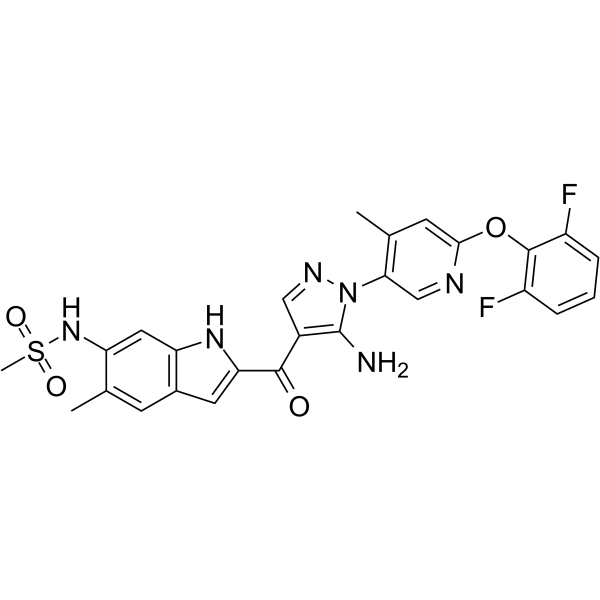
Physicochemical Properties
| Molecular Formula | C26H22F2N6O4S |
| Molecular Weight | 552.552490711212 |
| Exact Mass | 552.139 |
| Elemental Analysis | C, 56.31; H, 4.36; F, 6.85; N, 15.15; O, 11.54; S, 5.78 |
| CAS # | 2055918-71-1 |
| PubChem CID | 124149825 |
| Appearance | Off-white to light yellow solid powder |
| LogP | 4.6 |
| Hydrogen Bond Donor Count | 3 |
| Hydrogen Bond Acceptor Count | 10 |
| Rotatable Bond Count | 7 |
| Heavy Atom Count | 39 |
| Complexity | 978 |
| Defined Atom Stereocenter Count | 0 |
| SMILES | S(C)(NC1=CC2=C(C=C1C)C=C(C(C1C=NN(C3C=NC(=CC=3C)OC3C(=CC=CC=3F)F)C=1N)=O)N2)(=O)=O |
| InChi Key | YVXUHNOWRKWXSJ-UHFFFAOYSA-N |
| InChi Code | InChI=1S/C26H22F2N6O4S/c1-13-7-15-9-21(32-20(15)10-19(13)33-39(3,36)37)24(35)16-11-31-34(26(16)29)22-12-30-23(8-14(22)2)38-25-17(27)5-4-6-18(25)28/h4-12,32-33H,29H2,1-3H3 |
| Chemical Name | N-[2-[5-amino-1-[6-(2,6-difluorophenoxy)-4-methylpyridin-3-yl]pyrazole-4-carbonyl]-5-methyl-1H-indol-6-yl]methanesulfonamide |
| Synonyms | CH6953755; 2055918-71-1; N-[2-[5-Amino-1-[6-(2,6-difluorophenoxy)-4-methylpyridin-3-yl]pyrazole-4-carbonyl]-5-methyl-1H-indol-6-yl]methanesulfonamide; N-(2-(5-Amino-1-(6-(2,6-difluorophenoxy)-4-methylpyridin-3-yl)-1H-pyrazole-4-carbonyl)-5-methyl-1H-indol-6-yl)methanesulfonamide; orb1710073; SCHEMBL18332413; SCHEMBL29692938; |
| HS Tariff Code | 2934.99.9001 |
| Storage |
Powder-20°C 3 years 4°C 2 years In solvent -80°C 6 months -20°C 1 month |
| Shipping Condition | Room temperature (This product is stable at ambient temperature for a few days during ordinary shipping and time spent in Customs) |
Biological Activity
| Targets |
YES proto - oncogene 1 (YES1; IC50 = 1.8 nM) [1] |
| ln Vitro |
- Antiproliferative Activity: CH6953755 shows antitumor activity against YES1 - amplified cancer cells in vitro. It inhibits the proliferation of YES1 - amplified esophageal cancer cell lines by targeting YES1 kinase, which is related to its function of blocking the downstream signaling pathway of YES1 [1] - Effect on Signaling Pathway: YES1 regulates the transcription activity of Yes - associated protein 1 (YAP1) by controlling its nuclear translocation and serine phosphorylation. CH6953755 inhibits YES1 kinase, thus blocking the regulation of YAP1 by YES1, and then inhibits the growth of YES1 - amplified cancer cells [1] For four days, the autophosphorylation of YES1 at Tyr426 is inhibited by CH6953755 (0.001-1 μM) [1]. In YES1-supplemented KYSE70 and RERF-LC-AI, CH6953755 (0.001-1 μM; 2 hours duration) inhibits YES1 autophosphorylation at Tyr426. CH6953755 (0.1, 0.3, 1, 3 μM) suppresses the TEAD luciferase gene, upregulating the enzyme activity in KYSE70 cells shown by YES1 reporter [1]. |
| ln Vivo |
- Antitumor Efficacy: CH6953755 has antitumor activity against YES1 - amplified cancers in vivo. It can inhibit the growth of xenografted tumors derived from YES1 - amplified cancer cells in nude mice, indicating its potential for treating YES1 - amplified cancers [1] CH6953755 (lateral wall; 60 mg/kg/day; sustained for 10 days tumor) simultaneously inhibits phosphorylated Tyr426 YES1 and shows selective antitumor activity in xenografts [1]. CH6953755; 7.5, 15, 30, 60 mg; lateral wall |
| Cell Assay |
Cell viability assay [1] Cell Types: YES1-amplified cancer cell lines KYSE70 and OACP4 C, and non-YES1-amplified cancer cell line K562 expressing YES1-WT or YES1-GK. Tested Concentrations: 0.001, 0.01, 0.1. , 1 μM Incubation Duration: 4 days Experimental Results: Inhibits cell growth of YES1-amplified cancer cell lines. Western Blot Analysis [1] Cell Types: KYSE70 cell line Tested Concentrations: 0.001, 0.003, 0.01, 0.03, 0.1, 0.3, 1 μM Incubation Duration: 2 hrs (hours) Experimental Results: Prevents autophosphorylation at Tyr426 of YES1, thereby upregulating KYSE70 cells The enzymatic activity of YES1 amplifies - Proliferation Inhibition Assay: Culture YES1 - amplified esophageal cancer cell lines, add different concentrations of CH6953755 to the culture medium, and incubate for a certain period of time. Then, use methods such as the MTT assay or colony - forming assay to detect the proliferation of cancer cells, so as to evaluate the antiproliferative activity of CH6953755 on YES1 - amplified cancer cells [1] |
| Animal Protocol |
Animal/Disease Models: Female BALB/c-nu/nu (nude) mice with Rat-2_YES1 xenografts [1] Doses: 60 mg/kg Route of Administration: Oral ; /kg) inhibits phosphorylated-Tyr426 YES1[1] in a dose-dependent manner. Daily; lasted 10 days Experimental Results: Demonstrated selective antitumor activity in xenograft tumors, concomitant with inhibition of phosphorylated Tyr426 YES1. Xenograft Tumor Model in Nude Mice: Inject YES1 - amplified esophageal cancer cells into nude mice to establish xenograft tumor models. When the tumors grow to a certain size, give CH6953755 to the nude mice by gavage or intra - peritoneal injection (the specific administration route, dose, and frequency are not described in the literature), and observe the change of tumor volume over time to evaluate the antitumor effect of CH6953755 [1] |
| References |
[1]. YES1 Is a Targetable Oncogene in Cancers Harboring YES1 Gene Amplification. Cancer Res. 2019 Nov 15;79(22):5734-5745. |
| Additional Infomation |
- Mechanism of Action: CH6953755 is a YES1 kinase inhibitor. It exerts antitumor activity by inhibiting YES1 kinase, blocking the nuclear translocation and serine phosphorylation of YAP1 regulated by YES1, and then inhibiting the transcription activity of YAP1, thus inhibiting the growth of YES1 - amplified cancer cells [1] - Therapeutic Potential: It has therapeutic potential for cancers with YES1 gene amplification, including esophageal cancer, lung cancer, head and neck cancer, bladder cancer, etc. [1] |
Solubility Data
| Solubility (In Vitro) | DMSO : ~125 mg/mL (~226.22 mM) |
| Solubility (In Vivo) |
Solubility in Formulation 1: ≥ 2.08 mg/mL (3.76 mM) (saturation unknown) in 10% DMSO + 40% PEG300 + 5% Tween80 + 45% Saline (add these co-solvents sequentially from left to right, and one by one), clear solution. For example, if 1 mL of working solution is to be prepared, you can add 100 μL of 20.8 mg/mL clear DMSO stock solution to 400 μL PEG300 and mix evenly; then add 50 μL Tween-80 to the above solution and mix evenly; then add 450 μL normal saline to adjust the volume to 1 mL. Preparation of saline: Dissolve 0.9 g of sodium chloride in 100 mL ddH₂ O to obtain a clear solution. Solubility in Formulation 2: ≥ 2.08 mg/mL (3.76 mM) (saturation unknown) in 10% DMSO + 90% (20% SBE-β-CD in Saline) (add these co-solvents sequentially from left to right, and one by one), clear solution. For example, if 1 mL of working solution is to be prepared, you can add 100 μL of 20.8 mg/mL clear DMSO stock solution to 900 μL of 20% SBE-β-CD physiological saline solution and mix evenly. Preparation of 20% SBE-β-CD in Saline (4°C,1 week): Dissolve 2 g SBE-β-CD in 10 mL saline to obtain a clear solution. Solubility in Formulation 3: ≥ 2.08 mg/mL (3.76 mM) (saturation unknown) in 10% DMSO + 90% Corn Oil (add these co-solvents sequentially from left to right, and one by one), clear solution. For example, if 1 mL of working solution is to be prepared, you can add 100 μL of 20.8 mg/mL clear DMSO stock solution to 900 μL of corn oil and mix evenly. (Please use freshly prepared in vivo formulations for optimal results.) |
| Preparing Stock Solutions | 1 mg | 5 mg | 10 mg | |
| 1 mM | 1.8098 mL | 9.0490 mL | 18.0979 mL | |
| 5 mM | 0.3620 mL | 1.8098 mL | 3.6196 mL | |
| 10 mM | 0.1810 mL | 0.9049 mL | 1.8098 mL |