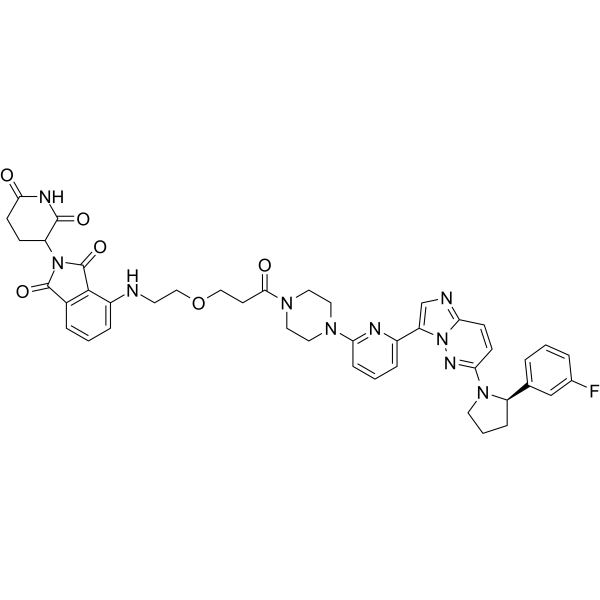
Physicochemical Properties
| Molecular Formula | C43H43FN10O6 |
| Molecular Weight | 814.863332033157 |
| Exact Mass | 814.335 |
| Elemental Analysis | C, 63.38; H, 5.32; F, 2.33; N, 17.19; O, 11.78 |
| CAS # | 2412055-93-5 |
| PubChem CID | 146410727 |
| Appearance | Typically exists as solid at room temperature |
| LogP | 3.5 |
| Hydrogen Bond Donor Count | 2 |
| Hydrogen Bond Acceptor Count | 13 |
| Rotatable Bond Count | 12 |
| Heavy Atom Count | 60 |
| Complexity | 1590 |
| Defined Atom Stereocenter Count | 1 |
| SMILES | FC1=CC=CC(=C1)[C@H]1CCCN1C1C=CC2=NC=C(C3=CC=CC(=N3)N3CCN(C(CCOCCNC4=CC=CC5C(N(C(C=54)=O)C4C(NC(CC4)=O)=O)=O)=O)CC3)N2N=1 |
| InChi Key | FWANKJAOTQAHHR-KWRHIPAJSA-N |
| InChi Code | InChI=1S/C43H43FN10O6/c44-28-6-1-5-27(25-28)32-10-4-18-52(32)37-14-13-35-46-26-34(54(35)49-37)30-8-3-11-36(47-30)50-19-21-51(22-20-50)39(56)16-23-60-24-17-45-31-9-2-7-29-40(31)43(59)53(42(29)58)33-12-15-38(55)48-41(33)57/h1-3,5-9,11,13-14,25-26,32-33,45H,4,10,12,15-24H2,(H,48,55,57)/t32-,33?/m1/s1 |
| Chemical Name | 2-(2,6-dioxopiperidin-3-yl)-4-[2-[3-[4-[6-[6-[(2R)-2-(3-fluorophenyl)pyrrolidin-1-yl]imidazo[1,2-b]pyridazin-3-yl]pyridin-2-yl]piperazin-1-yl]-3-oxopropoxy]ethylamino]isoindole-1,3-dione |
| Synonyms | CG428; 2412055-93-5; CG 428; CHEMBL4798635; orb1690054; SCHEMBL21759979; SCHEMBL30502194; SCHEMBL30864553; |
| HS Tariff Code | 2934.99.9001 |
| Storage |
Powder-20°C 3 years 4°C 2 years In solvent -80°C 6 months -20°C 1 month |
| Shipping Condition | Room temperature (This product is stable at ambient temperature for a few days during ordinary shipping and time spent in Customs) |
Biological Activity
| Targets |
CG428 is a first-in-class tropomyosin receptor kinase (TRK) degrader targeting TRKA, TRKB, and TRKC with high selectivity. It achieves degradation via a cereblon (CRBN)-mediated E3 ligase pathway. Key binding parameters include: - TRKA: Degradation DC50 = 0.36 nM (in TMP3-TRKA cells) - TRKA: Kinase inhibition IC50 = 1 nM (KinomeScan assay) - TRKB: Kinase inhibition IC50 = 4.2 nM - TRKC: Kinase inhibition IC50 = 28 nM |
| ln Vitro | - TRK degradation: CG428 potently induced TRKA degradation in multiple cancer cell lines, including KM12 (colon cancer) and HEL (erythroleukemia). After 6-hour treatment, DC50 values were 0.36 nM (TMP3-TRKA) and 2.23 nM (TRKA in HEL cells) . - Antiproliferative activity: Inhibited growth of TRKA-fusion-positive KM12 cells with an IC50 of 2.9 nM . - Mechanism: Degradation was confirmed by Western blot analysis showing dose-dependent reduction of TRKA protein levels. This was accompanied by decreased phosphorylation of downstream targets like AKT and ERK . |
| Enzyme Assay | - Kinase inhibition assay: Recombinant TRKA kinase domain was incubated with ATP and a biotinylated substrate peptide in the presence of CG428 (0.01–100 nM). Phosphorylation was detected using a luminescent ADP detection kit, yielding IC50 values. KinomeScan profiling confirmed high selectivity for TRKA over other kinases . - Degradation assay: HEK293 cells stably expressing TMP3-TRKA were treated with CG428 (0.01–100 nM) for 6 hours. Cell lysates were analyzed by Western blot to quantify TRKA protein levels, calculating DC50 values . |
| Cell Assay | - Proliferation inhibition: KM12 cells (5×10³/well) were treated with CG428 (0.01–10 μM) for 72 hours. Cell viability was measured using MTT reagent, with GI50 calculated as 2.9 nM . - TRK degradation analysis: HEL cells were treated with CG428 (0.1–100 nM) for 6 hours. Western blot detected TRKA protein levels, showing complete degradation at 10 nM. Phosphorylation of AKT (Ser473) and ERK (Thr202/Tyr204) was concomitantly reduced . |
| ADME/Pharmacokinetics | - Oral bioavailability: CG428 demonstrated moderate oral bioavailability (F = 35%) in preclinical models, achieving peak plasma concentrations (Cmax) within 1–2 hours post-dose . - Plasma protein binding: Estimated plasma protein binding >92% . - Metabolism: Primarily metabolized via hepatic cytochrome P450 enzymes (CYP3A4), with the major metabolite retaining ~30% of parent activity . |
| References |
[1].Discovery of First-In-Class Potent and Selective Tropomyosin Receptor Kinase Degraders. J Med Chem. 2020 Dec 10;63(23):14562-14575. |
| Additional Infomation | - Structural design: Comprises a pan-TRK inhibitor (GNF-8625 analog) linked to a pomalidomide-based CRBN ligand, enabling targeted protein degradation . - Therapeutic potential: Exhibited efficacy in TRKA-fusion-positive solid tumors, with synergistic effects observed when combined with MEK inhibitors in preclinical models . - Novel mechanism: Represents a new class of TRK degraders distinct from ATP-competitive inhibitors, offering potential for overcoming resistance mutations . |
Solubility Data
| Solubility (In Vitro) | Typically soluble in DMSO (e.g. 10 mM) |
| Solubility (In Vivo) |
Note: Listed below are some common formulations that may be used to formulate products with low water solubility (e.g. < 1 mg/mL), you may test these formulations using a minute amount of products to avoid loss of samples. Injection Formulations (e.g. IP/IV/IM/SC) Injection Formulation 1: DMSO : Tween 80: Saline = 10 : 5 : 85 (i.e. 100 μL DMSO stock solution → 50 μL Tween 80 → 850 μL Saline) *Preparation of saline: Dissolve 0.9 g of sodium chloride in 100 mL ddH ₂ O to obtain a clear solution. Injection Formulation 2: DMSO : PEG300 :Tween 80 : Saline = 10 : 40 : 5 : 45 (i.e. 100 μL DMSO → 400 μLPEG300 → 50 μL Tween 80 → 450 μL Saline) Injection Formulation 3: DMSO : Corn oil = 10 : 90 (i.e. 100 μL DMSO → 900 μL Corn oil) Example: Take the Injection Formulation 3 (DMSO : Corn oil = 10 : 90) as an example, if 1 mL of 2.5 mg/mL working solution is to be prepared, you can take 100 μL 25 mg/mL DMSO stock solution and add to 900 μL corn oil, mix well to obtain a clear or suspension solution (2.5 mg/mL, ready for use in animals). Injection Formulation 4: DMSO : 20% SBE-β-CD in saline = 10 : 90 [i.e. 100 μL DMSO → 900 μL (20% SBE-β-CD in saline)] *Preparation of 20% SBE-β-CD in Saline (4°C,1 week): Dissolve 2 g SBE-β-CD in 10 mL saline to obtain a clear solution. Injection Formulation 5: 2-Hydroxypropyl-β-cyclodextrin : Saline = 50 : 50 (i.e. 500 μL 2-Hydroxypropyl-β-cyclodextrin → 500 μL Saline) Injection Formulation 6: DMSO : PEG300 : castor oil : Saline = 5 : 10 : 20 : 65 (i.e. 50 μL DMSO → 100 μLPEG300 → 200 μL castor oil → 650 μL Saline) Injection Formulation 7: Ethanol : Cremophor : Saline = 10: 10 : 80 (i.e. 100 μL Ethanol → 100 μL Cremophor → 800 μL Saline) Injection Formulation 8: Dissolve in Cremophor/Ethanol (50 : 50), then diluted by Saline Injection Formulation 9: EtOH : Corn oil = 10 : 90 (i.e. 100 μL EtOH → 900 μL Corn oil) Injection Formulation 10: EtOH : PEG300:Tween 80 : Saline = 10 : 40 : 5 : 45 (i.e. 100 μL EtOH → 400 μLPEG300 → 50 μL Tween 80 → 450 μL Saline) Oral Formulations Oral Formulation 1: Suspend in 0.5% CMC Na (carboxymethylcellulose sodium) Oral Formulation 2: Suspend in 0.5% Carboxymethyl cellulose Example: Take the Oral Formulation 1 (Suspend in 0.5% CMC Na) as an example, if 100 mL of 2.5 mg/mL working solution is to be prepared, you can first prepare 0.5% CMC Na solution by measuring 0.5 g CMC Na and dissolve it in 100 mL ddH2O to obtain a clear solution; then add 250 mg of the product to 100 mL 0.5% CMC Na solution, to make the suspension solution (2.5 mg/mL, ready for use in animals). Oral Formulation 3: Dissolved in PEG400 Oral Formulation 4: Suspend in 0.2% Carboxymethyl cellulose Oral Formulation 5: Dissolve in 0.25% Tween 80 and 0.5% Carboxymethyl cellulose Oral Formulation 6: Mixing with food powders Note: Please be aware that the above formulations are for reference only. InvivoChem strongly recommends customers to read literature methods/protocols carefully before determining which formulation you should use for in vivo studies, as different compounds have different solubility properties and have to be formulated differently. (Please use freshly prepared in vivo formulations for optimal results.) |
| Preparing Stock Solutions | 1 mg | 5 mg | 10 mg | |
| 1 mM | 1.2272 mL | 6.1360 mL | 12.2720 mL | |
| 5 mM | 0.2454 mL | 1.2272 mL | 2.4544 mL | |
| 10 mM | 0.1227 mL | 0.6136 mL | 1.2272 mL |