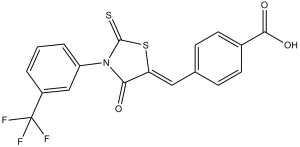
CFTRinh-172 (also known as CFTR Inhibitor172; CFTR-Inh 172; CFTR inhibitor 172) is a potent, voltage-independent, and selective inhibitor of CFTR (Cystic fibrosis transmembrane conductance regulator) with potential anti-fibrotic and anti-diarrhea effects. It inhibits CFTR with a Ki of 300 nM, and exhibits little/no effects on MDR1, ATP-sensitive K+ channels, or other transporters. CFTRinh-172 could reversibly inhibit CFTR short-circuit current in less than 2 minutes in a voltage-independent manner.
Physicochemical Properties
| Molecular Formula | C18H10F3NO3S2 | |
| Molecular Weight | 409.4 | |
| Exact Mass | 409.005 | |
| CAS # | 307510-92-5 | |
| Related CAS # |
|
|
| PubChem CID | 1554208 | |
| Appearance | Light yellow to yellow solid powder | |
| Density | 1.6±0.1 g/cm3 | |
| Boiling Point | 555.7±60.0 °C at 760 mmHg | |
| Flash Point | 289.9±32.9 °C | |
| Vapour Pressure | 0.0±1.6 mmHg at 25°C | |
| Index of Refraction | 1.698 | |
| LogP | 4.51 | |
| Hydrogen Bond Donor Count | 1 | |
| Hydrogen Bond Acceptor Count | 8 | |
| Rotatable Bond Count | 3 | |
| Heavy Atom Count | 27 | |
| Complexity | 657 | |
| Defined Atom Stereocenter Count | 0 | |
| SMILES | C1=CC(=CC(=C1)N2C(=O)/C(=C/C3=CC=C(C=C3)C(=O)O)/SC2=S)C(F)(F)F |
|
| InChi Key | JIMHYXZZCWVCMI-ZSOIEALJSA-N | |
| InChi Code | InChI=1S/C18H10F3NO3S2/c19-18(20,21)12-2-1-3-13(9-12)22-15(23)14(27-17(22)26)8-10-4-6-11(7-5-10)16(24)25/h1-9H,(H,24,25)/b14-8- | |
| Chemical Name | 4-{[(5Z)-4-Oxo-2-sulfanylidene-3-[3-(trifluoromethyl)phenyl]-1,3-thiazolidin-5-ylidene]methyl}benzoic acid | |
| Synonyms |
|
|
| HS Tariff Code | 2934.99.9001 | |
| Storage |
Powder-20°C 3 years 4°C 2 years In solvent -80°C 6 months -20°C 1 month |
|
| Shipping Condition | Room temperature (This product is stable at ambient temperature for a few days during ordinary shipping and time spent in Customs) |
Biological Activity
| Targets |
Cystic Fibrosis Transmembrane Conductance Regulator (CFTR) (IC50 for CFTR-mediated chloride transport inhibition: 1.3 μM; IC50 for cholera toxin-induced fluid secretion inhibition: 2.4 μM)[1][2] |
| ln Vitro |
Inhibition by CFTR(inh)-172 is complete in around 10 minutes (t1/2=4 min) and is reversed after roughly 5 minutes at t1/2. CFTRinh-172 suppresses FRT after 24 hours at doses up to 100 μM[1] Cells are non-toxic. CFTR(inh)-172 does not modify the CFTR unitary conductance (8 pS) but reduces the open probability by >90% at Ki=0.6 μM. This effect is due to increasing the average channel off time without changing the average channel on time. The Ki value of wild-type, G551D, and G1349D CFTR for blocking Cl- current is approximately 0.5 μM; however, for vF508 CFTR, the Ki is drastically lowered to 0.2 μM [2]. In human bronchial epithelial cells (Calu-3) and colonic epithelial cells (T84), CFTRinh-172 (0.1-10 μM) dose-dependently inhibited CFTR-mediated chloride transport with an IC50 of 1.3 μM, as measured by Ussing chamber assay. It also blocked cholera toxin-induced intestinal epithelial fluid secretion, with an IC50 of 2.4 μM[1] - In HEK293 cells stably expressing recombinant human CFTR and Xenopus laevis oocytes injected with CFTR cRNA, CFTRinh-172 (0.5-5 μM) suppressed CFTR channel activity by altering gating mechanism. At 1 μM, it reduced CFTR-mediated current by >90%, prolonged channel closed time, and did not compete with ATP binding to CFTR. The inhibition was reversible after drug washout[2] |
| ln Vivo |
In mice, cholera toxin-induced small intestinal fluid secretion was reduced by almost 90% after a single intraperitoneal injection of CFTR(inh)-172 (250 μg/kg) within 6 hours. In mouse models, CFTR(inh)-172 is not harmful at high concentrations. While inactive CFTRinh-172 analogues do not suppress fluid secretion, CFTRinh-172 dramatically decreases fluid secretion into the saline control circuit [1]. In a mouse model of cholera toxin-induced diarrhea, intraperitoneal administration of CFTRinh-172 (1 mg/kg, 5 mg/kg, 10 mg/kg) dose-dependently reduced intestinal fluid secretion. The 10 mg/kg dose decreased intestinal weight/length ratio (a marker of fluid accumulation) by 70% compared to vehicle control. Oral administration of 50 mg/kg also exhibited significant inhibitory effect on cholera toxin-induced fluid secretion[1] |
| Enzyme Assay |
CFTR channel gating assay: Recombinant human CFTR was expressed in HEK293 cells or Xenopus laevis oocytes. Gradient concentrations of CFTRinh-172 (0.1-5 μM) were added to the extracellular solution. Whole-cell patch-clamp (HEK293 cells) or two-electrode voltage clamp (oocytes) was used to record CFTR-mediated currents. Channel gating parameters (open time, closed time, open probability) were analyzed to evaluate the effect of the drug on CFTR gating mechanism[2] |
| Cell Assay |
Chloride transport inhibition assay: Calu-3 or T84 cells were seeded on permeable supports and cultured until confluent. CFTRinh-172 (0.1 μM, 1 μM, 10 μM) was added to the apical or basolateral medium, and CFTR was activated by forskolin. Transepithelial chloride current was measured by Ussing chamber to quantify inhibition efficiency[1] - Cholera toxin-induced fluid secretion assay: T84 cells were seeded in 24-well plates and treated with CFTRinh-172 (0.5 μM, 2.5 μM, 5 μM) for 30 minutes, then stimulated with cholera toxin. After 24 hours, the volume of culture medium above the cell monolayer was measured to assess fluid secretion inhibition[1] - CFTR current patch-clamp assay: HEK293 cells transfected with CFTR plasmid were plated on glass coverslips. CFTRinh-172 (0.5 μM, 1 μM, 3 μM) was applied to the extracellular solution, and CFTR currents were recorded under voltage-clamp conditions. Current amplitude and gating kinetics were analyzed to determine the inhibitory effect[2] |
| Animal Protocol |
Dissolved in 20 μg/6 h; i.p. administration An adult mouse model of Vibrio cholerae-induced diarrhea Cholera toxin-induced diarrhea mouse model: Male CD-1 mice (20-25 g) were randomly divided into treatment and control groups. CFTRinh-172 was dissolved in dimethyl sulfoxide (DMSO) and diluted with saline (final DMSO concentration <5%), administered via intraperitoneal injection (1 mg/kg, 5 mg/kg, 10 mg/kg) or oral gavage (50 mg/kg) 30 minutes before intraperitoneal injection of cholera toxin. Four hours later, mice were euthanized, and the small intestine was removed to measure intestinal weight/length ratio as an indicator of fluid accumulation[1] |
| References |
[1]. Thiazolidinone CFTR inhibitor identified by high-throughput screening blocks cholera toxin-induced intestinal fluid secretion. J Clin Invest. 2002 Dec;110(11):1651-8. [2]. Altered channel gating mechanism for CFTR inhibition by a high-affinity thiazolidinone blocker. FEBS Lett. 2004 Jan 30;558(1-3):52-6. |
| Additional Infomation |
See also: CFTRinh-172 (annotation moved to). CFTRinh-172 is a thiazolidinone-derived CFTR inhibitor identified through high-throughput screening, primarily used as a research tool to study CFTR function[1][2] - Its core mechanism involves altering CFTR channel gating rather than blocking ATP binding, specifically prolonging the closed state of the channel to inhibit chloride transport across epithelial membranes[2] - It exhibits potent inhibitory activity against both endogenous and recombinant CFTR, with potential application in treating secretory diarrheas (e.g., cholera) by blocking intestinal fluid secretion[1] - The drug shows reversible inhibition of CFTR, making it suitable for in vitro and in vivo studies requiring temporary CFTR function blockade[2] |
Solubility Data
| Solubility (In Vitro) |
|
|||
| Solubility (In Vivo) |
Solubility in Formulation 1: 2.5 mg/mL (6.11 mM) in 10% DMSO + 40% PEG300 + 5% Tween80 + 45% Saline (add these co-solvents sequentially from left to right, and one by one), suspension solution; with sonication. For example, if 1 mL of working solution is to be prepared, you can add 100 μL of 25.0 mg/mL clear DMSO stock solution to 400 μL PEG300 and mix evenly; then add 50 μL Tween-80 to the above solution and mix evenly; then add 450 μL normal saline to adjust the volume to 1 mL. Preparation of saline: Dissolve 0.9 g of sodium chloride in 100 mL ddH₂ O to obtain a clear solution. Solubility in Formulation 2: ≥ 2.5 mg/mL (6.11 mM) (saturation unknown) in 10% DMSO + 90% Corn Oil (add these co-solvents sequentially from left to right, and one by one), clear solution. For example, if 1 mL of working solution is to be prepared, you can add 100 μL of 25.0 mg/mL clear DMSO stock solution to 900 μL of corn oil and mix evenly. (Please use freshly prepared in vivo formulations for optimal results.) |
| Preparing Stock Solutions | 1 mg | 5 mg | 10 mg | |
| 1 mM | 2.4426 mL | 12.2130 mL | 24.4260 mL | |
| 5 mM | 0.4885 mL | 2.4426 mL | 4.8852 mL | |
| 10 mM | 0.2443 mL | 1.2213 mL | 2.4426 mL |