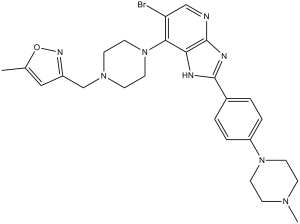
CCT137690 is a novel, potent, highly selective and orally bioavailable inhibitor of Aurora kinase A/B/C with potential antitumor activity. It inhibits Aurora A/B/C with IC50s of 15 nM, 25 nM and 19 nM respectively and shows no/little effect on hERG potassium ion-channel. CCT137690 shows potent in vitro antiproliferative activity and high in vivo antitumor efficacy.
Physicochemical Properties
| Molecular Formula | C26H31BRN8O | |
| Molecular Weight | 551.48 | |
| Exact Mass | 550.18 | |
| CAS # | 1095382-05-0 | |
| Related CAS # |
|
|
| PubChem CID | 25154041 | |
| Appearance | White to light yellow solid powder | |
| Density | 1.4±0.1 g/cm3 | |
| Boiling Point | 722.9±70.0 °C at 760 mmHg | |
| Flash Point | 391.0±35.7 °C | |
| Vapour Pressure | 0.0±2.3 mmHg at 25°C | |
| Index of Refraction | 1.664 | |
| LogP | 3.07 | |
| Hydrogen Bond Donor Count | 1 | |
| Hydrogen Bond Acceptor Count | 8 | |
| Rotatable Bond Count | 5 | |
| Heavy Atom Count | 36 | |
| Complexity | 710 | |
| Defined Atom Stereocenter Count | 0 | |
| InChi Key | GFLQCBTXTRCREJ-UHFFFAOYSA-N | |
| InChi Code | InChI=1S/C26H31BrN8O/c1-18-15-20(31-36-18)17-33-9-13-35(14-10-33)24-22(27)16-28-26-23(24)29-25(30-26)19-3-5-21(6-4-19)34-11-7-32(2)8-12-34/h3-6,15-16H,7-14,17H2,1-2H3,(H,28,29,30) | |
| Chemical Name | 6-Bromo-7-[4-[(5-methyl-3-isoxazolyl)methyl]-1-piperazinyl]-2-[4-(4-methyl-1-piperazinyl)phenyl]-3H-imidazo[4,5-b]pyridine | |
| Synonyms | CCT-137690; CCT 137690; CCT137690 | |
| HS Tariff Code | 2934.99.9001 | |
| Storage |
Powder-20°C 3 years 4°C 2 years In solvent -80°C 6 months -20°C 1 month |
|
| Shipping Condition | Room temperature (This product is stable at ambient temperature for a few days during ordinary shipping and time spent in Customs) |
Biological Activity
| ln Vitro | In a variety of human tumor cell lines, such as the SW620 colon carcinoma (GI50=0.30 μM) and the A2780 ovarian cancer cell line (GI50=0.14 μM), CCT 137690 exhibits antiproliferative activity. In vitro phosphorylation of histone H3 is inhibited by CCT 137690. The hERG ion-channel is moderately inhibited by CCT 137690 (IC50=3.0 μM)[1]. HeLa and HCT116 cells are effectively inhibited by CCT137690-mediated phosphorylation of histone H3 and TACC3, which are substrates for Aurora B and Aurora A, respectively. Multipolar spindle formation, chromosome misalignment, polyploidy, and apoptosis are all brought on by the inhibitor's continuous exposure to tumor cells[2]. | ||
| ln Vivo | With no discernible toxicity, CCT 137690 reduces the growth of the SW620 xenografts[1]. In a transgenic mouse model of neuroblastoma (TH-MYCN) that overexpresses MYCN protein and is susceptible to spontaneous neuroblastoma development, CCT 137690 effectively reduces tumor growth[2]. | ||
| Animal Protocol |
|
||
| References |
[1]. Imidazo[4,5-b]pyridine derivatives as inhibitors of Aurora kinases: lead optimization studies toward the identification of an orally bioavailable preclinical development candidate. J Med Chem. 2010 Jul 22;53(14):5213-28. [2]. The aurora kinase inhibitor CCT137690 downregulates MYCN and sensitizes MYCN-amplified neuroblastoma in vivo. Mol Cancer Ther. 2011 Nov;10(11):2115-23. |
Solubility Data
| Solubility (In Vitro) |
|
|||
| Solubility (In Vivo) |
Solubility in Formulation 1: ≥ 1.67 mg/mL (3.03 mM) (saturation unknown) in 10% DMSO + 40% PEG300 + 5% Tween80 + 45% Saline (add these co-solvents sequentially from left to right, and one by one), clear solution. For example, if 1 mL of working solution is to be prepared, you can add 100 μL of 16.7 mg/mL clear DMSO stock solution to 400 μL PEG300 and mix evenly; then add 50 μL Tween-80 to the above solution and mix evenly; then add 450 μL normal saline to adjust the volume to 1 mL. Preparation of saline: Dissolve 0.9 g of sodium chloride in 100 mL ddH₂ O to obtain a clear solution. Solubility in Formulation 2: ≥ 1.67 mg/mL (3.03 mM) (saturation unknown) in 10% DMSO + 90% (20% SBE-β-CD in Saline) (add these co-solvents sequentially from left to right, and one by one), clear solution. For example, if 1 mL of working solution is to be prepared, you can add 100 μL of 16.7 mg/mL clear DMSO stock solution to 900 μL of 20% SBE-β-CD physiological saline solution and mix evenly. Preparation of 20% SBE-β-CD in Saline (4°C,1 week): Dissolve 2 g SBE-β-CD in 10 mL saline to obtain a clear solution. Solubility in Formulation 3: ≥ 1.67 mg/mL (3.03 mM) (saturation unknown) in 10% DMSO + 90% Corn Oil (add these co-solvents sequentially from left to right, and one by one), clear solution. For example, if 1 mL of working solution is to be prepared, you can add 100 μL of 16.7 mg/mL clear DMSO stock solution to 900 μL of corn oil and mix evenly. Solubility in Formulation 4: 1% DMSO+30% polyethylene glycol+1% Tween 80:~30mg/mL (Please use freshly prepared in vivo formulations for optimal results.) |
| Preparing Stock Solutions | 1 mg | 5 mg | 10 mg | |
| 1 mM | 1.8133 mL | 9.0665 mL | 18.1330 mL | |
| 5 mM | 0.3627 mL | 1.8133 mL | 3.6266 mL | |
| 10 mM | 0.1813 mL | 0.9067 mL | 1.8133 mL |