|
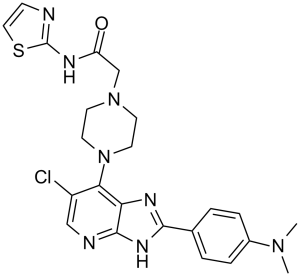
CCT129202 (CCT-129202), an imidazopyridine compound, is a potent and ATP-competitive pan-Aurora inhibitor with potential antitumor activity. It inhibits Aurora A, Aurora B and Aurora C with IC50s of 0.042 μM, 0.198 μM and 0.227 μM, respectively. CCT129202 shows potent in vitro antiproliferative activity and high in vivo antitumor efficacy.
|
Physicochemical Properties
| Molecular Formula |
C23H25CLN8OS
|
| Molecular Weight |
497.02
|
| Exact Mass |
496.156
|
| CAS # |
942947-93-5
|
| Related CAS # |
|
| PubChem CID |
16202152
|
| Appearance |
Light yellow to yellow solid powder
|
| Density |
1.4±0.1 g/cm3
|
| Index of Refraction |
1.719
|
| LogP |
4.94
|
| Hydrogen Bond Donor Count |
2
|
| Hydrogen Bond Acceptor Count |
8
|
| Rotatable Bond Count |
6
|
| Heavy Atom Count |
34
|
| Complexity |
688
|
| Defined Atom Stereocenter Count |
0
|
| InChi Key |
QYKHWEFPFAGNEV-UHFFFAOYSA-N
|
| InChi Code |
InChI=1S/C23H25ClN8OS/c1-30(2)16-5-3-15(4-6-16)21-28-19-20(17(24)13-26-22(19)29-21)32-10-8-31(9-11-32)14-18(33)27-23-25-7-12-34-23/h3-7,12-13H,8-11,14H2,1-2H3,(H,25,27,33)(H,26,28,29)
|
| Chemical Name |
2-(4-(6-chloro-2-(4-(dimethylamino)phenyl)-3H-imidazo[4,5-b]pyridin-7-yl)piperazin-1-yl)-N-(thiazol-2-yl)acetamide
|
| Synonyms |
CCT-129202; CCT 129202; CCT129202.
|
| HS Tariff Code |
2934.99.9001
|
| Storage |
Powder-20°C 3 years
4°C 2 years
In solvent -80°C 6 months
-20°C 1 month
|
| Shipping Condition |
Room temperature (This product is stable at ambient temperature for a few days during ordinary shipping and time spent in Customs)
|
|
Biological Activity
| ln Vitro |
Apoptosis results from the increase of z4N-containing human tumor cells brought on by CCT129202. It is discovered that CCT129202 induces apoptosis, with GI50 values ranging from 0.08 to 1.7 μM. Human tumor cells treated with CCT120202 exhibit spindle abnormalities, abrogation of nocodazole-induced mitotic arrest, and a delay in mitosis. H2F-DependentTK1Down-regulation, Rb Hypophosphorylation, and p21Up-regulation are all caused by CCT129202[1].
|
| ln Vivo |
CCT129202 is administered intraperitoneally (i.p.) to nude mice to suppress the growth of HCT116 xenografts. CCT129202 induces the cyclin-dependent kinase inhibitor p21. Thymidine kinase 1 transcription was reduced as a result of Rb hypophosphorylation and E2F suppression brought on by CCT129202's up-regulation of p21 in HCT116 cells[1].
|
| Animal Protocol |
| Dissolved in 10% DMSO, 5% Tween 20 in saline; 100 mg/kg; i.p. injection | | HCT116 colon carcinoma is established in female NCr athymic mice. | |
|
| References |
[1]. Mechanism of action of the Aurora kinase inhibitor CCT129202 and in vivo quantification of biological activity. Mol Cancer Ther. 2007 Dec;6(12 Pt 1):3147-57.
|
|
Solubility Data
| Solubility (In Vitro) |
| DMSO: 3 mg/mL (6.0 mM) | | Water:<1 mg/mL | | Ethanol:<1 mg/mL |
|
| Solubility (In Vivo) |
| 1% DMSO+30% polyethylene glycol+1% Tween 80: 30 mg/mL |
(Please use freshly prepared in vivo formulations for optimal results.)
|
| Preparing Stock Solutions |
|
1 mg |
5 mg |
10 mg |
| 1 mM |
2.0120 mL |
10.0600 mL |
20.1199 mL |
| 5 mM |
0.4024 mL |
2.0120 mL |
4.0240 mL |
| 10 mM |
0.2012 mL |
1.0060 mL |
2.0120 mL |
*Note: Please select an appropriate solvent for the preparation of stock solution based on your experiment needs. For most products, DMSO can be used for preparing stock solutions (e.g. 5 mM, 10 mM, or 20 mM concentration); some products with high aqueous solubility may be dissolved in water directly. Solubility information is available at the above Solubility Data section. Once the stock solution is prepared, aliquot it to routine usage volumes and store at -20°C or -80°C. Avoid repeated freeze and thaw cycles. |