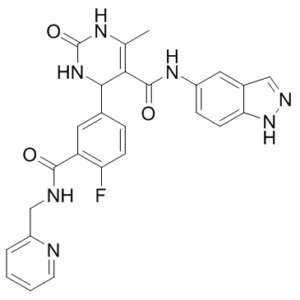
CCG215022 is a potent GRK2 and GRK5 inhibitor that exhibited nanomolar IC50 values against both GRK2 and GRK5 and good selectivity against other closely related kinases such as GRK1 and PKA. Murine cardiomyocytes treated with CCG215022 showed significantly increased contractility at 20-fold lower concentrations than paroxetine, an inhibitor with more modest selectivity for GRK2. G protein-coupled receptor kinases (GRKs) regulate cell signaling by initiating the desensitization of active G protein-coupled receptors. The two most widely expressed GRKs (GRK2 and GRK5) play a role in cardiovascular disease and thus represent important targets for the development of novel therapeutic drugs.
Physicochemical Properties
| Molecular Formula | C₂₆H₂₂FN₇O₃ | |
| Molecular Weight | 499.5 | |
| Exact Mass | 499.176 | |
| CAS # | 1813527-81-9 | |
| Related CAS # |
|
|
| PubChem CID | 118888941 | |
| Appearance | White to gray solid powder | |
| Density | 1.4±0.1 g/cm3 | |
| Boiling Point | 783.2±60.0 °C at 760 mmHg | |
| Flash Point | 427.4±32.9 °C | |
| Vapour Pressure | 0.0±2.7 mmHg at 25°C | |
| Index of Refraction | 1.691 | |
| LogP | 1.8 | |
| Hydrogen Bond Donor Count | 5 | |
| Hydrogen Bond Acceptor Count | 6 | |
| Rotatable Bond Count | 6 | |
| Heavy Atom Count | 37 | |
| Complexity | 915 | |
| Defined Atom Stereocenter Count | 0 | |
| InChi Key | BLMBNKDQXGINRE-UHFFFAOYSA-N | |
| InChi Code | InChI=1S/C26H22FN7O3/c1-14-22(25(36)32-17-6-8-21-16(10-17)12-30-34-21)23(33-26(37)31-14)15-5-7-20(27)19(11-15)24(35)29-13-18-4-2-3-9-28-18/h2-12,23H,13H2,1H3,(H,29,35)(H,30,34)(H,32,36)(H2,31,33,37) | |
| Chemical Name | 4-[4-fluoro-3-(pyridin-2-ylmethylcarbamoyl)phenyl]-N-(1H-indazol-5-yl)-6-methyl-2-oxo-3,4-dihydro-1H-pyrimidine-5-carboxamide | |
| Synonyms |
|
|
| HS Tariff Code | 2934.99.9001 | |
| Storage |
Powder-20°C 3 years 4°C 2 years In solvent -80°C 6 months -20°C 1 month |
|
| Shipping Condition | Room temperature (This product is stable at ambient temperature for a few days during ordinary shipping and time spent in Customs) |
Biological Activity
| Targets |
G Protein-Coupled Receptor Kinase 5 (GRK5) (IC50 = 0.19 μM, recombinant GRK5 kinase activity assay; Ki = 0.05 μM, isothermal titration calorimetry (ITC) assay) [1] |
||
| ln Vitro |
When it comes to both GRK2 and GRK5, CCG215022 exhibits nanomolar potency and is at least 20 times more potent than propecia. CCG215022 demonstrates nanomolar IC50 values against both GRK2 and GRK5, along with good selectivity against other closely related kinases like GRK1 and PKA, during a GRK2 structure-based drug design campaign. When CCG215022 is applied to murine cardiomyocytes, contractility is markedly increased at 20-fold lower concentrations than when paroxetine, an inhibitor with a more moderate selectivity for GRK2, is used[1]. 1. GRK5 kinase activity inhibition: CCG215022 dose-dependently inhibited the kinase activity of recombinant human GRK5, with an IC50 of 0.19 μM. It showed high selectivity for GRK5, with no significant inhibition of other GRK subtypes (GRK2, GRK3, GRK4, GRK6) at concentrations up to 10 μM (inhibition rate < 15% for all tested subtypes) [1] 2. Direct binding to GRK5: CCG215022 directly bound to the ATP-binding pocket of GRK5, as confirmed by X-ray crystallography (PDB code: 4ZIP). Isothermal titration calorimetry (ITC) experiments showed a binding affinity (Ki) of 0.05 μM, indicating a strong interaction between the drug and GRK5 [1] 3. Inhibition of GRK5-mediated receptor phosphorylation: In HEK293 cells overexpressing GRK5 and β2-adrenergic receptor (β2AR), CCG215022 (0.5-5 μM) dose-dependently inhibited GRK5-mediated β2AR phosphorylation. Western blot analysis using a phospho-specific antibody against β2AR (Ser355/356) showed a 70% reduction in phosphorylation at 5 μM compared to the vehicle group [1] 4. No significant off-target kinase inhibition: CCG215022 (10 μM) did not inhibit the activity of 48 other kinases (including PKA, PKC, ERK1/2, Akt) tested in a panel kinase assay, confirming high kinase selectivity [1] |
||
| ln Vivo |
|
||
| Enzyme Assay |
1. Recombinant GRK5 kinase activity assay: Recombinant human GRK5 protein was diluted in assay buffer containing Tris-HCl, MgCl2, and DTT. Different concentrations of CCG215022 (0.01-10 μM) were added to the reaction mixture, followed by the addition of ATP (10 μM) and a synthetic peptide substrate derived from the β2-adrenergic receptor (containing the GRK phosphorylation site). The reaction was incubated at 30℃ for 60 minutes, and the phosphorylated peptide was detected using a radioactive [γ-32P]ATP incorporation assay. Radioactivity was measured by liquid scintillation counting, and the inhibition rate of GRK5 activity was calculated. IC50 was derived from nonlinear regression of dose-response curves [1] 2. GRK subtype selectivity assay: Recombinant GRK2, GRK3, GRK4, and GRK6 proteins were used to evaluate the selectivity of CCG215022 (10 μM) using the same kinase activity assay protocol as for GRK5. The inhibition rate of each GRK subtype was calculated to confirm selectivity for GRK5 [1] 3. Isothermal titration calorimetry (ITC) binding assay: CCG215022 was dissolved in buffer matching the protein solution. GRK5 protein (20 μM) was loaded into the sample cell, and CCG215022 (200 μM) was injected sequentially into the cell at 25℃. The heat change associated with binding was measured, and the binding affinity (Ki) was calculated using ITC data analysis software [1] 4. Panel kinase selectivity assay: A panel of 48 recombinant kinases was incubated with CCG215022 (10 μM) and their respective substrates in kinase buffer. Kinase activity was detected using a homogeneous time-resolved fluorescence (HTRF) assay, and inhibition rates were calculated to assess off-target effects [1] |
||
| Cell Assay |
1. GRK5-mediated β2AR phosphorylation assay: HEK293 cells were co-transfected with GRK5 expression plasmid and β2AR expression plasmid using transfection reagent. After 24 hours of transfection, cells were serum-starved for 12 hours, then treated with CCG215022 (0.5, 1, 5 μM) for 1 hour, followed by stimulation with isoproterenol (10 μM) for 10 minutes to activate β2AR. Cells were lysed in RIPA buffer containing protease and phosphatase inhibitors, and β2AR phosphorylation was detected by Western blot using a phospho-specific antibody against β2AR (Ser355/356). Total β2AR and GAPDH were used as loading controls [1] |
||
| Animal Protocol |
|
||
| References |
[1]. Crystal Structure of G Protein-coupled Receptor Kinase 5 in Complex with a Rationally DesignedInhibitor. J Biol Chem. 2015 Aug 21;290(34):20649-59. |
||
| Additional Infomation |
1. CCG215022 is a rationally designed small-molecule inhibitor of G Protein-Coupled Receptor Kinase 5 (GRK5), a serine/threonine kinase that regulates the desensitization and internalization of G protein-coupled receptors (GPCRs) by phosphorylating their cytoplasmic tails [1] 2. The drug binds to the ATP-binding pocket of GRK5 with high affinity, as confirmed by X-ray crystallography, which reveals key interactions between CCG215022 and amino acid residues in the GRK5 active site (e.g., Lys215, Asp229, Leu273). This binding mode blocks ATP access, thereby inhibiting GRK5 kinase activity [1] 3. CCG215022 exhibits high selectivity for GRK5 over other GRK subtypes and unrelated kinases, making it a valuable tool compound for studying the physiological and pathological functions of GRK5. Potential therapeutic applications include diseases associated with abnormal GRK5 activity, such as cardiovascular disorders (e.g., heart failure, hypertension) and neurological diseases [1] 4. The crystal structure of the GRK5-CCG215022 complex provides a structural basis for further optimization of the drug to improve potency, pharmacokinetic properties, and clinical potential [1] |
Solubility Data
| Solubility (In Vitro) |
|
|||
| Solubility (In Vivo) |
Solubility in Formulation 1: ≥ 2.5 mg/mL (5.01 mM) (saturation unknown) in 10% DMSO + 40% PEG300 + 5% Tween80 + 45% Saline (add these co-solvents sequentially from left to right, and one by one), clear solution. For example, if 1 mL of working solution is to be prepared, you can add 100 μL of 25.0 mg/mL clear DMSO stock solution to 400 μL PEG300 and mix evenly; then add 50 μL Tween-80 to the above solution and mix evenly; then add 450 μL normal saline to adjust the volume to 1 mL. Preparation of saline: Dissolve 0.9 g of sodium chloride in 100 mL ddH₂ O to obtain a clear solution. Solubility in Formulation 2: 2.5 mg/mL (5.01 mM) in 10% DMSO + 90% (20% SBE-β-CD in Saline) (add these co-solvents sequentially from left to right, and one by one), suspension solution; with ultrasonication. For example, if 1 mL of working solution is to be prepared, you can add 100 μL of 25.0 mg/mL clear DMSO stock solution to 900 μL of 20% SBE-β-CD physiological saline solution and mix evenly. Preparation of 20% SBE-β-CD in Saline (4°C,1 week): Dissolve 2 g SBE-β-CD in 10 mL saline to obtain a clear solution. (Please use freshly prepared in vivo formulations for optimal results.) |
| Preparing Stock Solutions | 1 mg | 5 mg | 10 mg | |
| 1 mM | 2.0020 mL | 10.0100 mL | 20.0200 mL | |
| 5 mM | 0.4004 mL | 2.0020 mL | 4.0040 mL | |
| 10 mM | 0.2002 mL | 1.0010 mL | 2.0020 mL |